
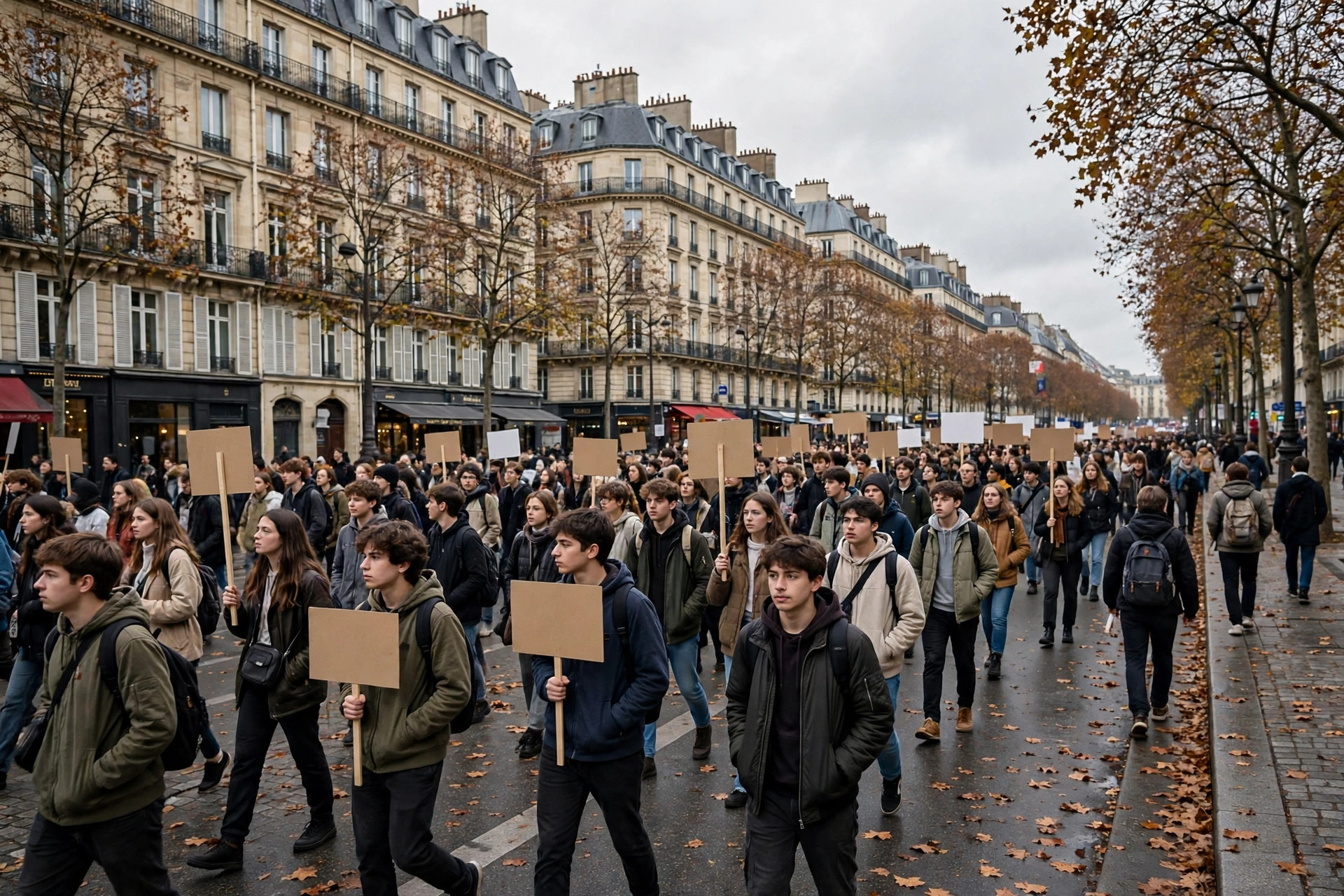
The Gen Z protests Europe November 2026 have now run for three consecutive weekends in France, and they are spreading. On Saturday 31 October 2026, hundreds of thousands of young people marched across France for the third weekend in a row, while a new youth movement in Germany, calling itself Gen Z regelt, took to the streets in dozens of cities. Protests have also been reported in Belgium, Ireland, Spain, Portugal, Italy, Greece, Serbia, Kosovo and Albania, turning what began as a French student movement into a wider European moment. The crowds are smaller than at their peak, the confrontations are sharper in places, and the next test is already set: unions have called a nationwide strike in France for 5 November, which students and yellow-vest protesters say they will join.
Gen Z protests Europe November 2026: France in numbers
The French government estimated 320,000 participants nationally on Saturday 31 October, down from more than 500,000 on the first weekend and 410,000 on the second. Student unions put the figure higher, saying half a million people took part. The gap between official and organiser estimates is normal at large protests, and both counts agree on the direction: the movement is still large, but it is smaller than it was.
Around 70,000 police and gendarmes were deployed across France, and about 300 people were arrested nationwide, down from 800 arrests the previous weekend. The day was not without violence. In Paris a police officer was hit by a Molotov cocktail, and Interior Minister Laurent Nuñez called the attack attempted murder, with Paris prosecutors opening an attempted-homicide probe. The incident has become a focal point in the French debate, with the government pointing to it as evidence of a dangerous fringe, and protest organisers insisting the movement itself is peaceful.
Students also barricaded some high schools after the half-term break, a sign that the movement has a foothold inside schools as well as on the streets. The government has offered more funding for education and has said it will scrap an unpopular university admissions system, but organisers say they will continue protesting. The core grievances in France are living costs, education and pensions, a mix that reaches well beyond students and explains why the marches have drawn in older protesters too.
The government's response so far has been to offer more funding for education and to scrap an unpopular university admissions system, two concessions aimed directly at students. Organisers have said they will keep protesting anyway, which suggests the offers have not matched the scale of what the movement is asking for. Concessions on one issue rarely end a protest when the grievances span living costs, education and pensions at once, and when the movement has already spread to other countries. The barricading of some high schools after the half-term break shows that the dispute has also moved inside schools themselves, where students are organising directly rather than waiting for unions or politicians to act on their behalf.
Germany's Gen Z regelt movement takes to the streets
In Germany, the new movement Gen Z regelt, which translates roughly as Gen Z will sort this or Gen Z takes charge, marched in 30 to 34 cities, with tens of thousands taking part. Organisers said 120,000 people marched, a figure that, if accurate, would make it one of the largest youth mobilisations in Germany in years. The German protests were not all peaceful: there was looting in Frankfurt, where stores were looted, and water cannon was used in Frankfurt, Cologne, Berlin and Hamburg.
The German demands are concrete: more money for schools, therapy and housing, no conscription, and fairer burden-sharing between generations. Pensions are part of the argument. Youth MPs from the CDU and CSU opposed extending pension levels beyond 2031, pointing to a calculated cost of more than 115 billion euros between 2032 and 2040, but the law passed with only two votes to spare. For many young Germans, that vote has become a symbol of a system they believe asks the young to pay for the old, and the protests are their answer.
The pension argument shows how the German protests connect to decisions taken far from the streets. Young MPs from the governing parties argued against extending pension levels beyond 2031, warning of the cost to younger taxpayers, yet the law still passed, and by only two votes. For protesters, that narrow margin is evidence that their generation's concerns are barely being heard in parliament, even when young representatives raise them. Their demands for more money for schools, therapy and housing are, in their view, the other side of the same coin: investment in the young, rather than spending that falls mainly on them.
Protests beyond France and Germany
The movement is not confined to the two largest countries. Protests have also taken place in Belgium, Ireland, Spain, Portugal, Italy, Greece, Serbia, Kosovo and Albania, each with its own local flavour but sharing a common thread of frustration about costs, housing, education and the future. In Italy, a general strike was held on Friday, adding a labour dimension to the youth protests and showing how the anger is spreading from students to workers.
What links these countries is a generation that came of age during a pandemic, entered adulthood during a cost-of-living crisis, and now faces high rents, uncertain job prospects and expensive education. Social media has let them compare notes across borders in real time, and the French marches have become a template that others are copying. The result is a loosely connected European movement rather than a single organisation, which makes it harder for governments to negotiate with, and harder to dismiss.
That loose structure is both a strength and a weakness. It lets the movement grow quickly, without waiting for a central organisation to approve each new protest, but it also means there is no single leader for a government to sit down with, and no single list of demands that would settle the dispute everywhere at once.
Gen Z protests Europe November 2026: what happens next on 5 November
The next big date is Thursday 5 November, when unions have called a nationwide strike in France. Students and yellow-vest protesters have said they will take part, which could make it one of the largest days of action yet. It is important to be clear: the strike has not happened yet. It is planned, and its size and impact are unknown. The French Interior Minister has warned of elevated risks of disorder after dark, a warning that reflects both the Molotov cocktail attack in Paris and the scale of the planned mobilisation.
For governments across Europe, the question is whether to concede more, as France has begun to do on education funding and admissions, or to hold firm and wait for the movement to fade. The crowds have shrunk for two weekends running, which suggests some momentum is being lost, but the spread to Germany and beyond suggests the underlying grievances are not going away. The earlier wave of youth protests across France, Germany and Italy already showed how quickly this can grow, and the economic backdrop, from a contracting French economy to household pressures seen in the UK budget debate, gives protesters plenty to point at. The 5 November strike will be the clearest test yet of whether this movement is fading or gathering force.