
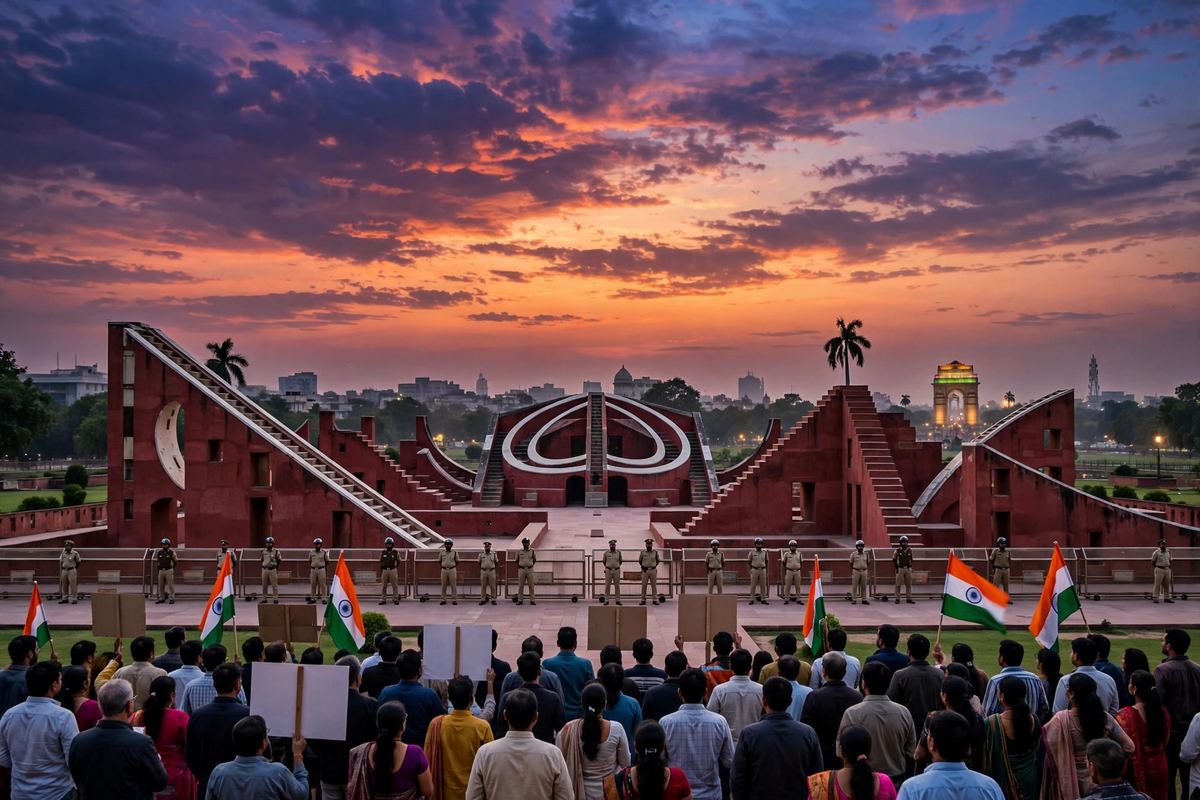
On October 10, 2026, the national capital is bracing for one of the largest protest-related security operations in recent months. A demonstration planned at Jantar Mantar — Delhi's designated protest site — has been denied permission by Delhi Police, triggering a sweeping set of precautionary measures: 57 metro stations with restricted entry and exit, a 24-hour internet suspension around the protest site, schools shifted to online classes, postponed college examinations, and cancelled trains.
This article explains everything you need to know — who is protesting, why permission was denied, what restrictions are in place, how daily life in Delhi is affected, and the wider political context behind the unrest.
What Is Happening on October 10?
A group calling itself the Cockroach Janata Party (CJP) had announced a large demonstration at Jantar Mantar for October 10. Delhi Police estimate that around 7,000 protesters could arrive in the capital for the event.
However, in a formal communication, Delhi Police denied permission for the gathering. The police cited concerns over public safety, crowd management, and the safety of local residents. Authorities pointed to past demonstrations by the same organisers that, according to police, resulted in significant violence and injuries to police personnel.
Despite the denial of permission, security agencies are preparing for the possibility that protesters may still attempt to gather, which is why the extensive restrictions described below have been imposed across the capital.
Why Was Permission Denied?
Under Indian law, the right to peaceful protest is protected by Article 19(1)(b) of the Constitution, which guarantees citizens the right to assemble peaceably and without arms. However, this right is not absolute — Article 19(3) allows the state to impose reasonable restrictions in the interests of public order, security, and safety.
Delhi Police invoked these grounds while denying permission, raising three main concerns:
- Risk of violence: Police claim previous protests by the organisers turned violent, with injuries to personnel.
- Crowd management: An estimated 7,000 protesters converging on Jantar Mantar — a relatively compact site in central Delhi — poses logistical challenges.
- Resident safety: Authorities expressed concern about disruption to people living and working near the protest site.
Jantar Mantar is the only place in central Delhi where protests are officially permitted, following a National Green Tribunal order that banned demonstrations at Jantar Mantar road itself and shifted them to the designated area. Any gathering without police permission at the site is treated as unauthorised.
Security Measures: What Is Shut and What Is Restricted
The security response is unusually wide-ranging. Here is what is affected:
Metro Stations
Delhi Metro announced the closure of entry and exit at 57 stations from October 9, on the request of Delhi Police, to curb unruly mob movement. The government later told the Supreme Court that entry and exit were restricted at 45 of the network's 303 stations on October 10. In addition, Namo Bharat stations at Sarai Kale Khan and New Ashok Nagar will remain closed till October 10 for security reasons. Train services between Anand Vihar and Modipuram continue as scheduled.
Internet Suspension
A 24-hour internet suspension has been ordered in areas around Jantar Mantar, issued by Delhi Police. Such suspensions are typically imposed to prevent the spread of rumours and to disrupt coordination of unauthorised gatherings.
Schools and Colleges
Several schools in Delhi shifted to online classes, and colleges postponed examinations scheduled for October 10. Parent-teacher meetings were also postponed, with institutions citing student safety and compliance with police directives.
Trains and Flights
Indian Railways cancelled Mail and Express trains scheduled to arrive at key railway stations during the restricted period, and train services to New Delhi and Hazrat Nizamuddin stations were suspended for 10 hours (4 am to 2 pm on Saturday). The disruption pushed airfares sharply upward — Amritsar–Delhi one-way fares surged to around Rs 8,000, nearly double the usual Rs 4,000, as travellers scrambled for alternatives.
The Wider Political Context
The planned protest does not exist in isolation. Delhi has seen a charged political atmosphere over the past week:
- INDIA bloc march: On October 9, opposition MPs marched from Parliament to Rashtrapati Bhavan to meet President Droupadi Murmu, demanding the resignation of Chief Election Commissioner Gyanesh Kumar over concerns surrounding the Special Intensive Revision (SIR) of electoral rolls. Rahul Gandhi said the President had asked for proof of alleged vote theft, which the opposition promised to provide.
- 27 FIRs in 7 days: Law enforcement agencies registered 27 FIRs over a seven-day protest targeting the Chief Election Commissioner.
- Sit-in at Vijay Chowk: Opposition leaders staged a sit-in protest at Vijay Chowk as part of the same agitation.
While the CJP protest and the opposition's CEC agitation are separate developments, together they explain why the capital's security apparatus is on high alert.
What Does the Law Say About Protests in Delhi?
Understanding the legal framework helps make sense of the current situation:
- Designated protest site: Jantar Mantar is the earmarked location for demonstrations in Delhi. Protests elsewhere in central Delhi, especially near Parliament and government buildings, face stricter restrictions under Section 144 (now Section 163 of the Bharatiya Nagarik Suraksha Sanhita) prohibitory orders.
- Prior permission: Organisers are required to seek police permission, providing details of expected numbers, timings, and routes.
- Police discretion: Permission can be denied on grounds of public order, traffic disruption, or security threats — though such denials can be challenged in court.
- Internet shutdowns: Governed by the Temporary Suspension of Telecom Services Rules, 2017, such orders must be reviewed by a committee and are meant to be proportionate and time-bound.
For a deeper understanding of how civic rights work in India, read our explainers on democracy and the fundamental rights of Indian citizens.
How Are Ordinary Citizens Affected?
Even for Delhi residents with no connection to the protest, October 10 will feel different:
- Commuters face metro station closures and possible road diversions in central Delhi. Check the DMRC app before travelling.
- Students in affected schools attend online classes; some college exams stand postponed.
- Travellers arriving by train or flying into Delhi should expect disruption and higher fares.
- Businesses near Jantar Mantar and Connaught Place may see reduced footfall amid the internet shutdown and security cordon.
What Happens Next?
On October 10, the planned gathering was prevented under the security clampdown, and more than 7,000 people were reported detained across Delhi, including opposition leaders; most of those detained were subsequently released, according to the Solicitor General. At a special sitting on Sunday, October 11, a Supreme Court bench of Justices Joymalya Bagchi and V. Mohana directed that there must be no illegal detention, and that metro, rail and internet services function normally unless restrictions were needed for public order, issuing notice on a contempt plea over the court's earlier transport order and seeking a compliance report. Protest movements are stirring beyond India as well — in Tunisia, thousands have marched against President Saied in the largest demonstrations in years.
The situation remains fluid. On October 11, Delhi Police denotified Jantar Mantar as a designated protest site by an order of Police Commissioner Anurag Kumar, partially modifying the 2022 standing order, and designated Ramlila Ground, Burari Ground and CBD Ground as the replacement venues; Delhi Police said a committee constituted by the Union Ministry of Home Affairs had examined alternative locations for demonstrations. Citizens are advised to follow official advisories from Delhi Police and Delhi Metro, avoid the Jantar Mantar area unless necessary, and rely on verified news sources rather than social media forwards during the internet-restricted period.
Key Takeaways
- A protest planned at Jantar Mantar on October 10, 2026, was denied permission by Delhi Police over safety concerns.
- 57 metro stations face entry/exit closures; Namo Bharat stations at Sarai Kale Khan and New Ashok Nagar shut till October 10.
- 24-hour internet suspension around Jantar Mantar; schools online; some college exams postponed.
- Trains cancelled or suspended; Amritsar–Delhi airfares doubled to ~Rs 8,000.
- The protest unfolds against a backdrop of opposition agitation over the Chief Election Commissioner and the SIR issue.
Away from the capital, unrest is flaring elsewhere too: fresh violence in Manipur's Kamjong district has left one person dead and 15 houses torched.