
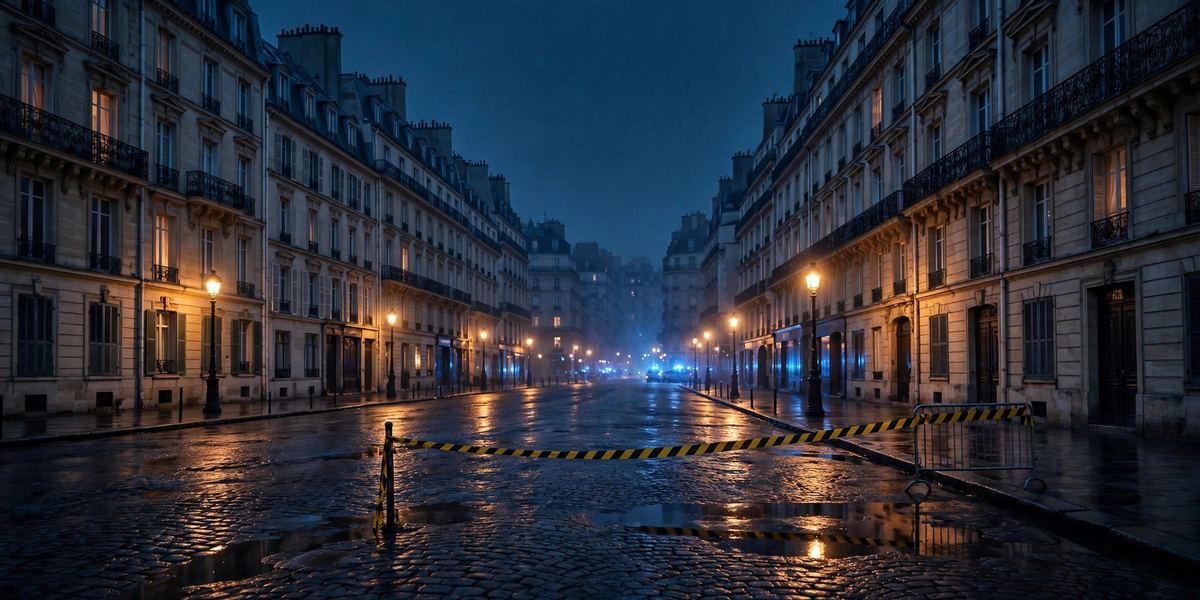
France's crisis has entered a more dangerous phase: authorities have imposed overnight curfews in parts of central Paris itself, and the interior minister has admitted that police "lost control" in some cities after three nights of rioting over living costs and school conditions. The escalation marks a turning point — what began as localised restrictions in the suburbs has now reached the symbolic heart of the capital. The story is trending per news coverage.
Paris police said a curfew would be in force between 23:00 and 06:00 local time at Place de la Republique — the square where protesters gathered at the weekend — and in the Les Halles shopping district. A ban on unauthorised gatherings was imposed across several other parts of the city centre. Beyond the capital, partial curfews restricting the movement of young people were announced for Marseille, Bordeaux, Nice and Lyon in the south, and Lille and other towns in the north.
"Lost control" — the minister's admission
The most striking moment of the day came from Interior Minister Laurent Nunez, who acknowledged that police had "lost control" in some cities. The admission, carried widely in French and international media, was seized on by opposition politicians who have been demanding his resignation for days. President Emmanuel Macron refused that resignation on Sunday, saying continuity of command was needed — but the minister's own words on Monday deepened the sense of a government struggling to contain the streets.
Nunez's admission followed a crisis meeting of ministers on Monday, after which Prime Minister Sebastien Lecornu gave local mayors the power to impose curfews "where they need", and pointedly declined to rule out a nationwide state of emergency under the 1955 law — France's most drastic tool for civil disorder, last used nationally after the November 2015 Paris attacks. "My determination to restore order is absolute," Lecornu said, adding that money would be set aside to repair damaged areas and then recovered from those behind the violence.
The human toll: 2,500 arrested, 1,000 officers hurt
The official figures published on Monday show the scale of the disorder. More than 2,500 people have now been arrested nationwide, around 90 percent of them adults. About 1,000 police officers, gendarmes and firefighters have been injured. In one of the grimmest incidents, the AFP news agency reported that a demonstrator's hand was blown off by a police crowd-control grenade.
The interior ministry, quoted by the national tourism body Atout France, said 550,000 people had participated in demonstrations nationwide — and stressed that the violence "should not be attributed to all demonstrators and is not indicative of the overall situation." The vast majority of marchers remained peaceful, according to authorities; the destruction was attributed to black-clad fringe groups who set fires, looted shops and attacked police and public buildings.
US and allies issue security alerts
The crisis has gone international. The U.S. Embassy in Paris issued a security alert warning Americans to "avoid the areas of the demonstrations" and steering them away from all unauthorised gatherings, while France remains under the State Department's Level 2 travel advisory ("exercise increased caution" over unrest and terrorism). The alert noted that peaceful protests can turn violent suddenly and that police crowd-control measures — tear gas and water cannons — can catch bystanders.
Britain, Italy and Germany issued parallel advisories. The UK urged its citizens to avoid demonstration zones and monitor local media; Italy asked its nationals to register with official tracking platforms; and Germany's foreign ministry warned that German tourists could face fines or claims for damages if they failed to disperse when ordered by French police. For a country that receives tens of millions of visitors a year, the travel warnings are a significant economic and reputational blow.
How the protests got here
The unrest began last month with students demonstrating over poor conditions in schools — crumbling buildings, overcrowded classes and teacher shortages. The movement was then taken up by trade unions and workers angry about rising living costs, and by activists seeking to revive the yellow-vest movement that rocked France in 2018. The weekend of 17-18 October saw the largest coordinated mobilisation, and the first wave of localised curfews was ordered on 19 October after around 2,400 arrests.
The second wave of unrest escalated sharply: rioters burned the historic city hall of Limoges, protesters blocked access to the Louvre Museum — which remained closed on 19 October — and running battles with police spread from Paris to Lyon, Marseille and Bordeaux. Macron addressed the nation on Sunday evening with a hardline message: "Those who destroyed must pay. Those who looted must pay back. Those who sought to bring down the Republic will be held accountable."
Spilling across Europe
The French crisis is reverberating beyond its borders. Cost-of-living protests have already spread to Belgium, Italy and Portugal, and in Albania's capital Tirana police clashed with anti-government protesters for a sixth straight day, with 388 people charged and US lawmakers publicly warning the Albanian authorities to respect peaceful protest. The shared grievances — stagnant wages, rising prices, strained public services — are continent-wide, which is why other European capitals are watching France's response so closely.
The political fallout is also crossing the Atlantic. The U.S. Department of Homeland Security posted a stark warning on X as the riots raged: "Every nation that loses control of its borders eventually pays the price," while Republican House Majority Whip Tom Emmer told Newsmax the French unrest should serve as "a warning to the U.S." about immigration enforcement. President Donald Trump himself, posting on the Paris violence, declared: "Migrants have taken over France. Close the borders fast."
What happens next
The immediate test is Tuesday night in Paris: whether the central-Paris curfews, bans on gatherings and reinforced police deployments calm the capital's nights, or simply push the violence into new streets. The government's promised curfew map, covering Paris, Lyon, Marseille and Lille, will be the first measure of how far the crackdown goes — and whether Lecornu's refusal so far to order blanket curfews holds.
Politically, the stakes are rising with every night of unrest. With a presidential election to succeed Macron now months away, the handling of the crisis has become the central battleground of French politics — the far right and far left both blaming the government, and the government blaming radical groups for trying to prolong the disorder. If the curfews fail, the 1955 state-of-emergency law remains on the table. France's ministers have now admitted, in plain words, that they lost control in places. Regaining it is the test of the coming days.
Small-town America has seen its own policing crisis: the whole police force of Milner, Georgia, resigned after a dispute with the mayor over a tracking policy.