
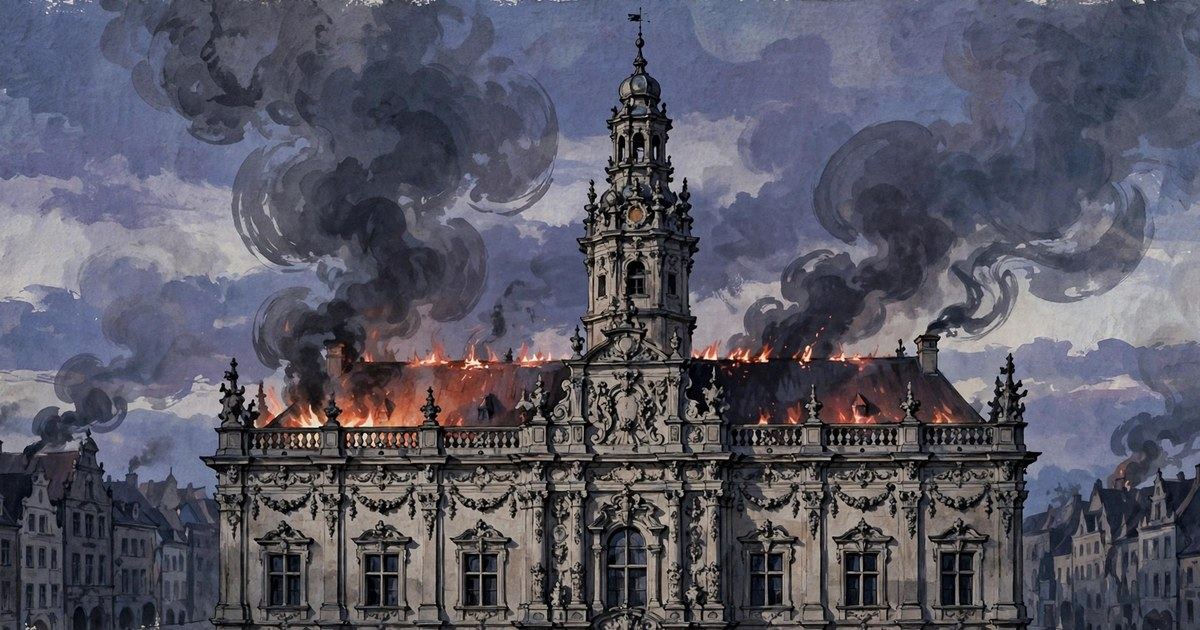
France's cost-of-living protests entered their most destructive night yet on Saturday 17 October 2026, as rioters torched the 143-year-old town hall of Limoges, looted shops across Paris, and clashed with police in dozens of cities. The Interior Ministry's final tally for Saturday was 2,397 arrests and 997 police officers and gendarmes injured, seven of them seriously. President Emmanuel Macron addressed the nation in a televised speech on Sunday evening, 18 October, after an emergency meeting with his ministers, saying those who destroyed must pay and those who looted must reimburse, and stopping short of declaring a state of emergency. The story is trending per news coverage.
The fire in Limoges was the defining image of the night. Flames tore through the roof of the neo-Renaissance town hall, the spire collapsed, and residents watched helplessly as a building that had survived two world wars was largely destroyed in hours.
What happened in Limoges
The town hall of Limoges, in central France about three hours south of Paris, was inaugurated on 14 July 1883 and designated a protected historic landmark in 1975. On Saturday evening, a group of masked demonstrators first set fire to a police car outside the building, smashed its windows, forced their way inside and started the blaze, according to AFP and local authorities.
The prefect of Haute-Vienne, Maurice Barate, told AFP the damage was near-total: "The roof has collapsed onto lower floors, except the west wing, and two-thirds of the exterior has already disappeared." He called the fire "a deliberate act by hooligans" and "a catastrophe for heritage."
Footage showed the town hall's bell tower giving way as flames consumed its supports — scenes that revived haunting memories of the collapse of Notre Dame's spire in the 2019 Paris fire. "It broke my heart. I saw Notre Dame all over again, except this time it was our town," a resident, Francoise Faurie, told Reuters. Her family had planned to celebrate her granddaughter's baptism in the town hall next month.
The prefecture said around 2,000 people had gathered in the Casseaux area of the city earlier in the day, including "more than 500 individuals deliberately seeking confrontation," some of whom attacked security forces with projectiles. Four police officers sustained serious injuries, four police vehicles were destroyed, and protesters briefly blocked the A20 motorway before marching into the city centre. Nineteen people were detained in the region.
A night of violence across France
Limoges was the worst single incident, but violence flared across the country. In Paris, hooded and masked groups looted shops late into the evening, many of them travelling around on Vélib rental bicycles and leaving broken glass and debris behind them. Stores selling trainers or smartphones were particular targets. "Entire streets have been methodically ravaged," said the mayor of Paris, Emmanuel Grégoire, warning that it was the poorest residents who would pay the price.
On the Champs-Elysees, cars were torched and barricades briefly erected before riot police deployed tear gas and water cannon to disperse the crowds. In one dramatic incident, several hooded individuals managed to get within about 150 yards of the Elysée palace, the president's residence, before being driven back.
Elsewhere, protesters set fire to a tourist office in the centre of Lyon. Groups forced their way into town halls in Marseille and Lille and vandalised the premises, while a police compound in Bordeaux was attacked and masked groups tried to storm city halls in Calais and a police station in Brest. Violence was also reported in Rennes, Toulouse, Montpellier, Grenoble and Nice. In Lille, an Apple store was reportedly stripped by looters.
The interior ministry said more than half a million people took part in over 100 marches nationwide on Saturday — with most demonstrations peaceful, but masked groups hijacking the fringes in city after city.
The human cost
Interior Minister Nuñez's Sunday-evening tally put arrests at 2,397 and injured police officers and gendarmes at 997, seven of them seriously — well above the interim figures of around 1,800 arrests and more than 500 injured reported earlier in the day. In Saint-Etienne, a demonstrator lost his hand when a police crowd-control grenade exploded, according to a police source cited by AFP. It followed a similar incident on 5 October, when a 15-year-old lost his hand after a police stun grenade exploded during a protest in the northern city of Lens — adding to scrutiny of crowd-control weapons used by French police.
Two deaths were linked to the weekend: a 22-year-old police officer struck by a third-party vehicle in Nantes, and a protester who suffered a cardiorespiratory arrest just north of Paris, according to CNN, citing Interior Minister Laurent Nuñez and BFMTV. Prime Minister Sébastien Lecornu said nobody was killed in the violence.
How France got here
The unrest entered its fourth week on Saturday. It began in mid-September as a student revolt over teacher shortages and deteriorating school facilities at a high school in Creteil, near Paris, and grew into a far broader movement. High-school and university students were joined by trade unions opposing the government's proposed 2027 budget and public spending cuts, and by cost-of-living demonstrators angry at fuel prices and the erosion of the French social model. Saturday's nationwide day of action — tens of thousands marching from Rennes to Marseille — was the moment those grievances converged, as the day's demonstrations showed. The movement has since spread solidarity protests across Belgium, Italy, Portugal and beyond, tracing back to the student protests that lit the fuse.
Macron's response and the Sunday address
President Macron condemned the violence in a social media post on Saturday: "There is no place for violence in our republic." He warned that "those who have broken, attacked the prefectures as well as businesses, looted even our town halls, will be prosecuted and punished," and expressed "the support of the Nation" for law enforcement, vowing that France would stand united against "the sowers of chaos."
The Elysée Palace announced on Sunday that Macron would deliver a televised address to the nation at 8pm local time (7pm UK time) after meeting government ministers — his first formal speech to the country since the unrest turned violent.
His ministers have blamed "ultra-left" groups for the destruction. Nuñez described the culprits as "extremely violent, radical far-left groups" — a characterisation that reflects the government's effort to separate organised agitators from the peaceful majority of demonstrators. In the United States, Vice-President JD Vance weighed in on X, sharing video of the Limoges fire and blaming immigration policy — a reaction that drew attention on both sides of the Atlantic.
The political stakes
The timing could hardly be more charged. Macron leaves office in six months, and France goes to the polls to elect his successor — making the handling of the worst unrest in years a defining issue of the end of his presidency. The government's 2027 budget, with its spending cuts, sits at the heart of the protesters' grievances, and tonight's address will be judged on whether the president offers concessions, crackdowns, or both.
What happens next
France's interior ministry has put security forces on high alert for the coming days. Unions and student groups have signalled further action this week, while the government has promised that prosecutions of rioters will follow swiftly. With Saturday's violence dominating headlines across Europe, pressure is also building on neighbouring countries where solidarity protests were already underway. Macron's televised address on Sunday evening set the tone for the government's response: he said looters would have to pay for the damage, prefects working with mayors could ban certain rallies where necessary, and he rejected Interior Minister Laurent Nuñez's resignation offer, asking him to stay on.