
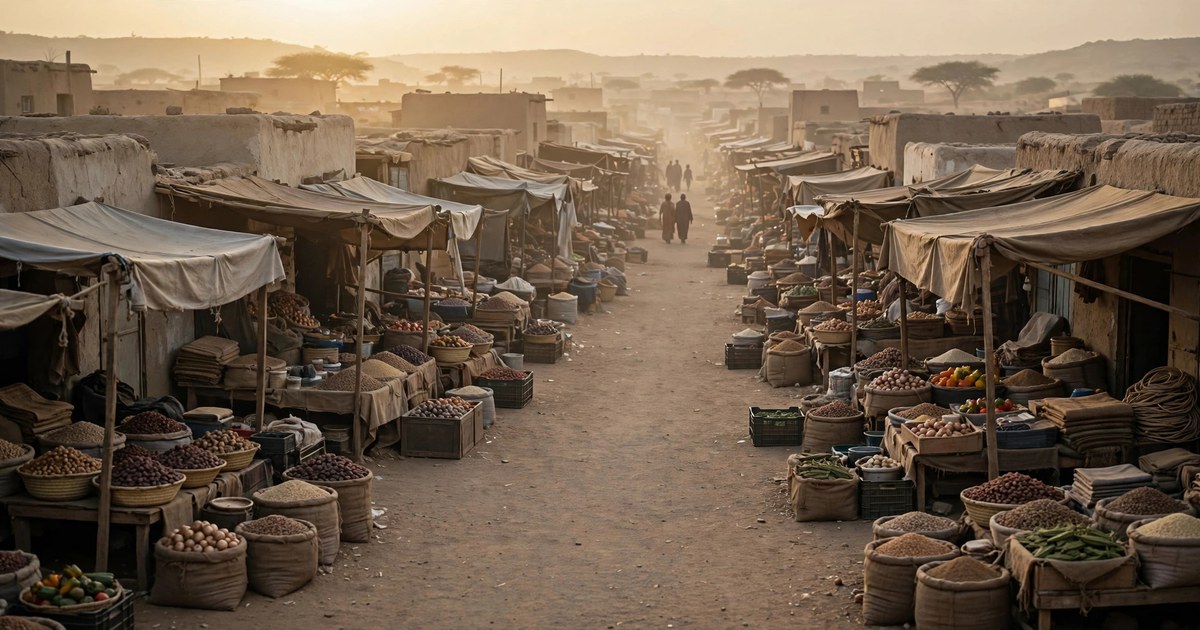
A drone strike hit a crowded market in Nyala, the capital of South Darfur in western Sudan, on the evening of Monday, 26 October 2026, killing and injuring scores of people who had gathered to buy food and daily goods. The Nyala market drone strike, trending per news coverage, is one of the deadliest single incidents reported in Sudan's drone war in October 2026. Yet the most basic question about it — how many people died — does not yet have one agreed answer. A Sudanese rights group reported more than 100 people killed, hospital figures reported by aid workers were far lower, and no final, independently confirmed death toll had been established when the reports emerged on Tuesday, 27 October.
What the reports do agree on is the setting and the timing: a busy market in the northern part of Nyala, struck at around 8 p.m. local time (18:00 GMT) when traders and shoppers were still gathered there, in a city that has become the political centre of the paramilitary Rapid Support Forces (RSF). Medical teams in the city then faced a sudden rush of wounded people, some with shrapnel wounds and severe burns, arriving at hospital through the night. A second strike was reported to have hit a nearby residential neighbourhood. The attack came in the same week that governments warned Sudan faces a growing risk of famine, and in the same days that drone strikes on power stations left millions of people without electricity elsewhere in the country.
What happened in the Nyala market drone strike?
According to the accounts published on Tuesday, the strike hit a market in northern Nyala on Monday evening, 26 October. Reports name the market differently — some call it the Tankung market in the Dumaya area, others use a similar-sounding local name — so this article refers to it simply as a market in northern Nyala, the description all of the main accounts share. Residents quoted by news agencies said the market was crowded at the time, with people buying goods for their households. One resident said the area was frequented by young men, including members of the RSF, a detail that matters for understanding the city but does not by itself establish who was present at the moment of the strike or why the market was hit.
Emergency Lawyers, a Sudanese human rights group that tracks violence against civilians, said in a statement on Tuesday that more than 100 people were killed and 113 others were injured in the strike, including women and children. The group blamed the Sudanese Armed Forces, condemned the attack as a massacre, and called for an independent investigation. Its statement described a civilian marketplace turned into a scene of mass killing and injury, and said the attack compounded the suffering of residents already living through war.
Separately, Doctors Without Borders, known by its French initials MSF, reported what its supported hospital received. The organisation said Nyala Teaching Hospital took in 36 bodies after the attack, including 21 people wearing civilian clothing, and treated more than 150 injured patients in its emergency department. Medical workers described patients with shrapnel wounds and severe burns, some brought to hospital on motorcycles and animal-drawn carts. Dale Koninckx, MSF's project coordinator in Nyala, said markets, homes and essential civilian infrastructure must be protected, and called on all parties to the conflict to protect civilians. MSF also reported that a second drone strike hit a residential neighbourhood, adding to the alarm in the city.
A medic at Nyala Hospital who spoke to the AFP news agency gave a third, lower figure on Tuesday: 21 people killed and more than 40 injured. That medic could not say how many of those killed or injured were fighters. As of Tuesday, no group had publicly claimed responsibility for the strike in the reports published by the main news agencies, and no official account from the Sudanese military about this specific strike had been reported.
Why the Nyala market drone strike death toll differs so widely
Readers searching for the Nyala market drone strike death toll will find very different numbers, and the difference is not a rounding error. Emergency Lawyers reported more than 100 dead and 113 injured. MSF reported 36 bodies received at one hospital and more than 150 people treated for injuries. An AFP-quoted medic reported 21 dead and more than 40 injured. All three figures describe the same Monday-evening attack on a market in northern Nyala, but they come from different vantage points, and none of them, on its own, is a final confirmed toll.
The rights group's figure appears to draw on field reporting beyond a single hospital, which can capture people who died at the scene or were taken elsewhere, but which is also harder to check from outside a war zone. A hospital count, by contrast, records only the bodies and patients that reached that facility; it will miss people who died where they fell, were buried quickly, or were taken to other clinics. An early medic's figure may reflect only what was known in the first hours. The 21 people in civilian clothing among the 36 bodies MSF reported is a reminder that the dead included ordinary shoppers, but it is not a breakdown of every victim: the status of the remaining bodies, and of the more than 150 people treated, was not established in the published reports.
Verification is difficult in Nyala. The city is held by the RSF, communications are restricted, and independent investigators have not been reported on the ground establishing the circumstances of this strike person by person. That is why responsible reporting on the Nyala market drone strike has to carry the attribution with the number: more than 100 killed according to Emergency Lawyers, 36 bodies received according to MSF, 21 killed according to a hospital medic quoted by AFP. Until a consolidated, independently checked count appears, any single number presented without its source would mislead.
Who was blamed for the Nyala market drone strike, and what remains unconfirmed
Emergency Lawyers blamed the Sudanese military for the strike and demanded an independent investigation. That allegation has not been independently established, and it is not a finding by a court or an investigating authority. The Sudanese military regularly carries out strikes on Nyala, and the city is a frequent target precisely because the RSF has set up a rival administration there. But a pattern of past strikes does not, on its own, prove who carried out this one, and the published reports did not include an official military statement about the 26 October market strike.
Residents' accounts that RSF fighters frequented the market also need care. A market used at times by armed men is still, in its ordinary function, a place where civilians gather to obtain food — the point MSF's coordinator made when he spoke of protecting markets and homes. The reported presence of fighters does not establish who was shopping there on Monday evening, and it does not settle whether this particular attack complied with the obligation to protect civilians. The army's account of its intended target, if one is given, would be essential to examining that question, and it had not been reported when the first accounts of the strike were published.
The strike follows a pattern seen earlier in October. About ten days earlier, a drone strike on a Nyala market was also reported to have killed a large number of people, and in that case the army was reported to have said it had targeted RSF command and control centres, while the RSF accused the military of killing civilians. The competing claims from that earlier strike show why the 26 October attack cannot be settled by assertion alone: both sides in this war blame each other for strikes on crowded places, and outside monitors can rarely check the claims in full.
Why Nyala matters in Sudan's war
Nyala is the capital of South Darfur state and the largest city in the Darfur region. Since the war began in April 2023, it has become the de facto capital of the RSF and the seat of the rival administration the paramilitary group set up to challenge the army-backed, internationally recognised government based in Khartoum. That makes Nyala both a political prize and a regular target. The Sudanese Armed Forces, led by General Abdel Fattah al-Burhan, have vowed to retake territory held by the RSF, led by Mohamed Hamdan Dagalo, widely known as Hemedti. The RSF, in turn, has struck deep into army-held territory. Neither side has established full control of the country, and the fighting has increasingly been fought from the sky.
Drone warfare has changed how this war reaches civilians. Unmanned aircraft can strike markets, transport hubs, camps and power stations hundreds of kilometres behind the front lines, in places with no defence against attack from above. The United Nations said drone strikes killed more than 300 people in the first three weeks of October 2026 alone, and the UN secretary-general's spokesperson had already condemned a wave of deadly drone strikes earlier in the month. That earlier October drone-strike wave, which was reported to have killed more than 160 people across Sudan, hit markets, displaced people's gatherings, dams and the capital itself — the same kinds of civilian and infrastructure targets seen again in Nyala.
The Nyala strike did not happen in isolation from attacks on infrastructure. In the same days, RSF drones were reported to have hit the Al-Markhiyat transformer station, disrupting power across large parts of Khartoum and Al-Jazira states, a day after a coordinated attack on six power stations left millions without power in Al-Jazira, White Nile, Sennar and Gedaref states. Those power strikes that left millions without electricity forced hospitals onto backup generators and disrupted water pumping, showing how the drone war now targets both people and the services they depend on to survive.
What the Nyala strike means for civilians facing famine warnings
For the people of Nyala, a market is not only a place to shop. In a city under wartime pressure, with food supplies disrupted and aid operations restricted, markets are where households obtain the grain, vegetables and daily goods that keep them fed. A strike on a crowded market therefore does more than kill and injure the people present: it frightens traders and shoppers away from the places food is sold, at a moment when Sudan's hunger crisis is already among the worst in the world.
On 27 October, the United States, Canada and more than two dozen international partners warned that 19.5 million Sudanese — 41 per cent of the population — were experiencing high levels of acute food insecurity, with five million already in emergency conditions. The joint statement, originally issued on 23 October and circulated by the US State Department on 27 October, warned that the number of children suffering from severe acute malnutrition could exceed the projected 825,000 if conditions kept deteriorating, and that the number of areas facing serious food insecurity could double from 14. The signatories identified the continuing armed conflict as the principal cause, compounded by restrictions on humanitarian assistance and by drought linked to El Niño across more than half the country, and they demanded that all parties lift restrictions on aid, allow access across front lines and borders, and grant air access into Darfur.
The scale of displacement behind those figures is staggering. Aid agencies report that around 14 million people have been displaced by the war, within Sudan and across its borders, in what the United Nations has described as one of the world's worst humanitarian and displacement crises. Estimates of the total death toll since April 2023 vary very widely — the Associated Press cited conflict data putting it at at least 59,000, while some aid-worker estimates run far higher — and a reliable national total is not available, because so much of the fighting happens where counting is impossible. What is not in dispute is that the crisis is under-funded: only about 40 per cent of Sudan's 2026 humanitarian needs plan had been resourced as of September, according to reporting on the UN appeal, leaving community kitchens and other lifelines without long-term support.
It was against that background that Emergency Lawyers proposed on 24 October that relief centres be established in the worst-affected regions, providing food, clean water, healthcare and other essentials, and warned that deliberately depriving civilians of food and water could constitute a war crime. An assessment by the Integrated Food Security Phase Classification system earlier in October had already found rapidly deteriorating food security in Darfur and Kordofan, driven by shortages, malnutrition and drought. The Nyala market strike landed in the middle of that emergency — and, by hitting a place where food is bought and sold, it struck at one of the few remaining ways civilians in the city feed themselves.
What happens next after the Nyala market drone strike?
Four questions will determine what follows. First, will a consolidated casualty count emerge, and will it confirm, revise or replace the very different figures published on Tuesday? Second, will the Sudanese military or the RSF issue an account of the strike, and will Emergency Lawyers' call for an independent investigation be answered? Third, will the international demand for unhindered humanitarian access — repeated in the 27 October joint statement — produce any change on the ground in Darfur, where aid groups say restrictions, visa delays and customs holdups have slowed relief for months? And fourth, will the pattern of market and infrastructure strikes continue, as it has through October, or will the scale of the Nyala toll change the calculations of either side?
Accountability efforts are already moving on a separate track. On 26 October, the United Kingdom imposed sanctions on 15 Sudanese military leaders and commanders over war crimes, including sexual violence, during the fighting for El Fasher — a reminder that outside governments are documenting alleged atrocities even while the war continues. Those UK sanctions over El Fasher do not relate to the Nyala strike itself, but they show the direction of international pressure: record the abuses, name those accused, and press for access for investigators and aid workers alike.
For now, the documented facts are these: on the evening of 26 October 2026, a drone struck a crowded market in northern Nyala; Emergency Lawyers reported more than 100 people killed and 113 injured and blamed the army; MSF reported 36 bodies received at Nyala Teaching Hospital and more than 150 injured people treated; a hospital medic quoted by AFP reported 21 killed and more than 40 injured; a second strike hit a nearby residential area; and no final confirmed toll or official account of the strike had been published. As Sudan's war grinds toward its fourth year, the weapon that defines it is increasingly the drone — and, as Nyala shows again, its victims are found in the most ordinary of places: a market, on a Monday evening, where people had gone to buy food. Sources: Associated Press via AccessNorthGA and DailyWorld (28 October 2026); AFP via Fact.net.in, SpeedyNews and QNC News (27 October 2026); Doctors Without Borders (MSF); Emergency Lawyers; United Nations; joint statement of the United States, Canada and international partners circulated by the US State Department (27 October 2026).