
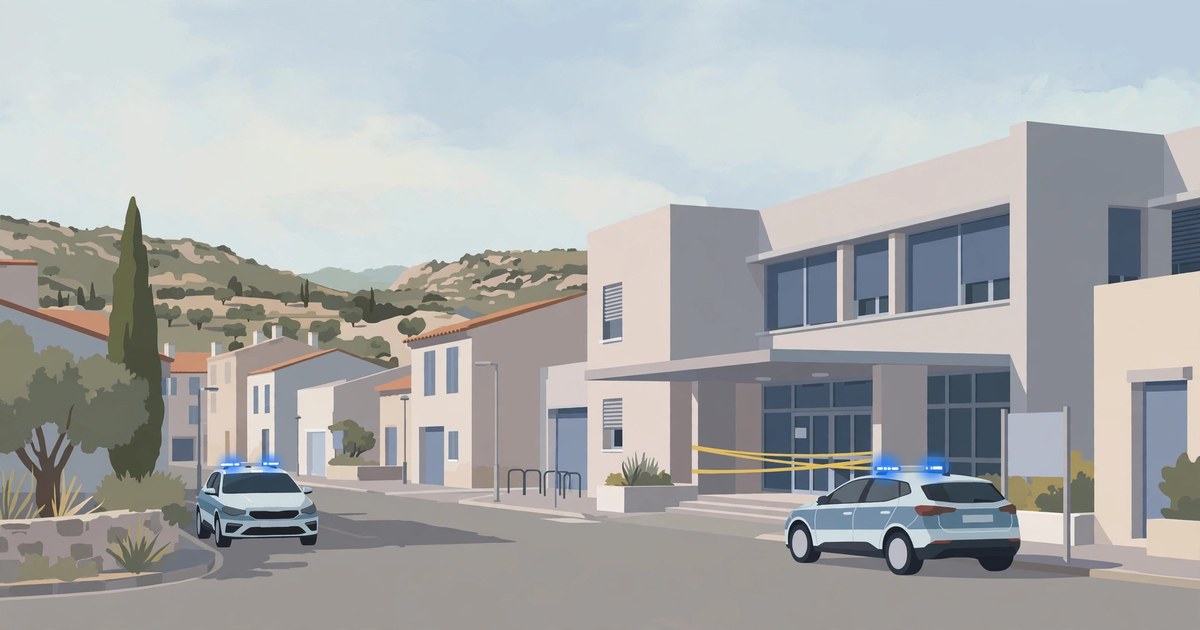
On the morning of Monday 12 October 2026, a 14-year-old boy walked into his own middle school in the southern French town of Aubagne carrying a 12-gauge hunting shotgun hidden inside a guitar case. Within minutes he had opened fire on the school's principal and a teacher, sending nearly 700 pupils into lockdown in what prosecutors are calling an attempted-murder case. The story is trending per news coverage across AP, Reuters, Sky News, and French media, and it has shaken a country where school shootings by pupils are vanishingly rare.
What happened inside the Joseph Lakanal school
According to statements from the Marseille prosecutor's office, the pupil fired once or twice on the first floor of the Joseph Lakanal middle school in Aubagne — about 15 kilometers (9 miles) east of the Mediterranean port city of Marseille — wounding the principal and a teacher in the legs with shotgun pellets. Both were taken to hospital; prosecutors said their injuries were not life-threatening.
The boy then moved to the second floor and fired twice more — once at the floor in front of a teacher and once in a classroom, striking the teaching board. No teachers or pupils in that classroom were hit, but they were "very shocked," prosecutor Nicolas Bessone said. The boy was finally intercepted and disarmed by a school staff member in a stairwell, whom deputy prosecutor Audrey Jouaneton praised for acting with "extreme courage." Police then took the 14-year-old into custody. Aubagne's mayor, Jean-Pierre Squillari, told reporters that all students were "immediately confined and made safe within seconds" and that no pupils were injured.
Jouaneton was careful about how much could be said: "We still don't have sufficiently precise evidence to say that he wanted to target the teaching staff — this principal and the teacher — but they were in any case hit by the shots." The boy's motives are unknown.
The staff member who stopped the shooting
The day's most widely praised figure is the school supervisor who disarmed the teenager before police arrived. President Emmanuel Macron wrote on X that he wanted to acknowledge "the composure and exemplary response of the educational team, which prevented an even worse outcome," and extended his "full solidarity and total support" to the principal, the teacher, the students, and the shocked parents. Education Minister Édouard Geffray — who headed to Aubagne with Interior Minister Laurent Nunez — called the attack "unacceptable" and said it "highlights the rise of unbridled violence in our society, against which we must all mobilise. In words as well as deeds."
The city set up a crisis centre and a psychological support unit at the school, and mental health counselling was offered to pupils, some of whom described panicking and running for the exits as the alarm sounded. One student told local media that after a blast and an alarm, corridors emptied: "We were panicking, we ran. There were two ways out: one passage to the sports hall and one passage to go outside. Survival instinct took over and I ran towards the outside."
The investigation: attempted murder, motive unknown
The Marseille public prosecutor's office has opened an investigation for "attempted murder." How a 14-year-old obtained a hunting shotgun is one of the central questions: in France, firearms like the 12-gauge hunting shotgun the boy reportedly used are relatively common in rural areas, where many are legally licensed for hunting — the weapons are not military-style rifles, but hunting arms stored in households. Investigators will be examining where the weapon came from and how it entered the school undetected.
Authorities also stressed what the case is not connected to: France has been rocked by weeks of high-school student protests over teacher shortages and deteriorating school conditions — our explainer on why 250,000 people marched over school funding in France covers the background — with some demonstrations turning violent, 504 people arrested, and 48 police officers injured. Police said the Aubagne middle school had not been affected by the protests or blockades, and there is no evidence linking the shooting to them. Education Minister Geffray described France's education system as "an educational community that has been severely tested."
The political fallout
The shooting arrived at a moment when schools are already a national flashpoint. Far-right leader Marine Le Pen, described in coverage as the frontrunner to replace Macron next spring, said the government was losing control of security in schools: "Schools, which should be sanctuaries, are now places where people risk their lives. Insecurity has entered the school. Many pupils and teachers go there with a knot in their stomach."
The government, meanwhile, has been trying to contain weeks of student unrest while insisting the education system must be protected from politicization. Macron condemned the protest-related violence separately on Monday, even as the two issues — the protests and the shooting — were being disentangled by investigators. For the broader picture of France's strained relations with its partners, see our reporting on the France-Germany clash over the EU's €2 trillion budget.
Why this matters: school shootings are rare in France
France does not have the school-shooting crisis that defines the United States. Gun violence perpetrated by pupils in schools is rare in France, which makes each case national news. The most recent comparable incident was in 2017, when a 16-year-old student armed with a rifle, pistols, and a small grenade opened fire at a high school in the southern town of Grasse, wounding three students and the principal.
Knife attacks have been somewhat more common in recent years: last year, a middle school employee in eastern France was stabbed to death by a 14-year-old student during a bag check, and in 2025 a 15-year-old student stabbed four other students at a secondary school in western France, killing one and wounding three before being arrested. The Aubagne shooting is the first school shooting by a pupil in France in nearly a decade — which is precisely why it has drawn such intense coverage and such strong reactions from the top of French politics.
What happens next
Several questions will determine how this story develops. First, the investigation: the prosecutor's attempted-murder inquiry will establish how the boy obtained the shotgun, whether anyone knew of his intentions, and what the motive was. Second, the school community's recovery: classes were suspended, counselling is in place, and authorities will be watching how quickly pupils and staff can return to normal life. Third, the political dimension: with student protests continuing, Le Pen's attacks on school security, and Macron's government defending its record, the shooting is likely to become part of the broader debate about violence, youth mental health, and safety in French schools.
France's rarity of school shootings means the response tends to be systemic rather than procedural — national reviews, ministerial visits, and debates about society itself, rather than lockdown drills as routine. The country will now watch whether Aubagne changes that.
Schools elsewhere in Europe have faced scares of a different kind: hoax bomb threats targeted schools across Scotland and Northern Ireland in a coordinated campaign.
Sources
Reporting drawn from the Associated Press (via reflector.com), Reuters (via KELO-FM), Sky News (via sunshineradio.co.uk and partner stations), BFM TV, and statements from the Marseille prosecutor's office and the mayor of Aubagne (12 October 2026).