
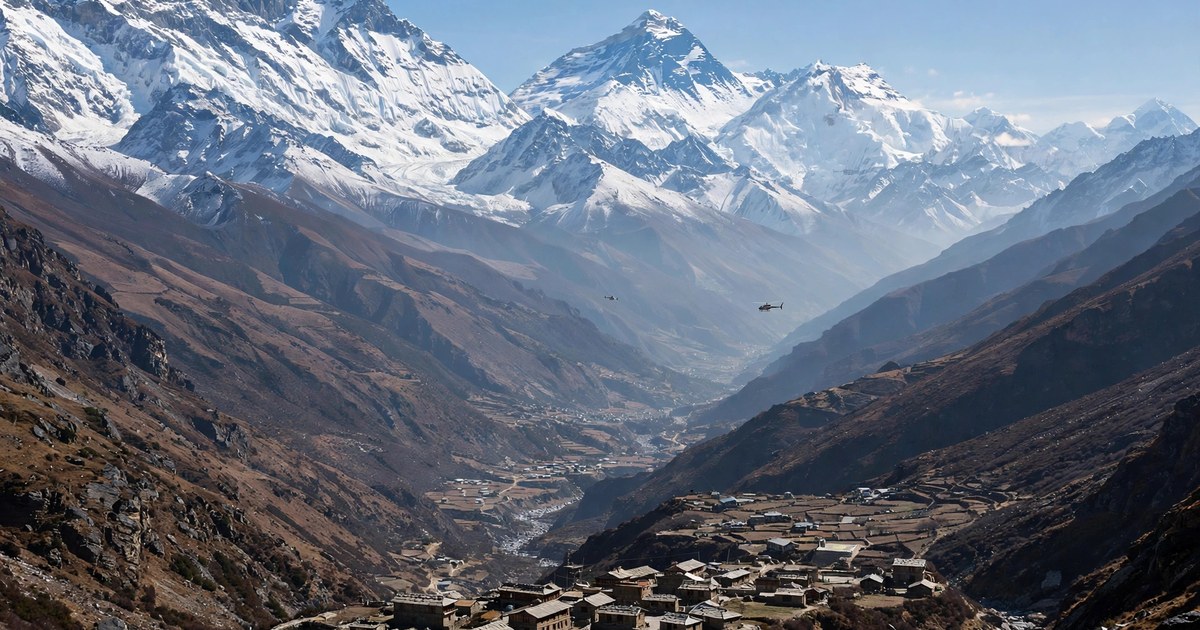
Trending per news coverage: the Everest helicopter crash killed one tourist and injured two people on Tuesday 3 November 2026, when two helicopters collided while trying to land at the same high-altitude helipad near Everest Base Camp in Nepal. The rotor blades of the two aircraft struck each other as they came in to land at Pheriche, a village on the trekking route to Everest, sending both helicopters down into the snow. The crash happened at the height of the autumn trekking season, when helicopters ferry climbers, trekkers and supplies between Lukla and the Everest region every day. Here is what happened, who was on board, and why investigators are looking hard at how landings are coordinated at remote Himalayan helipads.
Everest helicopter crash: what happened at Pheriche
The collision happened at about 8:11 am local time on Tuesday 3 November, according to Nepal Police. The two helicopters, operated by Fishtail Air and Air Dynasty, had both taken off from Lukla Airport, the gateway to Mount Everest, and were coming in to land at the Pheriche helipad in Solukhumbu district, about 12 kilometres south of Everest Base Camp and roughly 150 kilometres northeast of Kathmandu. Pheriche sits at an altitude of about 4,200 metres (13,780 feet) on the main trekking route to Base Camp.
As the two aircraft approached the helipad at nearly the same time, the rotor blades of one smashed into the fuselage of the other, slicing off its tail boom. Footage from the scene shows the blades clipping each other as both helicopters descend toward the snowy landing site, with people waiting on the ground scrambling clear as the two aircraft came down. The Fishtail Air helicopter was carrying passengers, while the Air Dynasty helicopter was carrying only cargo. Fishtail Air said in a statement that its helicopter was carrying passengers who had been rescued from the Everest region when it crashed while landing.
The crash came in the middle of Nepal's peak autumn trekking season, when the trails to Everest Base Camp are at their busiest and helicopters work their hardest. Pheriche is a regular stop on the trekking route, where walkers pause to acclimatise before climbing higher, and its helipad handles a steady flow of aircraft through the day: helicopters bringing trekkers and climbers up from Lukla, carrying supplies in, and flying sick or injured walkers back down to Kathmandu. That volume is exactly what makes a small helipad dangerous. With only one usable landing spot and several aircraft arriving within minutes of each other, there is little margin for a mistimed approach, a misunderstood radio call, or two pilots choosing the same patch of snow at the same moment.
Rescue crews reached the site quickly. The injured were flown out by helicopter to hospitals in Kathmandu, and police and aviation officials began examining the wreckage the same day. The Civil Aviation Authority of Nepal (CAAN) and Nepal Police have opened an investigation into the collision.
Who was killed and injured in the Nepal helicopter collision
Nepal Police identified the man killed as Vasanth Kumar Balaramaramadu, a 47-year-old Indian national travelling on the Fishtail Air helicopter. He died at the scene. Some international reports spell his name slightly differently; the spelling used here is the one given by Nepal Police.
Two people were injured. Shailesh Krishna Patel, a 49-year-old New Zealand citizen of Indian origin who was also a passenger on the Fishtail Air helicopter, was seriously injured and evacuated by helicopter to Mediciti Hospital in Kathmandu. Captain Rabindra Prajapati, the Fishtail Air pilot, was also seriously injured and taken to hospital in Kathmandu. The pilot of the Air Dynasty helicopter escaped without injury.
Why two helicopters tried to land at the same spot
Officials have not yet said what caused the two aircraft to come together, but the early account points to a landing coordination failure at a small, high-altitude helipad. A spokesman for Nepal's Civil Aviation Authority, Gyanendra Bhul, said: "It appears the accident happened when two helicopters... attempted to land at the same spot."
Pheriche is a constrained landing site. The helipad is small and snow-covered, the air is thin at 4,200 metres, and landings there fall outside Lukla air-traffic control coverage, so pilots coordinate largely by sight and radio. During the peak trekking season the route is busy: helicopters are the main transport and rescue link on Everest routes, ferrying trekkers and climbers up from Lukla and bringing supplies and rescued walkers back down. Reports on the investigation say officials are looking at the snow-covered landing surface, pilot coordination outside Lukla's air-traffic control coverage, and the operational hazards of constrained high-altitude helipads.
Nepal's helicopter safety record under scrutiny
The crash has put Nepal's helicopter safety record back in focus. Safety has drawn scrutiny since a 2025 review found dozens of past crashes and recommended stronger oversight of helicopter operations. Nepal's mountains make flying unusually demanding: sudden weather changes, thin air at altitude, and landing sites that are little more than cleared patches of snow or rock.
Helicopter crashes have made headlines elsewhere this year too, including a Bosnia helicopter crash in October that killed four EUFOR peacekeepers and a Learjet 60 crash in Florida in November that killed all nine people aboard. Spain is also investigating a deadly train crash near Urda, Toledo. Each investigation turns on the same questions: what failed, who was responsible for separating the aircraft, and what changes before the next flight.
What happens next after the Everest helicopter crash
The investigation by CAAN and Nepal Police is at an early stage. Investigators will examine the wreckage of both helicopters, the accounts of the pilots and ground staff, and the radio and flight records from the morning of the crash. Their findings will decide whether landing procedures at Pheriche and other high-altitude helipads need to change, and whether the two operators face any action.
For trekkers, the crash is a reminder that the helicopter ride many treat as a routine part of an Everest trip is one of the riskiest legs of the journey. Until the investigation into the Everest helicopter crash reports, the central question remains unanswered: how did two helicopters end up trying to land on the same small patch of snow at the same moment?
Sources: Reuters; The Times; The Hindu BusinessLine; BBC; Civil Aviation Authority of Nepal; Nepal Police.