
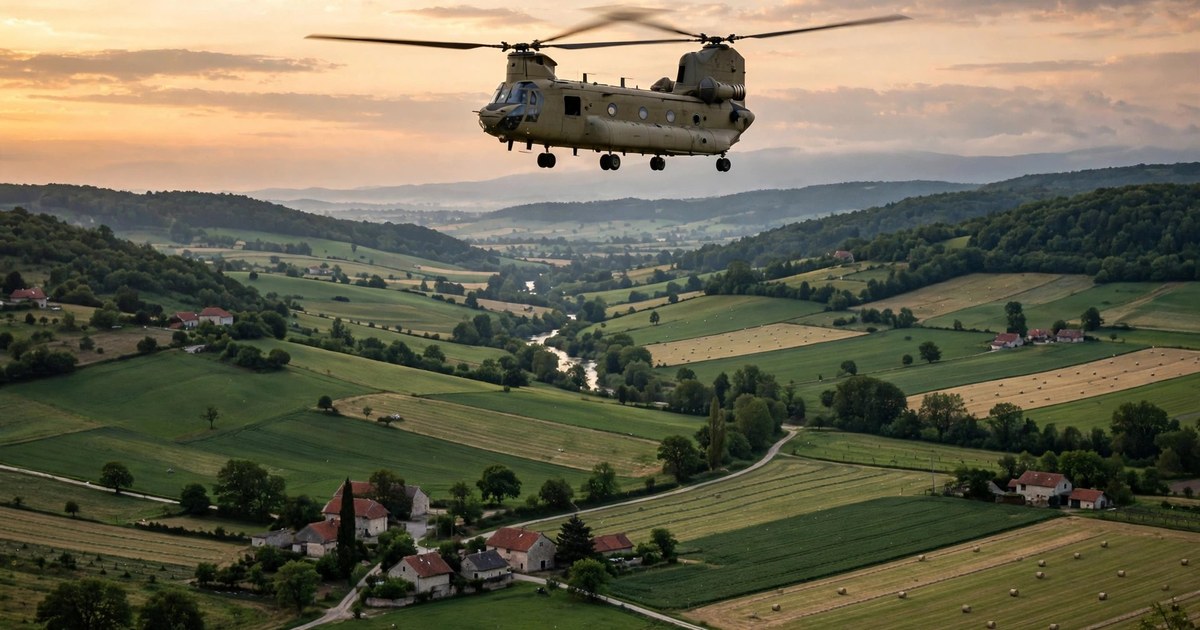
Four Italian personnel serving with the European Union's peacekeeping force in Bosnia and Herzegovina were killed and 11 others injured when their helicopter went down during a routine training flight on Thursday, 29 October 2026. The Bosnia helicopter crash happened near the village of Gorice in the Brcko District, about 180 kilometres (110 miles) north of the capital, Sarajevo. All 15 people on board were Italian nationals, and the aircraft was an Italian Army Boeing CH-47 Chinook operating as part of the EUFOR Operation Althea mission. No civilians were hurt, and no civilian buildings, vehicles or property were damaged.
The Bosnia helicopter crash is the deadliest accident for the European Union force in Bosnia in almost two decades, and it has drawn condolences from Italy's government and the mission's commanders. Investigators from EUFOR and the Italian military have begun a full inquiry, but as of Friday, 30 October, no cause has been confirmed. This article explains what happened, who the victims were, what EUFOR does in Bosnia, and what the investigation will examine.
What Happened in the Bosnia Helicopter Crash
According to Italy's Ministry of Defence and EUFOR, the CH-47 Chinook was taking part in a routine training activity on the evening of Thursday, 29 October, when it went down in an uninhabited area on the outskirts of Gorice, in the Brcko District of northern Bosnia and Herzegovina. Local media published photographs of the wreckage showing the large twin-rotor helicopter overturned in a flat field.
Three people died at the scene. A fourth person died later from injuries in hospital in Brcko, a spokesman for the hospital told the AFP news agency. Twelve people were taken to the hospital in Brcko; two of the injured were later transferred to a medical facility in Tuzla, while the remaining nine continued to receive treatment in Brcko. EUFOR and the Italian Defence Ministry said all 11 injured personnel were in a stable condition and none was in a life-threatening condition.
Italian media reported that the helicopter had departed from Viterbo in Italy that morning, made a technical stop at Pratica di Mare Military Airport, and then continued to the mission area in Bosnia. The same reporting said the aircraft crashed just after takeoff after a sudden loss of altitude, with the pilot trying to regain control. Unverified video shared on social media appeared to show the helicopter rotating during its descent, but that footage does not by itself establish what caused the accident, and officials have not confirmed any technical explanation.
EUFOR said the aircraft crashed during "routine training" and announced a "thorough and complete" investigation, adding that it would release more information as it is verified. Italy's Defence Minister, Guido Crosetto, said his thoughts were with the families of the fallen, and extended the condolences of the entire defence establishment.
Who Were the Four Victims of the Bosnia Helicopter Crash?
The Italian Ministry of Defence identified the four people killed after their families had been notified. Two were members of the Italian Army and two belonged to the Italian Red Cross Volunteer Military Corps.
The two soldiers were Sergeant Simone Ruggia and Sergeant Claudio Marchesi, both serving with the Italian Army Aviation Command. The two Red Cross volunteers were Lieutenant Franco Adriano Zecchillo and Sergeant Laura Procacci, members of the Italian Red Cross Volunteer Military Corps. The ministry said all 15 people on board were Italian nationals.
Italy's ambassador to Bosnia and Herzegovina, Sarah Eti Castellani, travelled from Sarajevo to Brcko after the crash and said the number of casualties and the condition of the injured were "changing by the minute" and that the circumstances were still unclear. Italian news agency ANSA first reported the names of the four victims.
What Is EUFOR Operation Althea?
EUFOR is the European Union Force in Bosnia and Herzegovina, and Operation Althea is the name of its military mission. The force has been deployed in Bosnia since 2004, when it took over from a NATO-led peacekeeping force that had been in the country since the Bosnian War ended in 1995. Its job is to oversee the implementation of the Dayton Peace Agreement, the 1995 deal that ended the war, and to support a safe and secure environment in the country.
The mission has between 1,000 and 1,500 personnel drawn from EU member states and partner countries. Troops carry out patrols, training and capacity-building work with the Armed Forces of Bosnia and Herzegovina. Italy has commanded the EUFOR Althea mission since January 2026, under the leadership of General Maurizio Fronda, and the Italian contingent provides helicopters and other aviation support for the mission.
The Bosnia helicopter crash underlines the risks of even routine military flying. Training flights are a daily part of the mission, and the Chinook is a heavy-lift helicopter used to move troops and equipment across Bosnia's mountainous terrain. The accident is a reminder that peacekeeping missions carry real dangers even when there is no fighting, a point that has also shaped European security debates this year, including Poland's debate over its place in the European Union and the wider questions facing EU defence cooperation.
What Caused the Bosnia Helicopter Crash?
As of Friday, 30 October 2026, the cause of the Bosnia helicopter crash has not been established. Neither the Italian Ministry of Defence nor EUFOR has identified a mechanical failure, a weather-related issue, an operational error or any other specific cause. Both have said only that investigations have begun to reconstruct the sequence of events and establish the circumstances of the accident.
That caution is normal after a military aviation accident. Investigators will examine the wreckage, the flight data and voice recorders if the aircraft carried them, maintenance records, the weather at the time of the flight, and the accounts of the survivors and of witnesses on the ground. The helicopter was an ICH-47F, the Italian Army's configuration of Boeing's CH-47F Chinook heavy-lift helicopter, a type with decades of service around the world.
Transport accidents are investigated in a similar way across Europe, and the process can take months before a final report is published. Readers following other major investigations this week can also read our report on the Spain train crash investigation, in which a signalling failure is the focus after 68 people died. In the Bosnia case, officials have urged the public not to speculate while the inquiry is under way.
What Happens Next: The Investigation
EUFOR has promised a "thorough and complete investigation to ascertain the facts which led to this tragic accident" and said it will release more information as it is verified and when appropriate. The Italian military is conducting its own inquiries in parallel, and the two investigations are expected to share findings.
In the short term, the focus is on the injured. Two of the 11 injured were transferred to a hospital in Tuzla, and the other nine are being treated in Brcko. The Italian government has been in contact with the families of all those on board. Funerals and official commemorations in Italy are expected in the coming days, although no dates have been announced.
The mission itself continues. EUFOR has not announced any suspension of flights, and the force's mandate in Bosnia runs on a yearly renewal by the United Nations Security Council. The accident comes at a tense moment for European security more broadly, with the war in Ukraine still shaping the continent's politics — including the recent reported decision by Ukraine to pause strikes on Russian refineries — and with EU governments under pressure to show that their missions abroad are properly resourced and safe.
A Previous EUFOR Helicopter Crash in 2008
The Bosnia helicopter crash is not the first fatal air accident for the EU force. In June 2008, two German officers and two Spanish pilots serving with EUFOR were killed in a helicopter crash in Bosnia. That accident, like this one, happened during the mission's routine operations rather than in combat, and it led to a full investigation by the force.
The 2008 precedent shows why the current investigation matters beyond the immediate tragedy. Each accident produces lessons about maintenance, training, flight procedures and the age and condition of the aircraft used by contributing nations. The findings of the inquiry into the 2026 crash will be watched closely by Italy, by the other countries that contribute troops to EUFOR, and by the European Union's institutions in Brussels.
Why the Bosnia Helicopter Crash Matters
The crash matters for three reasons. First, it is a human tragedy: four families in Italy have lost a loved one, and 11 more people are recovering from injuries. Second, it is a test of the EU's peacekeeping mission in Bosnia, a country where the EU's presence is meant to guarantee the peace deal that ended a war in which around 100,000 people died. Third, it is a reminder that Europe's security depends on forces that operate far from the headlines, on routine missions that rarely make the news until something goes wrong.
For now, the facts of the Bosnia helicopter crash are these: on 29 October 2026, an Italian CH-47 Chinook carrying 15 people crashed near Gorice in the Brcko District during routine EUFOR training; four people were killed and 11 injured; the cause is under investigation. Worldlession will update this article as EUFOR and the Italian authorities release verified findings.
Sources: Reuters; EUFOR; Italian Ministry of Defence; ANSA; Associated Press; La Stampa; Brussels Signal.