
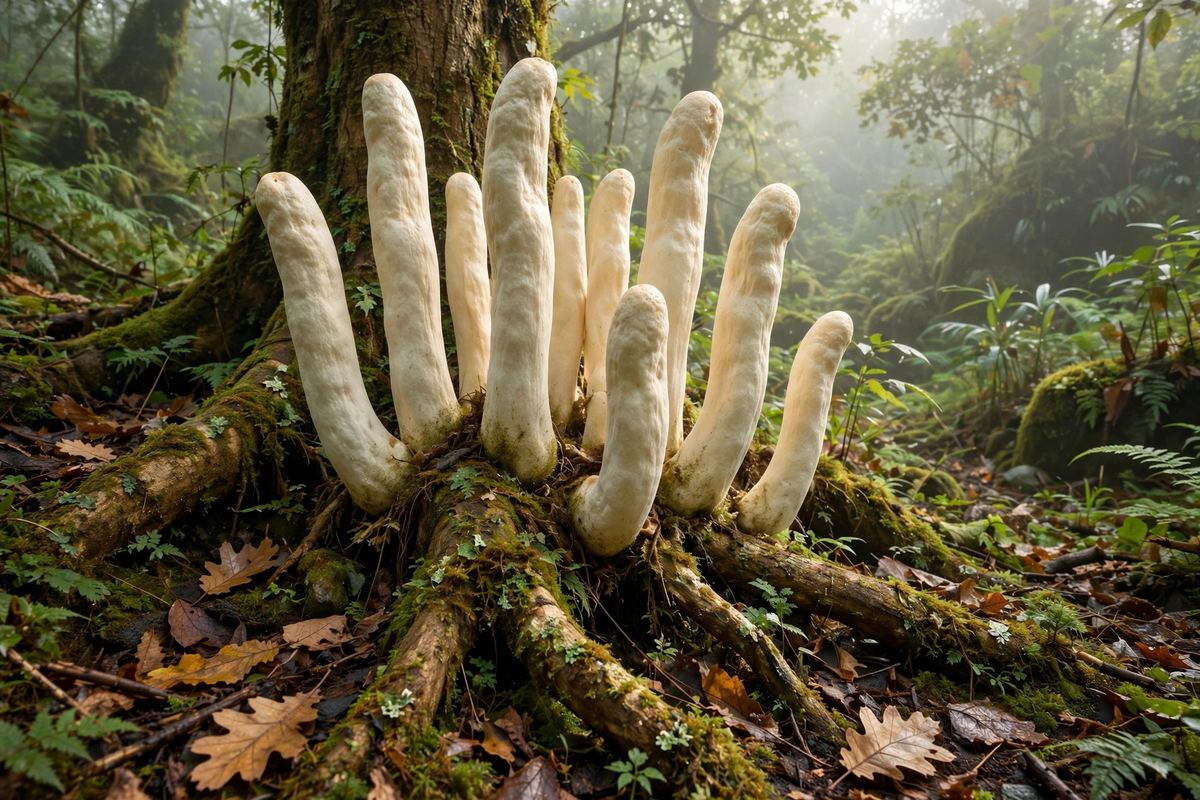
A fungal giant in Yunnan's forests
Deep in the forests of Yunnan, China, scientists have discovered a "fungal giant" that challenges our understanding of how large fungi can become. The newly described species, Dianjunus rex, produces vertical fruiting bodies up to 50 cm high and weighing up to 2.2 kg — the largest known within the phylum Ascomycota. "This remarkable species represents a new fungal family, Dianjunaceae, and provides a rare window into the evolution of extreme fungal body forms," said Dr Indunil C. Senanayake, an associate professor at the Germplasm Bank of Wild Species of the Kunming Institute of Botany in China and corresponding author of the new study, published in Frontiers in Fungal Biology. "The discovery illustrates how much fungus biodiversity remains to be discovered in East Asian forests."
The nickname "D-rex" is a playful nod to the dinosaur Tyrannosaurus rex, and it is apt in more than one way. Like the dinosaurs, this fungus's lineage traces back to a world reshaped by mass extinction. Analysis of its genome suggests that the new family arose approximately 65 million years ago, soon after the Cretaceous-Paleogene mass extinction, when new niches for wood-decomposing fungi may have opened up. The authors speculate that the record-breaking fruiting bodies may help with spore dispersal in dense forests.
How the discovery was made
The story began during routine fungal diversity surveys across three very different Yunnan habitats: a tropical rainforest in Xishuangbanna Dai Autonomous Prefecture, and temperate coniferous forests near Kunming and Lufeng. During fieldwork in 2024 and 2025, collectors noticed pale, finger-like structures emerging from the roots of dying host plants, particularly oaks of the genus Quercus. Young specimens bore bulb-like apices that matured into finger-shaped branches, their surfaces covered in a persistent, powdery, whitish-yellow fibrous layer that darkened with age. Unlike the hard, carbonaceous structures typical of its order, these structures were fleshy and dehydrated rapidly once detached. The largest bilobed specimen weighed 2.2 kilograms on a field scale, dwarfing the previous record holder, Engleromyces goetzei, whose structures on bamboo culms in Kenya reached about 30 centimetres in diameter and roughly 3.2 kilograms in a two-lobed mass.
The scientists collected the fruiting bodies and deposited voucher specimens in the collections of the Kunming Institute of Botany. They grew spores on media to study the fungus's form and sequenced its genome, including the ensemble of protein-coding genes. The team was led by the Kunming Institute of Botany of the Chinese Academy of Sciences, with collaborators in Thailand and Mexico. The findings appeared in Frontiers in Fungal Biology on 29 September 2026, in a paper titled "Unearthing a fungal giant: Dianjunaceae fam. nov., a novel Paleocene lineage of Xylariales harboring Dianjunus rex gen. et sp. nov."
Why a new family, not just a new species
Most new discoveries are new species within an existing genus and family. Dianjunus rex is different: genetic analysis and morphology showed that it is also a new genus and a new family, Dianjunaceae, within the order Xylariales. The paper says its closest known relative is Graphostroma platystoma, a dead-wood fungus found across the northern hemisphere and the only member of the family Graphostromataceae. The researchers used an integrative taxonomic approach combining detailed morphology, multilocus phylogeny (ITS, LSU, RPB2 and TUB2 gene regions) and phylogenomic analyses to establish the new family. Phylogenetic analyses robustly place Dianjunaceae as a distinct sister clade to Graphostromataceae. Divergence time estimation dates the origin of this family to the early Paleocene, about 65 million years ago, coinciding with the period following the Cretaceous–Paleogene extinction, when an estimated 75% of all plant and animal species went extinct and a significant ecological reorganisation of life on Earth happened.
To understand why this matters, it helps to know what the order Xylariales normally looks like. The order is better known for small, charcoal-black, wood-decomposing structures — the kind of fungi you might see as dark crusts on dead wood. Dianjunus rex dramatically expands the known morphological range of the order, showing that the same evolutionary lineage can produce tiny black crusts and giant fleshy fingers half a metre tall. That range is a reminder that fungal diversity is far greater than what we see in everyday life, and that our classification systems are still catching up with reality.
What makes it the largest in its phylum
Ascomycetes, the phylum Ascomycota, are the largest group of fungi, with more than 64,000 species. They include morels, truffles and most molds. They don't grow true mushrooms but instead release spores from tiny, sac-like structures inside or on the surface of their fruiting bodies. The fruiting bodies of D. rex represent the largest documented within Ascomycota, significantly expanding the known morphological range of Xylariales. The study provides a comprehensive description, including a nodulisporium-like anamorph with periconiella-like branching patterns, and discusses the taxon's phylogenetic placement and distinctive morphology.
Size matters for a fungus because it affects how spores are dispersed. The authors speculate that the tall fruiting bodies may help spores travel on the wind through dense forest, where air movement near the ground is limited. A fungus that can lift its spores half a metre into the air has a better chance of reaching new wood to colonise than one that releases spores at ground level. That hypothesis is plausible, but it has not yet been tested directly — future research could measure spore dispersal from D. rex in the field to see whether height really does improve dispersal.
What the discovery tells us about life after extinction
The timing of the new family's origin — soon after the mass extinction that ended the reign of the dinosaurs — is one of the most intriguing aspects of the discovery. When the asteroid struck 66 million years ago, it killed an estimated 75% of plant and animal species and left vast amounts of dead wood. That dead wood was a resource for fungi that could decompose it. The authors suggest that the ecological niches opened up by that dead wood may have allowed new fungal lineages to evolve, including the ancestors of Dianjunus. In other words, the extinction that ended the dinosaurs may have created the conditions for a fungal giant to evolve. It is a reminder that mass extinctions are not just stories of loss, but also of opportunity: when old ecosystems collapse, new ones emerge, and the organisms that thrive in the aftermath are not always the ones we expect.
Fungi remain far less understood than plants and animals despite their central role in decomposition and nutrient cycling. Scientists estimate that only a small fraction of fungal species have been described, and that many more remain to be found, especially in tropical and subtropical forests. The discovery of a new family in a relatively well-studied region like Yunnan suggests that even more surprises await in less-explored forests. Each new discovery adds a piece to the puzzle of how fungi evolved, how they shape ecosystems, and how they might be used — for example, in biotechnology, medicine or agriculture.
Why it matters
This discovery matters for several reasons. For science, it expands our understanding of fungal evolution and shows that extreme body forms can evolve in lineages we thought we knew. For conservation, it highlights the value of Yunnan's forests, which are a hotspot of biodiversity that deserves protection. For the public, it is a reminder that the natural world still holds surprises — that a fungus the size of a small dog can be hiding in a forest, waiting to be found, and that its story stretches back to the aftermath of the dinosaurs. Readers interested in science can follow our earlier coverage of the Mars Moons mission and the bird flu outbreak on Macquarie Island for more on discovery and ecology.
What happens next
Future research on Dianjunus rex is likely to focus on its ecology, its genome, and its potential applications. Scientists will want to know how widespread it is, what other hosts it colonises, and how it interacts with the forest ecosystem. They will also want to study its genome in more detail to understand how its giant fruiting bodies evolved. And they will continue to survey Yunnan's forests for more undiscovered species. If the discovery of D. rex teaches us anything, it is that the forests of East Asia still hold secrets — and that the next giant could be just one survey away.