
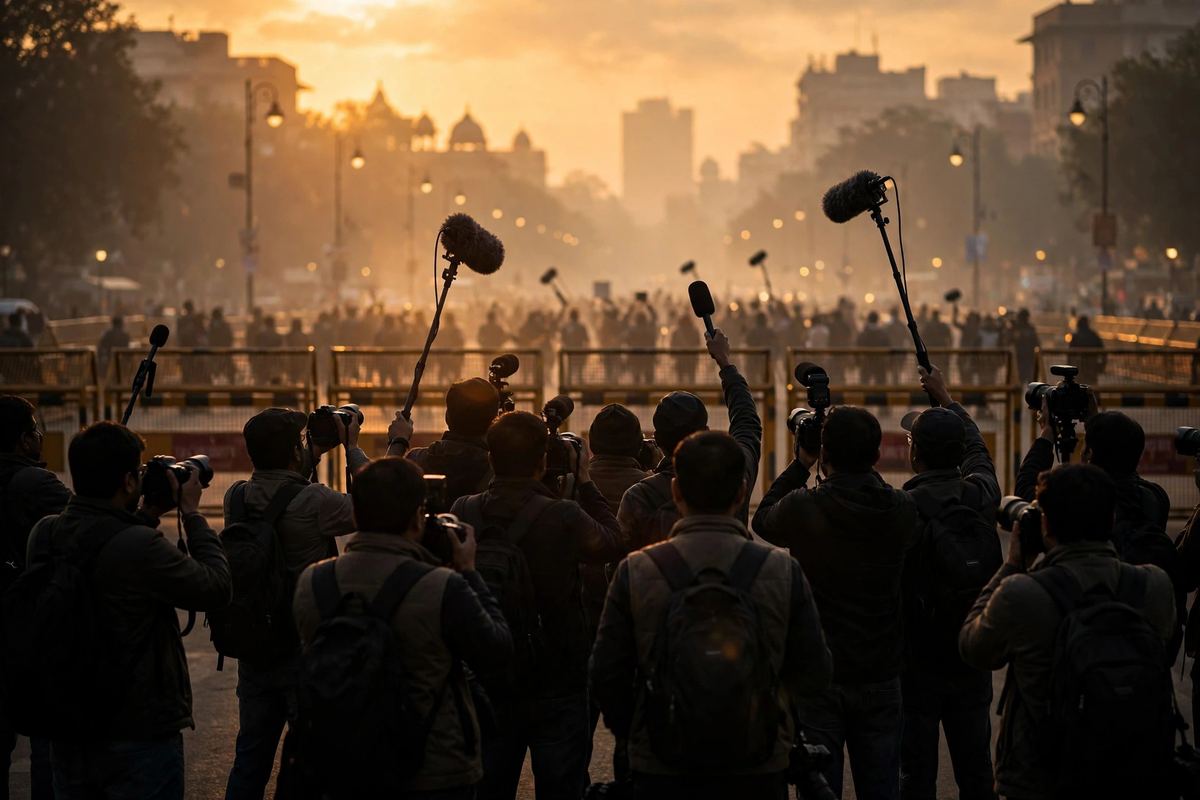
Over the weekend of October 10 and 11, 2026, central New Delhi became the scene of one of India's most contentious confrontations in recent memory between the state, the press, and street-level protesters. Tens of thousands of young demonstrators poured into the capital demanding the resignation of Chief Election Commissioner Gyanesh Kumar over a sharply contested revision of voter lists. By the time the weekend ended, dozens of journalists who had come to cover the protests had themselves been detained, some said they were dragged and had their phones seized, and India's Supreme Court had stepped in to order that reporters and lawyers be allowed to do their jobs. The episode has raised urgent questions about the integrity of India's electoral rolls, the conduct of the Delhi Police, and the state of press freedom in the world's largest democracy.
Background: what is the voter-roll dispute?
At the heart of the controversy is the Election Commission of India's Special Intensive Revision, known as SIR, of electoral rolls. The Election Commission describes the exercise as a routine clean-up operation: an attempt to remove duplicate, deceased, and otherwise ineligible entries from voter lists so that elections can be held on accurate rolls. Election commissions around the world periodically update voter registers for similar reasons, and India's poll body has carried out revision exercises for decades.
This time, however, the revision has been met with fierce opposition. Youth activists, student organisations, and opposition parties allege that the exercise has been used to strip the names of more than 130 million voters from the electoral rolls, and that the deletions disproportionately affect people seen as unlikely to vote for Prime Minister Narendra Modi's Bharatiya Janata Party. The Election Commission has denied the allegation, insisting that the revision is neutral and party-blind, and that it removes only entries that are genuinely duplicate or invalid.
Because the claims concern the fairness of the vote itself, they have struck a nerve that goes beyond routine political disagreement. In a country of more than a billion people, where winning margins in close constituencies can be decided by a few thousand votes, disputes over who appears on the electoral roll can determine who holds power. That is why the demand of the weekend's protesters was so direct: they want Chief Election Commissioner Gyanesh Kumar, who heads the three-member Election Commission, to step down.
The protests were called by the Cockroach Janta Party, a youth movement that has adopted the "cockroach" as its emblem and has built a following among young Indians frustrated with the political establishment. Its founder, Abhijeet Dipke, has become a familiar face at demonstrations in the capital. For the October 10 and 11 protests, the movement was joined by student groups linked to left-wing parties, including the All India Students' Association, and by opposition politicians, turning what began as a youth-led stir into a broader opposition show of strength. For background on recent political events in India, see our coverage of Modi's recent Chennai Metro Phase 2 inauguration.
What happened on October 10 and 11
The protests began on Friday, October 10, with demonstrators gathering at multiple locations across central Delhi, including near Jantar Mantar, the traditional protest site that the Delhi Police has now withdrawn as a designated protest venue. Police had prepared a large security deployment, imposed restrictions on gatherings, and set up barricades at key intersections. As protesters marched and raised slogans against the Election Commission and the voter-roll revision, police detained political leaders, student activists, lawyers, and journalists at multiple locations.
The crackdown continued into Saturday, October 11. Delhi Police detained at least 100 protesters in the central district for a second consecutive day as demonstrations continued demanding the CEC's resignation. Protesters affiliated with student organisations staged demonstrations at several locations across the city before police detained them and took them away in vehicles. One group of protesters tried to stop police vehicles carrying Neha Bora and other detained leaders near the Safdarjung Airport flyover, in scenes that were widely shared on social media.
It was the treatment of the press, however, that drew the sharpest national and international condemnation. The Committee to Protect Journalists said that at least 37 journalists were detained while covering the protests in New Delhi, Ahmedabad, and Pune on October 10 and 11. Reuters reported that nearly three dozen journalists from outlets including the Indian Express, Scroll, and Newslaundry were detained for hours before being released. Several journalists told Reuters they were dragged and roughly handled by police and had their phones seized, even though they were clearly identifiable as members of the press. A Reuters journalist at the scene was briefly detained as well.
Accounts from individual reporters paint a picture of a confused and aggressive policing operation. Newslaundry reporter Anmol Pritam said he was interviewing detained people inside a bus when a police officer grabbed his microphone, dragged him, snatched his phone, and detained him along with his producer for nearly three hours on October 10. Journalists said they were picked up while filming police detaining protesters, despite prominently displaying their press cards. Four journalists' organisations — the Press Club of India, the Indian Women's Press Corps, the Delhi Union of Journalists, and the Delhi unit of the Kerala Union of Working Journalists — said in a joint statement that detained reporters had their phones and equipment seized and were bundled into buses before being taken to detention centres, including Chhatrasal Stadium and the Chanakyapuri police station.
Delhi Police has pushed back against these accounts. In a video posted on X, police said some protesters had posed as journalists and interfered with their work. The police did not immediately respond to emailed questions about how many journalists were detained and why, or about the reports of rough treatment. Hindustan Times reporter Ashish Singh was among the journalists who publicly described being detained while covering the protests, adding a mainstream-media voice to accounts that might otherwise have been dismissed as the complaints of partisan outlets.
The police action also caught up with the protest's leadership. Cockroach Janta Party founder Abhijeet Dipke, Saurav Das, and another activist named Ranka were arrested, but a court ordered their release on October 11, subject to an undertaking to maintain public peace. Shortly after Dipke's release, the movement posted on its X account that its founder had returned to his home in Maharashtra to be with his family following the death of his grandmother, alongside the defiant slogan the group has made its own.
Even as the weekend unfolded, the legal fight was moving to India's highest court. Lawyers sought an urgent ruling from the Supreme Court on Sunday, October 11, to allow lawyers and journalists to perform their professional duties. Justices won assurances from Solicitor-General Tushar Mehta that lawyers, journalists, and other professionals would not be impeded, and the court directed that no one should be detained except by procedure established by law. The court is due to hear the matter again on Tuesday, October 13. Journalists and press bodies pointed out, however, that some detentions happened even after the court's direction — a fact that the justices are likely to examine closely.
On Monday, October 12, the confrontation moved fully into the political arena. Opposition leaders marched to the Supreme Court and filed a petition concerning the alleged electoral irregularities. Authorities closed six metro stations ahead of the march, underscoring how seriously the government was taking the demonstration. Meanwhile, in Kerala, the state assembly was reported to be moving a resolution seeking the removal of the Chief Election Commissioner — a largely symbolic but politically potent gesture, since a CEC can only be removed through a parliamentary process similar to the removal of a Supreme Court judge. The INDIA opposition bloc's reported request for a meeting with Chief Justice of India Surya Kant was declined, a development opposition figures have cited as evidence of how high the stakes have become.
Why it matters
The weekend's events matter for two distinct but related reasons, and it is important to keep them separate. The first is the underlying dispute about the electoral rolls. The allegation that more than 130 million voters have been removed from the rolls has not been established by any final court ruling, and the Election Commission denies that the revision favours any party. But the sheer scale of the claim, and the fact that it is being made by a large section of the political opposition and by an organised youth movement, means it cannot simply be ignored. Public confidence in elections depends on public confidence in the voter list, and that confidence is now being tested in court and on the streets at the same time.
The second dispute is about how the state handles dissent and the press. India ranks 157 out of 180 countries in the press freedom index compiled by Reporters Without Borders, having fallen from 133 a decade ago. Critics attribute the decline to increased attempts by the Modi government to restrain the press and shrink the space for critical voices; the government has consistently denied the claim. The detention of nearly three dozen journalists — some while visibly displaying press cards, and reportedly even after the Supreme Court said they should not be impeded — has given critics fresh evidence for their argument and drawn condemnation from international media bodies. Press Club of India called the police action a blatant attack on the freedom of the press, and the four press organisations jointly demanded a formal apology and an investigation into the conduct of senior police officials.
The two disputes feed each other. When the story is about the credibility of the institution that runs elections, preventing reporters from covering protests about that institution looks, to critics, like an attempt to manage the narrative. Delhi Police's counter-claim — that some protesters were posing as journalists — is a reminder that the facts of any single detention can be contested, but it does not answer the broader question of why so many identifiable reporters were swept up in the operation. Electoral controversies are not unique to India; democracies elsewhere are also navigating fraught political moments, as in our explainer on the UK's Holborn and St Pancras by-election.
Key facts at a glance
- Protests took place in New Delhi on October 10 and 11, 2026, with solidarity demonstrations in Ahmedabad and Pune, demanding the resignation of Chief Election Commissioner Gyanesh Kumar over the Special Intensive Revision of electoral rolls.
- At least 37 journalists were detained while covering the protests, according to the Committee to Protect Journalists; Reuters reported nearly three dozen, from outlets including the Indian Express, Scroll, Newslaundry, The Quint, The Wire, and Reporter TV.
- Several journalists said they were dragged, roughly handled, or had their phones and equipment seized despite displaying press cards; the Reuters journalist at the scene was briefly detained too.
- The protests were led by the Cockroach Janta Party youth movement, founded by Abhijeet Dipke, and supported by student organisations and opposition parties; Dipke was arrested and then released by a court on October 11 on an undertaking to maintain public peace.
- On October 11, the Supreme Court secured assurances from the Solicitor-General that lawyers and journalists would not be impeded and directed that detentions follow due process; the matter returns to court on October 13.
- Opposition leaders marched to the Supreme Court on October 12 and filed a petition on alleged electoral irregularities; six metro stations were closed ahead of the march.
- Protesters allege more than 130 million voters were deleted from the rolls to benefit the BJP; the Election Commission denies favouring any party and says the revision removes duplicate and ineligible entries.
- Delhi Police said some protesters posed as journalists and interfered with officers; police did not immediately respond to questions about the number of journalists detained.
What happens next
The immediate focus is the Supreme Court, which hears the matter again on Tuesday, October 13. The justices will likely want to know why detentions of journalists reportedly continued after their October 11 direction, and whether the Solicitor-General's assurances were honoured on the ground. Any adverse observations from the court would put significant pressure on the Delhi Police and could lead to the inquiry that journalists' organisations have demanded.
On the political front, the Kerala assembly's move to seek the CEC's removal, even if symbolic, signals that the opposition intends to keep the pressure on in state legislatures as well as in Parliament, where removing a Chief Election Commissioner requires a special majority. The INDIA bloc's declined meeting request with the Chief Justice suggests the opposition is exploring every institutional avenue available to it. Whether the street protests continue, and at what scale, will depend partly on how the court proceedings unfold and partly on whether the Election Commission offers any concession on the voter-roll revision — such as publishing detailed data on the deletions, which critics have long demanded.
The deeper question, and the hardest to answer, is whether the weekend marks a turning point or simply another cycle in India's long-running argument over its elections. The Election Commission has weathered such storms before. But the combination of mass youth mobilisation, a documented pattern of press detentions now being tested in the Supreme Court, and opposition coordination across multiple states has created a moment of genuine uncertainty about what comes next for Indian democracy.
The tensions in Delhi mirror a wider pattern of unrest, with Manipur again reporting deadly violence and homes set ablaze in Kamjong.
The opposition is taking the voter-roll fight to the streets: the INDIA bloc will rally at Delhi's Ramlila Maidan on November 1 to demand the Chief Election Commissioner's removal.