
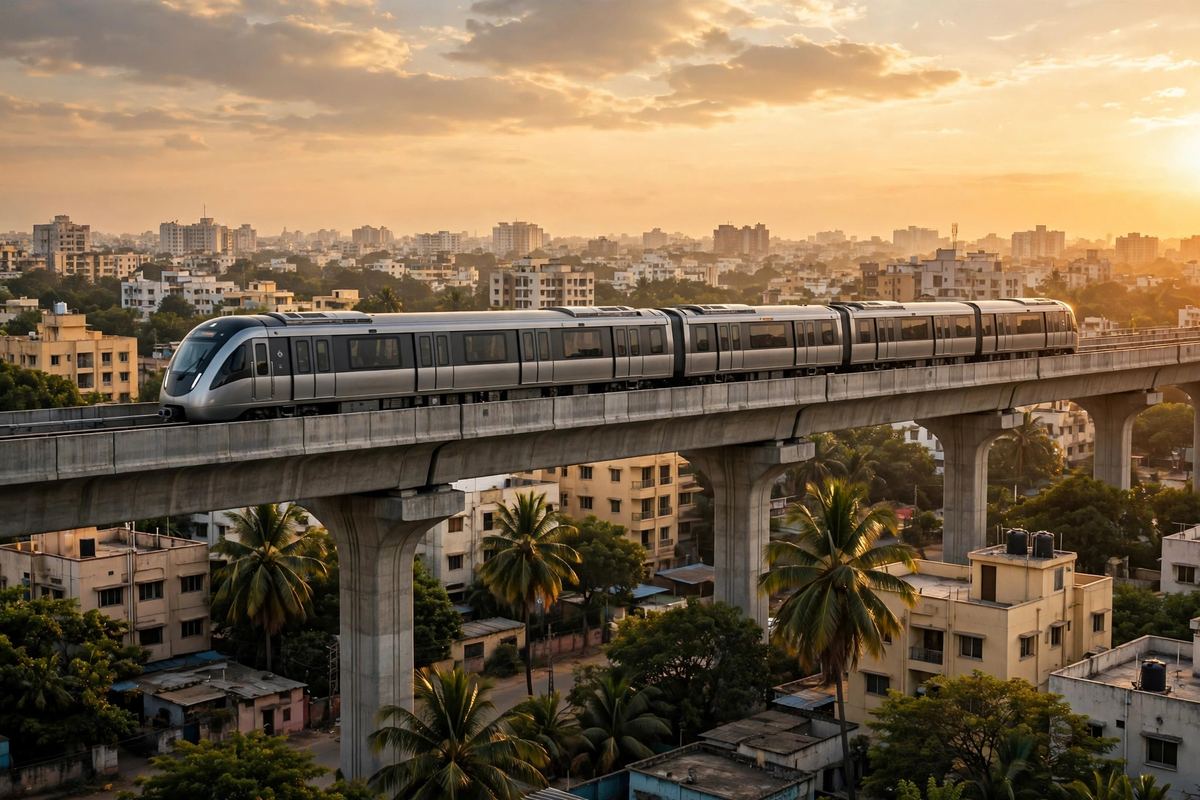
On 11 October 2026, Chennai's rapid-transit map grew in a significant way. Prime Minister Narendra Modi and Tamil Nadu Chief Minister C. Joseph Vijay jointly inaugurated the Poonamallee Bypass–Vadapalani stretch of Chennai Metro Phase II — the first operational segment of Corridor 4, known as the Yellow Line. The roughly 15-km elevated section, built at a cost of about Rs 4,900 crore, adds 11 new stations to the city's metro network and extends fast, air-conditioned rail travel deep into the western suburbs.
The two leaders flagged off services and then travelled on the train together, a symbolic first ride that drew wide public attention. In a moment noted by onlookers, Modi bought his own ticket at the station counter and interacted with the ticket-counter staff before boarding. Tamil Nadu Governor R. V. Arlekar also attended the inauguration ceremony.
Background: Chennai Metro So Far
Chennai Metro Rail began commercial operations in June 2015 with Phase I, a network of about 54 km comprising two corridors: the Blue Line (Wimco Nagar Depot to Chennai International Airport) and the Green Line (Chennai Central to St. Thomas Mount). Together they connect the airport, the central business district, the two main railway terminals and dense residential neighbourhoods, and the system now carries several lakh passengers on a typical weekday.
Phase II is the next, far larger chapter. Sanctioned at roughly 118.9 km, it adds three entirely new corridors to the city's transit map: Corridor 3 from Madhavaram to SIPCOT in Siruseri, Corridor 4 — the Yellow Line — from Lighthouse to Poonamallee Bypass, and Corridor 5 from Madhavaram to Sholinganallur. Portions of the programme are financed with support from international lenders, including the Japan International Cooperation Agency (JICA), and it ranks among the biggest metro rail expansions currently under construction anywhere in India.
The Poonamallee Bypass–Vadapalani section inaugurated on 11 October is the first portion of Corridor 4 to open to the public. It runs west to east along one of Chennai's busiest arterial corridors, linking the fast-growing western suburbs to Vadapalani, a major commercial and transit hub closer to the city core. When the remaining sections of the corridor are completed, the Yellow Line will eventually stretch all the way from Poonamallee Bypass in the west to Lighthouse near the Marina coast in the east.
The Inauguration: What Happened on 11 October
The inauguration ceremony brought the Prime Minister and the Chief Minister together on a shared platform — a notable moment given that metro projects in Indian cities are typically built by the state metro rail company with funding and clearances shared between the Union and state governments. Modi and Vijay flagged off the first services and then rode the train together along part of the new stretch, inspecting the stations and the rolling stock.
Modi's decision to buy a ticket at the counter, rather than simply board as a dignitary, and his conversation with the ticketing staff, became one of the most widely reported details of the day. Such gestures are meant to signal that the metro is a public service for ordinary commuters, and they tend to be closely watched during high-profile infrastructure launches.
Passenger services on the new stretch began at 4 pm on 11 October itself, and regular commercial operations started the next day, 12 October, with trains running from 7 am to 9 pm. The initial service window is shorter than the full-day schedules seen on mature Phase I lines, which is typical for newly opened sections as operations are stabilised and ridership patterns are studied.
In his address at the event, Modi said that India's metro rail networks had expanded from 5 cities in 2014 to 25 cities, presenting the Chennai opening as part of a wider national push for urban mass transit. Large capital projects of this kind — about Rs 4,900 crore for this stretch alone — are also shaped by the broader economic environment, including the cost of borrowing for infrastructure; our explainer on the RBI's 2026 repo rate hike breaks down how interest-rate decisions ripple through investment and public finance.
Why It Matters for Western Chennai
The most direct beneficiaries of the new stretch are the residents of Chennai's western suburbs — Poonamallee, Karayanchavadi, Kumananchavadi, Kattupakkam, Iyappanthangal and Porur. These are fast-growing residential areas whose workers have historically depended on buses, share-autos and private two-wheelers travelling along the chronically congested Mount-Poonamallee High Road. A metro line that bypasses road traffic entirely can cut door-to-door travel times sharply, especially during peak hours.
Porur, in particular, stands out. Porur Junction is one of the busiest commercial intersections in western Chennai, home to hospitals, colleges, IT offices and retail, and it has long been a choke point for traffic. The new Porur Bypass and Porur Junction stations give this hub a high-capacity transit option for the first time, which should ease pressure on the roads around it.
The project also brings rapid-transit connectivity to Avadi — a major residential and industrial suburb northwest of the city, known for the Heavy Vehicles Factory and large defence establishments — for the first time. For thousands of commuters travelling between Avadi and the western and central parts of the city, a metro connection changes the arithmetic of daily travel: predictable journey times, air-conditioned coaches and fares that compete with, or undercut, the cost of fuel and parking.
Major public infrastructure also plays out in the public square. In New Delhi this month, citizens gathered at the October 2026 protest at Jantar Mantar over separate civic concerns — a reminder of how closely Indians watch the decisions that shape their cities, from new metro lines to the policies debated on the streets of the capital.
Beyond individual commutes, the stakes are environmental and economic. Every commuter who shifts from a private vehicle to the metro reduces congestion, fuel consumption and tailpipe emissions on some of Chennai's most overloaded roads. International experience shows that metro lines also reshape land use over time: commercial activity clusters around stations, property values near transit tend to rise, and employers gain access to a wider labour pool. Those effects build slowly, over years rather than weeks, but the first requirement is that the line exists and runs reliably.
Key Facts: Stations, Fares, Timings and Engineering
The 11 stations, in order
All eleven stations on the new stretch are elevated. From west to east, they are:
- Poonamallee Bypass — the western terminus, serving the bypass and the town's western edge.
- Poonamallee Bus Stand — next to the town's bus terminus, enabling easy transfers between buses and the metro.
- Poonamallee Government Hospital — serving the government hospital and the surrounding residential areas.
- Karayanchavadi — a growing suburb along the Mount-Poonamallee High Road corridor.
- Kumananchavadi — serving residential neighbourhoods between Karayanchavadi and Kattupakkam.
- Kattupakkam — a developing residential and institutional zone on the corridor.
- Iyappanthangal — a key stop on the western approach to Porur.
- Thelliyaragaram — serving the locality between Iyappanthangal and Porur.
- Porur Bypass — serving the bypass road that skirts Porur's congested core.
- Porur Junction — at one of western Chennai's busiest commercial intersections.
- Vadapalani — the eastern terminus for now, a major commercial hub with onward connections toward the city.
Fares and timings
- Fares on the new stretch range from Rs 10 to Rs 40, depending on the distance travelled.
- The maximum fare anywhere on the Chennai Metro network is Rs 50.
- Passenger service began at 4 pm on 11 October 2026, the day of inauguration.
- Regular operations started on 12 October 2026, with trains running from 7 am to 9 pm.
The fare structure keeps the metro competitive with bus fares on short hops while remaining far cheaper than app-based cabs or the running cost of a private vehicle — the combination that has driven ridership growth on Phase I lines.
Engineering highlights
Two features of the new stretch have drawn particular attention from engineers. The first is a 3.7-km double-decker structure — a stacked viaduct in which the metro line runs above a road flyover as part of a single integrated structure. Double-decker construction is used where the corridor is too narrow or too congested for a road flyover and a metro viaduct to be built side by side; stacking them saves land, reduces acquisition headaches and keeps both road and rail traffic moving along the same alignment.
The second is the signalling system, which has been designed for driverless operations. Modern communications-based train control allows trains to run under automatic supervision with precise spacing and speed control, and driverless-ready signalling means the corridor can, in principle, operate without a driver in the cab once safety certification and operating procedures are in place. Whether services begin with drivers on board is an operational decision for Chennai Metro Rail, but building the capability in from the start avoids expensive retrofits later.
What Happens Next
The Poonamallee Bypass–Vadapalani section is only the first piece of a much larger programme. The remaining portion of Corridor 4, from Vadapalani eastward to Lighthouse, is still under construction, as are Corridor 3 (Madhavaram–SIPCOT, Siruseri) and Corridor 5 (Madhavaram–Sholinganallur). These sections are expected to open in phases over the coming years, and each opening will multiply the value of the sections already running by adding interchanges and new origin-destination pairs to the network.
For the new stretch itself, the immediate tasks are operational rather than ceremonial: stabilising train frequencies, integrating feeder bus services and last-mile options such as share-autos and e-rickshaws at stations, and monitoring ridership to calibrate the 7 am–9 pm service window. Metro lines rarely run at full potential on day one; ridership typically builds over months as commuters adjust their routines and feeder networks mature.
The longer-term urban impact will depend on how the city plans around the line. Transit-oriented development — denser, mixed-use construction near stations — can turn a metro corridor into an engine of orderly growth, but it requires coordinated planning on zoning, parking and pedestrian access. If Chennai gets that right, the Yellow Line's first 15 km could look, a decade from now, like the modest beginning of a much larger transformation in how the western suburbs move.
Sources
Reporting drawn from The Hindu BusinessLine, Press Trust of India (October 2026).