
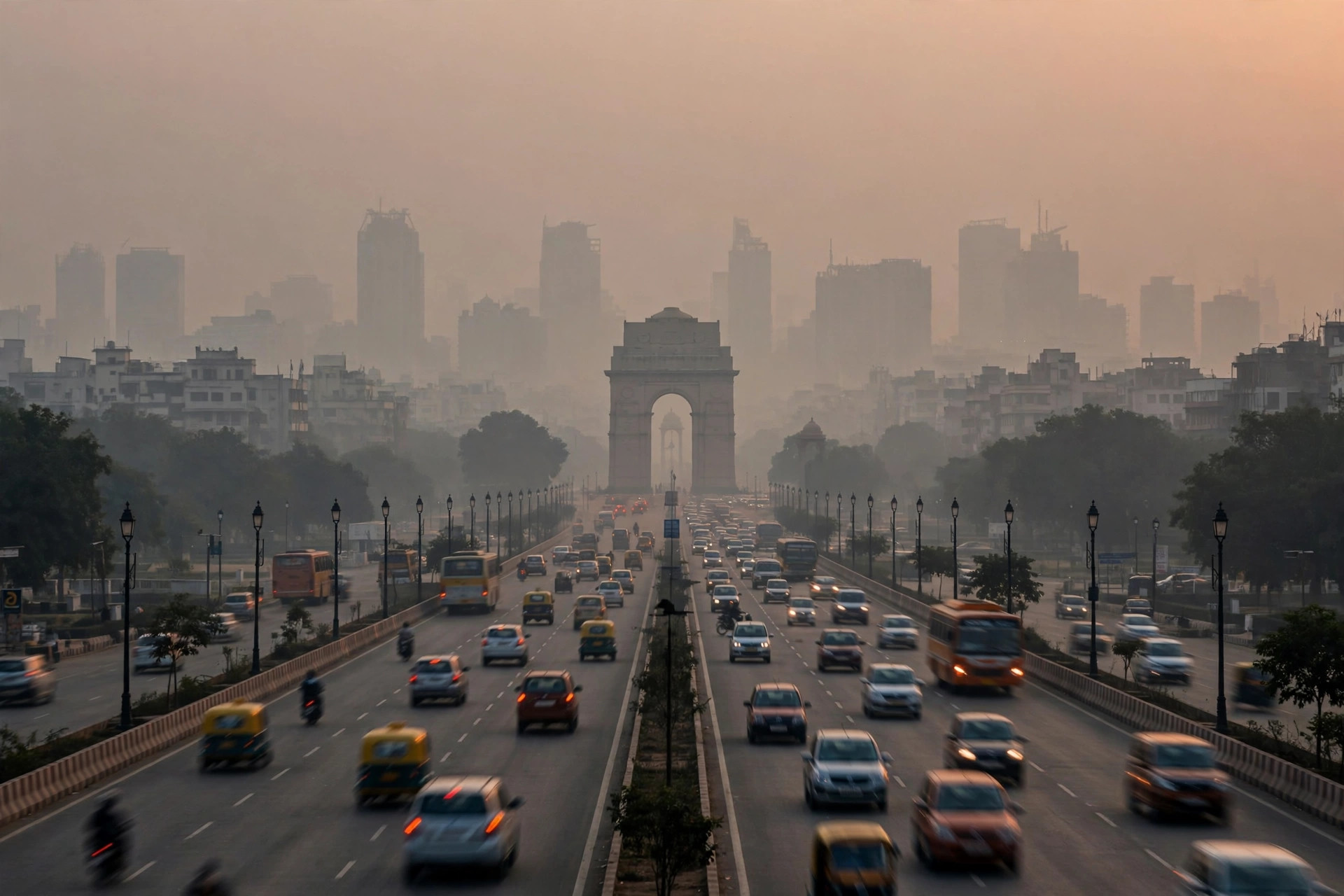
Delhi Winter Action Plan November 1 is the date from which the capital's new winter pollution measures take effect, and it is a date residents, commuters and employers will need to plan around. Announced by Delhi Chief Minister Rekha Gupta on 20 October 2026, the Winter Action Plan will be in force from 1 November 2026 to 28 February 2027. It brings together vehicle controls, fuel checks, work-from-home rules, parking changes and construction restrictions into a single seasonal package. Delhi Winter Action Plan November 1 matters because winter pollution in Delhi is not a surprise event. It returns every year, and the plan is designed to act before the worst period, rather than reacting after air quality has already deteriorated sharply.
Background: Delhi Winter Action Plan November 1 and winter pollution
The background to Delhi Winter Action Plan November 1 is the familiar annual pattern of winter pollution in the capital. As temperatures fall, the air becomes stiller, and pollutants from vehicles, construction dust, burning and other sources linger for longer. The result is a seasonal deterioration that affects daily life, health, travel and work, and that has become one of Delhi's most persistent public challenges. Previous winters have shown that single measures on their own are rarely enough, which is why this plan covers several areas at once. The aim is not to target one source in isolation, but to reduce pressure from traffic, construction and other activities during the months when conditions are least forgiving. That broad approach is also why the plan includes both restrictions and alternatives, such as public transport, last-mile connectivity and carpooling, rather than relying on bans alone.
Understanding the timetable is important, because two different end dates apply to different parts of the plan. The Winter Action Plan as a whole runs from 1 November 2026 to 28 February 2027. Within that wider period, the restriction on non-Delhi vehicles below BS-VI standard entering Delhi applies from 1 November to 31 January 2027. Keeping those two dates distinct avoids confusion for drivers and businesses. A vehicle rule that ends on 31 January is not the same as a winter plan that continues into February, and residents should check which rule applies to their journey before travelling. Delhi Winter Action Plan November 1 therefore marks the start of the full package, even though some individual measures have their own shorter windows inside it.
What happened: Delhi Winter Action Plan November 1 measures announced
What happened when Delhi Winter Action Plan November 1 was announced was the publication of a detailed set of controls covering vehicles, fuel, offices, parking and construction. One of the most talked-about measures is "No PUC, No Fuel". Under this rule, no petrol, diesel, CNG or LPG will be supplied without a valid Pollution Under Control Certificate. Checks will be carried out at 500 pumps with ANPR, or automatic number plate recognition, technology to support enforcement. In practical terms, that means drivers should make sure their PUC certificate is current before they reach a fuel station, because the check is built into the refuelling process rather than left to chance. The measure is designed to push vehicle owners towards regular emission testing, and to make it harder for vehicles without a valid certificate to keep running unchecked through winter.
The vehicle measures go further than fuel checks. Non-Delhi vehicles below BS-VI standard will be barred from entering Delhi from 1 November to 31 January 2027, with exemptions for CNG, LNG and electric vehicles, as well as emergency and essential services. That exemption list matters, because it protects cleaner fuels and essential movement while restricting older, higher-emitting vehicles from outside the city. Alongside the vehicle rules, the plan introduces 50% work-from-home and staggered office timings. Municipal Corporation of Delhi offices will operate from 8:30am to 5pm, while Delhi government offices will operate from 10am to 6:30pm. The staggered pattern is intended to spread peak travel, reduce congestion at rush hour, and lower the number of vehicles on the road at the busiest times. Municipal parking fees will also be doubled, with Delhi Metro Rail Corporation lots exempt, another step aimed at discouraging unnecessary car use. The plan also sits in a wider context of extreme weather and environmental pressure across India, including Cyclone Arnab in the Bay of Bengal and flooding elsewhere, such as southern France floods during Storm Austen, which show why seasonal preparedness matters.
Why it matters: Delhi Winter Action Plan November 1 for health and travel
Why it matters that Delhi Winter Action Plan November 1 covers so many areas at once is that winter air quality affects almost everyone, but not equally. People who commute daily, work outdoors, or live near busy roads and construction sites feel the effects most directly. Children, older people and people with breathing difficulties are also more vulnerable when pollution levels rise. By combining vehicle restrictions, fuel checks, work-from-home rules and construction controls, the plan tries to reduce exposure from several directions at the same time. The work-from-home element, for example, does more than cut one day of commuting. It reduces traffic volume, eases pressure on public transport at peak times, and gives employers a clear framework for planning rotas through winter. The staggered office hours reinforce that effect by preventing every office from starting and finishing at the same time.
The plan also matters because it uses clear triggers for stronger action. The Graded Response Action Plan, known as GRAP, stages trigger at air quality index levels of 300, 400 and 450. Those thresholds give residents a way to understand when conditions are worsening and when additional restrictions may follow. Rather than relying on general warnings, the staged approach links action to measured air quality. That clarity is important for public trust. People are more likely to accept restrictions when they can see the trigger, understand the reason, and know that measures are linked to actual conditions rather than imposed arbitrarily. Delhi Winter Action Plan November 1 therefore matters not only for what it restricts, but for how it explains the link between measured pollution and the response that follows.
Key facts: Delhi Winter Action Plan November 1 at a glance
The key facts for Delhi Winter Action Plan November 1 begin with the dates and the authority behind the plan. Delhi Chief Minister Rekha Gupta announced the plan on 20 October 2026. The full plan runs from 1 November 2026 to 28 February 2027. The ban on non-Delhi vehicles below BS-VI entering Delhi runs from 1 November to 31 January 2027, with exemptions for CNG, LNG and electric vehicles and for emergency and essential services. The "No PUC, No Fuel" rule covers petrol, diesel, CNG and LPG, with checks at 500 pumps using ANPR technology. Work from home is set at 50%, with staggered timings of 8:30am to 5pm for Municipal Corporation of Delhi offices and 10am to 6:30pm for Delhi government offices. Municipal parking fees are doubled, while Delhi Metro Rail Corporation lots are exempt.
Construction controls form another major part of Delhi Winter Action Plan November 1. Construction and demolition activity faces restrictions, with AI-camera monitoring of sites to support enforcement. There is also a complete ban on dust-heavy construction from 10 December to 20 January, covering the heart of the winter period when dust can add significantly to pollution. Alongside restrictions, the plan pushes for cleaner alternatives: more electric buses, greater use of the Metro, improved last-mile connectivity, and carpooling. Those alternatives are essential, because restrictions alone can create hardship if people have no practical way to travel. The GRAP triggers at AQI 300, 400 and 450 complete the framework, providing staged escalation as air quality worsens. Together, these facts show a plan that is detailed, time-bound and multi-layered, rather than a single headline measure.
What happens next: Delhi Winter Action Plan November 1 from 1 November
What happens next after Delhi Winter Action Plan November 1 is the practical start of enforcement and adaptation from 1 November 2026. Drivers should check their PUC status, vehicle standard and fuel type before travelling, especially if they drive a non-Delhi vehicle into the capital. Employers should confirm work-from-home rotas and staggered hours, and commuters should plan around the new office timings and doubled municipal parking fees. Construction firms should review site controls, dust management and the dates of the dust-heavy construction ban from 10 December to 20 January. The first weeks will be a test of how clearly the rules have been communicated and how consistently they are applied at fuel stations, city entry points and construction sites.
Over the full period to 28 February 2027, the key question will be whether the combined measures make a noticeable difference during the worst winter weeks, and how the GRAP stages are used as AQI levels move through 300, 400 and 450. Residents should also watch for updates on public transport, electric buses and last-mile options, because those alternatives determine whether reduced car use is sustainable. Delhi Winter Action Plan November 1 is therefore best understood as a starting point, not a final answer. Its success will depend on preparation before 1 November, consistent enforcement during winter, and honest assessment afterwards of which measures helped most. For now, the message for Delhi is clear: check your PUC, plan your commute, and expect winter travel and work patterns to look different from 1 November onwards.