
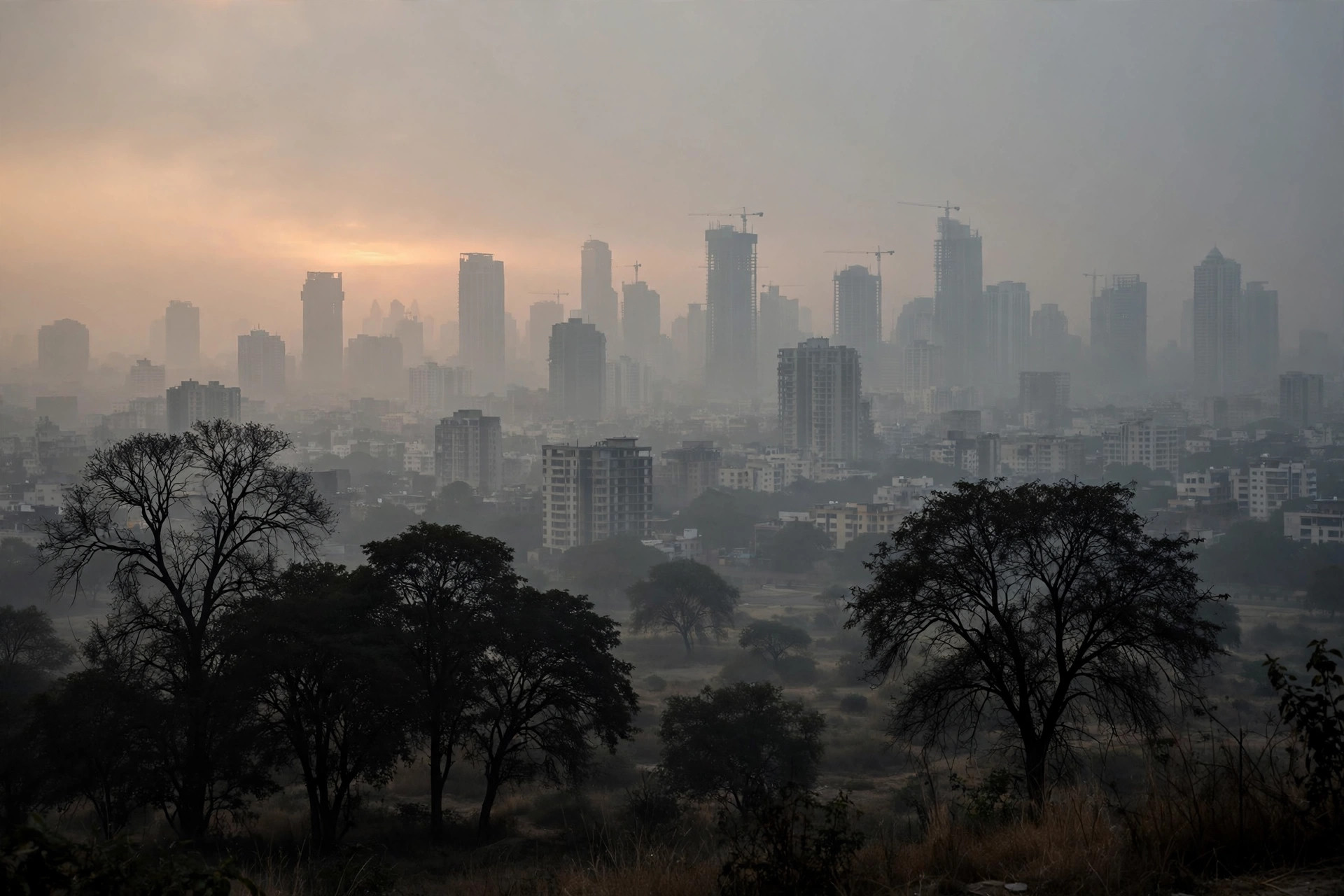
The morning after Diwali, Delhi woke to air it could see. The Delhi AQI after Diwali 2026 stood at 370 at 8 am on Monday 9 November, with the citywide average for Diwali day itself, Sunday 8 November, recorded at 376 by the Central Pollution Control Board (CPCB). Both numbers sit in the "very poor" band, one step below "severe", and the Diwali-day figure is worse than any Diwali-day reading since 2021. Between 14 and 20 of the city's monitoring stations crossed into the severe band on Monday morning, while the Air Quality Early Warning System warned that the air would stay severe or very poor for several days. With the Graded Response Action Plan (GRAP) Stage III already in force since Friday 6 November, the question for Delhi's residents is no longer whether the air is bad. It is how bad, how long it lasts, and what actually helps.
Delhi AQI After Diwali 2026: The Morning-After Readings
The numbers moved hour by hour on Monday morning, which is why different reports quote slightly different figures. The overall citywide AQI was 368 at 7 am, 370 at 8 am and 371 at 10 am on 9 November, according to CPCB data reported by PTI and the Times of India. All three readings fall in the very poor band, which runs from 301 to 400. Beneath that citywide average, the picture was worse. Depending on the hour counted, 14 to 20 monitoring stations recorded severe air, 33 stations recorded very poor air, and four to six recorded poor air. The spread matters because Delhi's air is not uniform: a reading taken near a busy crossing can be far worse than one taken in a leafy neighbourhood at the same hour.
Individual stations told the sharper story. Sonia Vihar recorded 449 in one morning snapshot and 463 in another, while Delhi Technological University recorded 439, the highest station reading in one count. Burari Crossing reached 441 and Vivek Vihar 437. Jahangirpuri recorded 433 in one snapshot and 460 on Sunday evening. ITO stood at 406 at about 4:20 am, already inside the severe band before dawn. Chandni Chowk reached 481 in one snapshot. These figures come from different hours, so they should not be blended into a single ranking. What they share is a direction: across the city, the morning after Diwali was the worst air of the year so far. Fine particulate matter, PM2.5, was the main pollutant at 54 of the 59 stations that reported data, which is the pattern Delhi sees whenever smoke and dust hang in still air.
Delhi AQI After Diwali 2026 in the Five-Year Table
The Delhi AQI after Diwali 2026 headline number, 376, gains its meaning from the years around it. CPCB data gives the following Diwali-day citywide averages: 382 in 2021, 312 in 2022, 218 in 2023, 328 in 2024, 345 in 2025 and 376 in 2026. On that run, 2026 is the highest Diwali-day reading since 2021, and the second-highest of the six years. Only 2021, at 382, was worse. The comparison is festival-day to festival-day, because Diwali moves dates from year to year and the weather on the night matters as much as the fireworks. A Diwali that falls on a windy, wet weekend will read very differently from one that falls on a still, dry night, even if the same number of crackers are burst.
The five-year table also shows how far the air has slipped since 2023, when the Diwali-day average was 218, the lowest of the run. From 218 in 2023 the figure climbed to 328 in 2024, 345 in 2025 and now 376. That is a steady rise over three festivals, not a single bad night. The morning-after readings point the same way: the city did not clear overnight, and the early-warning forecast expects severe or very poor air to persist for several days. For residents, the practical takeaway is simple. This was not a one-evening spike that vanished with the smoke. It was the worst Diwali-day air in five years of readings, and the air that followed it stayed bad through Monday morning.
What GRAP Stage III Actually Bans
The Graded Response Action Plan, known as GRAP, is the emergency rulebook the Commission for Air Quality Management (CAQM) switches on when Delhi's air crosses set thresholds. It was Stage III that governed the Delhi AQI after Diwali 2026 weekend. Stage III came into force across Delhi-NCR on Friday 6 November, two days before Diwali, and it stays in force while the air remains in the severe range. Its measures are concrete. Construction work is halted, with only essential projects allowed to continue. Restrictions apply to certain vehicles entering and moving within the region. Primary schools shift to hybrid learning, with a mix of online and in-person classes, so young children spend less time outdoors in the worst air.
Stage III sits above the milder Stage I and Stage II measures, which cover dust control, mechanical road sweeping and tighter checks on polluting vehicles. It sits below Stage IV, the strictest tier, which adds wider bans on truck entry and on diesel vehicles. The staging matters because each step is tied to the AQI itself: as the air worsens, the restrictions tighten. For most residents, Stage III is felt in three places. Building sites near their homes go quiet. Roads carry fewer of the older, dirtier vehicles. And school runs change, with younger children learning from home on the worst days. The rules do not clean the air by themselves. They slow the fresh pollution going into it while the weather does the rest, or fails to.
Why the Air Stays Bad After the Fireworks Stop
Firecrackers were the spark, not the whole fire. CPCB and the India Meteorological Department point to four drivers working together: firecracker emissions from Diwali night, stubble burning in neighbouring states, vehicle exhaust from Delhi's own traffic, and calm winds with dry weather that trap the mixture close to the ground. When the wind drops and the air turns still, pollution that would normally disperse instead accumulates. That is why the Delhi AQI after Diwali 2026 stayed high through Monday morning, and why the air can stay bad for days after the last cracker has gone off. The smoke needs wind or rain to clear, and neither was forecast in the days after Diwali.
The courts had tried to limit the damage in advance. On 2 November, the Supreme Court allowed only certified green crackers during set hours on 7 and 8 November, and a full firecracker ban was reinstated from Monday 9 November. Green crackers are designed to emit less smoke and particulate matter than conventional ones, but they still add pollution to air that was already poor before the festival began. Stubble burning added a second source from outside the city, and Delhi's own vehicles added a third. Climate change is shifting weather patterns in ways that can make still, dry spells more common, and every source of smoke counts more when the air refuses to move. Cutting personal emissions helps at the margins, and reducing your carbon footprint starts with the daily choices that add smoke to shared air, from vehicle use to open burning.
How to Read the AQI Bands
The CPCB scale runs from 0 to 500, and its bands are worth knowing because the words attached to them carry real health meaning. From 0 to 50 the air is good. From 51 to 100 it is satisfactory. From 101 to 200 it is moderate. From 201 to 300 it is poor. From 301 to 400 it is very poor. From 401 to 500 it is severe. Delhi's Diwali-day average of 376 sat in the very poor band, while the stations that crossed 401 entered severe. At very poor levels, prolonged outdoor exertion can trouble even healthy people, and those with asthma, heart conditions or other breathing problems face a higher risk. At severe levels, the guidance is stricter: the air can affect healthy people too, and outdoor activity should be kept to a minimum.
Two cautions belong here. First, a single station reading is not the city's air. A figure of 481 at Chandni Chowk describes Chandni Chowk at that hour, not the whole of Delhi. Second, private air-quality apps and platforms use their own scales and sensors, and their numbers can look wildly different from CPCB figures. A figure from a private platform is not a CPCB figure, and the two should never be compared as if they were the same measurement. Air quality works the same way in other countries: the number only means something when you know whose scale it sits on and which hour it was taken.
What the Forecast Says Next
The Air Quality Early Warning System, which forecasts Delhi's air several days ahead, expects the air to remain severe or very poor for several days after Diwali. That forecast is the reason GRAP Stage III stays in force rather than being lifted after a single bad morning. Until wind picks up or rain arrives, the pollution already in the air has nowhere to go, and fresh emissions from traffic and stubble burning keep topping it up. Residents following the Delhi AQI after Diwali 2026 should expect the morning readings to stay high and the evenings to stay hazy, with only slow improvement unless the weather changes. Singapore faced a similar stretch of unhealthy air in October 2026, when haze lingered for days and daily life had to adjust around it.
While the air stays bad, the practical steps are unglamorous and they work. Spend as little time outdoors as possible during the worst hours, usually the early morning and late evening, and keep windows shut when the haze is thick outside. If you must go out, wear a well-fitting mask that filters fine particles. Skip the morning run and exercise indoors instead. Children, older people and anyone with asthma or heart trouble should take extra care, and anyone who notices unusual breathlessness or chest discomfort should seek medical advice promptly. Air purifiers help indoors where they are available, but they are no substitute for keeping the smoke out in the first place. The air will clear. The forecast says it will take days, not hours, and Delhi has been here before.