
Chhath Puja 2026 dates are now fixed, and families across Bihar, Jharkhand, eastern Uttar Pradesh and Nepal can plan around them. The four-day festival runs from Friday 13 November to Monday 16 November 2026, about a week after Diwali, whose main day falls on 8 November. The heart of the festival is Sunday 15 November, when devotees stand in river water at sunset and offer arghya, water, to the setting sun. The festival closes on Monday morning with an offering to the rising sun and the breaking of a fast that lasts about 36 hours. This guide sets out each day, the rituals, the timings and what to prepare.
Chhath Puja 2026 dates at a glance
The four days follow the lunar calendar, and the dates for 2026 are confirmed by Drik Panchang. Day one, Nahay Khay, falls on Friday 13 November, on Kartika Shukla Chaturthi. Day two, Kharna, falls on Saturday 14 November, on Panchami. Day three, Sandhya Arghya, the main day, falls on Sunday 15 November, on Shashthi, the sixth day of the waxing moon. Day four, Usha Arghya and Parana, falls on Monday 16 November, on Saptami. The festival takes its name from Shashthi, the sixth day, which is why the Sunday evening offering is the centrepiece of the whole celebration.
One point of timing matters for anyone travelling. The dates are the same across India and Nepal, but the exact moment of sunset and sunrise changes by city. The evening offering follows the local sunset on 15 November, and the morning offering follows the local sunrise on 16 November. A time copied from another city will be wrong for yours, so the timings in this guide are given city by city, and devotees are advised to check their local panchang before heading to the ghat.
Chhath Puja 2026 rituals day by day
Nahay Khay, on Friday 13 November, is a day of cleaning and preparation. Devotees take a ritual bath, often in a river, and clean the home thoroughly. The day's food is a single sattvic meal, traditionally lauki-bhaat, bottle gourd with rice and chana dal, cooked without onion or garlic. The meal sets the tone of purity for the days that follow, and families begin gathering the items for the offerings: bamboo baskets called soop and daura, seasonal fruits, sugarcane, coconuts and thekua, a wheat sweet fried in ghee.
Kharna, on Saturday 14 November, is the day the fast tightens. Devotees fast through the day and, after sunset, prepare kheer made with jaggery, known as rasiya, along with chapatis. The kheer and chapatis are first offered to the deities and then eaten as prasad. Once that meal is finished, the long fast begins: about 36 hours without food or water, known as nirjala, which continues until the morning of 16 November. The kheer of Kharna is remembered by many families as the sweetest meal of the year, precisely because it is the last food before the long wait.
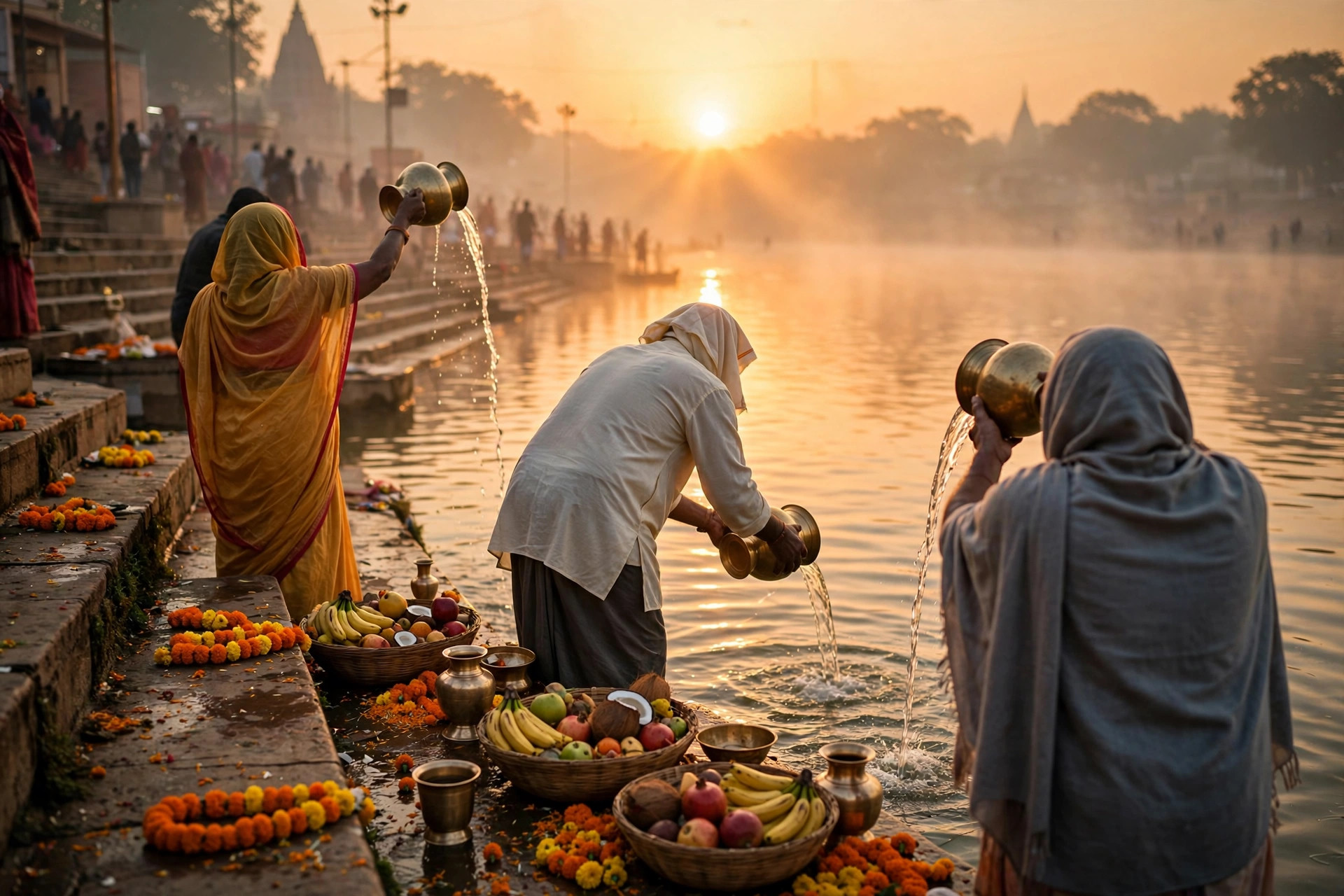
Sandhya Arghya, on Sunday 15 November, is the main day. In the late afternoon, devotees carry the soop to the riverbank or ghat, wade into the water and wait for the sun to set. As the sun touches the horizon, they pour water from a brass lota toward it, offering arghya to the setting sun. The thekua, fruits and sugarcane arranged in the bamboo baskets are part of the offering. Crowds gather at ghats across the region, and the scene, rows of families standing in the river as the light fades, is the image most people associate with Chhath.
Usha Arghya and Parana, on Monday 16 November, close the festival. Before dawn, devotees return to the ghat and offer arghya to the rising sun. After the morning offering, the fast is broken, an act called parana. The remaining prasad, including thekua and fruits, is shared among family and neighbours. For many families, the moment of breaking the fast is quiet and emotional after a night of waiting at the riverbank.
Why Chhath Puja 2026 matters: Surya and Chhathi Maiya
Chhath honours Surya, the sun, and Chhathi Maiya, the goddess associated with the sixth day. The festival is unusual among Hindu observances because it involves no idol worship and no priest is required. Devotees pray directly to the sun, the source of light and life, thanking it for sustaining the world and asking for the health and wellbeing of their families. The two arghya offerings frame the sun's daily journey: gratitude at sunset for the day that has passed, and welcome at sunrise for the day to come.
The fast is central to the festival's meaning. A nirjala fast of about 36 hours, without food or water, is one of the most demanding observances in the Hindu calendar. It is usually undertaken by women for the long life and health of their children and families, though men also observe it. The discipline of the fast, combined with the simplicity of the rituals, gives Chhath its reputation as a festival of devotion and endurance rather than display. There are no grand processions and no expensive decorations; the offering is water, fruit and a sweet made by hand.
The festival is also a homecoming. People who work in Delhi, Mumbai, Kolkata and other cities travel back to Bihar, Jharkhand and eastern Uttar Pradesh for Chhath, and the ghats fill with families who may only gather once a year. In Nepal, the festival is a public holiday, and the ghats of Kathmandu and the Terai draw large crowds. That sense of return is part of why the festival has grown in visibility in recent years, even as its rituals have stayed the same. It is a reminder of how festivals shape cultural identity in ways that go beyond ritual.
Chhath Puja 2026 dates and arghya timings by city
Arghya follows the sun, so the time differs from city to city. In Patna, the evening offering on Sunday 15 November is around sunset at about 5:01 to 5:02 PM, and the morning offering on Monday 16 November is around sunrise at about 6:05 to 6:07 AM. Patna has 91 ghats along the Ganga, and the city's riverfront is the most famous place to witness the festival, with crowds gathering from the afternoon onwards.
In New Delhi, the sunset on 15 November is about 5:28 PM and the sunrise on 16 November is about 6:44 AM. Delhi's Yamuna ghats and the many temporary ponds set up across the city host large gatherings, and local authorities usually arrange extra facilities for the crowds. In Kathmandu, Nepal, the evening offering is about 5:11 to 5:13 PM on 15 November and the morning offering is about 6:24 AM on 16 November, according to Access Nepal Tour. Devotees in other cities should confirm their own sunset and sunrise times against a local panchang, since even nearby towns can differ by several minutes.
What to know before you go to the ghat
Preparation makes the festival easier. The soop should be packed the day before, with thekua, seasonal fruits, sugarcane, coconuts and a brass lota for the water offering. Families usually carry a change of clothes, since devotees stand in the river. Those observing the fast should be careful with the 36-hour nirjala period, especially older people and anyone with a health condition, and should break the fast if they feel unwell. Children and elderly relatives should be watched closely at crowded ghats, and festival crowds in India have made headlines this season for other reasons too, including a stampede at a Durga Puja venue in Kolkata, and it is wise to arrive early, since the popular ghats fill up well before sunset.
Respect for the setting matters too. The ghats are places of prayer, and the offerings are sacred to the families making them. Visitors who come to watch should keep a distance, avoid stepping into the water where devotees are standing, and ask before taking photographs. Many cities set up temporary ponds and artificial ghats to ease crowding on the main riverbanks, and these are often a calmer option for first-time visitors. With the dates now set, 13 to 16 November, the practical work is simple: check the local timings, prepare the soop, and reach the ghat in good time for the sun.
Sources: Drik Panchang via hindutone.com, Vedantu, PunyaPaths, Access Nepal Tour, November 2026