
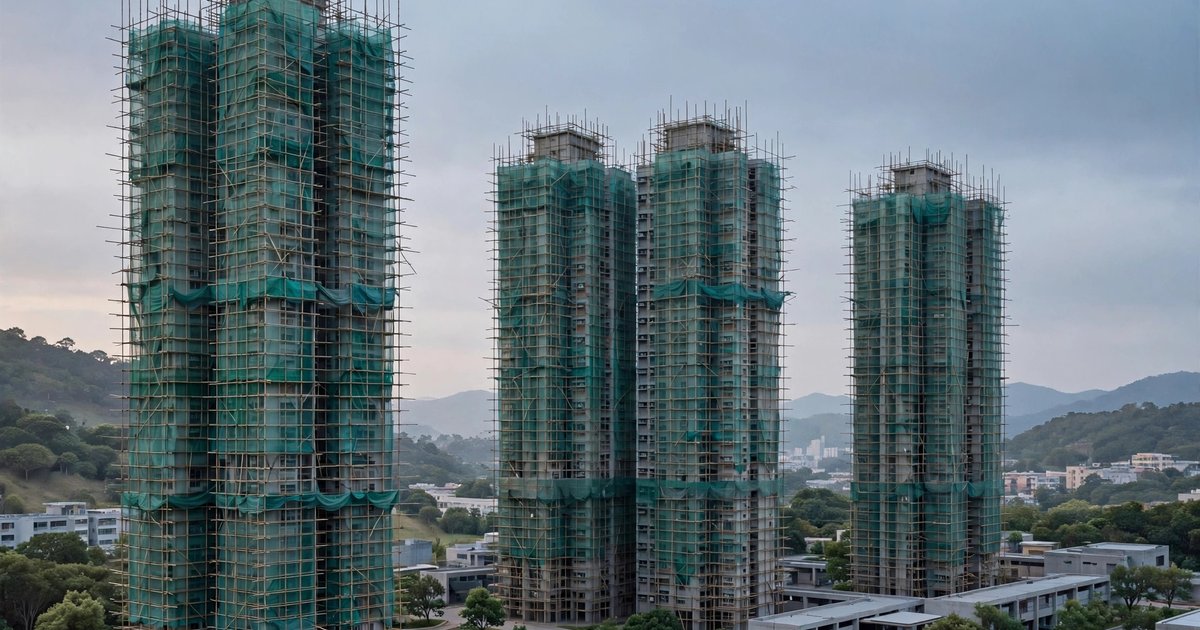
The Wang Fuk Court fire inquiry reached its public reckoning on Thursday 29 October 2026, when Hong Kong leader John Lee apologised for the fire that killed 168 people and announced that Housing Secretary Winnie Ho had resigned. The Wang Fuk Court fire inquiry, led by a judge, found that government oversight of renovation work at the Tai Po housing estate had failed in ways it described as systemic and pervasive. The story is trending per news coverage from the Associated Press, Reuters, Bloomberg and Hong Kong outlets, because the report names the people and departments held responsible, sets out 120 recommendations, and is the first time a senior official has resigned over the disaster.
Lee opened a news conference by bowing alongside seven other senior officials. “On behalf of the SAR government, I offer my apologies to the victims and the public at large,” he said. He said Ho had resigned on Wednesday 28 October and should bear political responsibility, although the inquiry had found no personal wrongdoing by her. Ho was the first official to resign over the fire, which broke out on 26 November 2025 and became Hong Kong’s deadliest fire since 1948.
Wang Fuk Court is a government-subsidised housing estate in Tai Po, in Hong Kong’s northern suburbs. Seven 31-storey towers were engulfed while the estate was undergoing large-scale maintenance work. More than 4,600 residents were left without homes. Families had spent almost a year waiting for answers about how a renovation project could end in such loss of life, and about who would be held accountable.
What the Wang Fuk Court fire inquiry found
The independent committee was appointed by the government and led by a judge. It examined more than a million files and heard testimony from 80 witnesses at hearings held between March and July, with more than 30 hearings in total. It submitted its report to Lee last week. The report made 120 recommendations, including steps to tackle collusive tendering, also known as bid-rigging, in the building maintenance industry.
Its central finding was stark. No government department had taken effective ownership of the fire safety issues at Wang Fuk Court, and complaints about potential hazards fell into a vacuum. Residents had raised safety concerns about the renovation work for more than a year before the fire, the report found, and those concerns went unheeded. The failings, in the committee’s words, were “systemic and pervasive.”
The report listed six core failures: over-reliance on the integrity of building professionals; failing to design supervision around the risk of fire at building maintenance and renovation sites; inadequate control of temporary materials such as scaffolding nets, canvas, foam boards and toe-boards; poor complaint handling; slack operational enforcement; and poor coordination between the Buildings Department and the Housing Bureau’s independent checking unit, including the Buildings Department’s failure to audit that unit.
The committee concluded that the fire was most likely started by a “glowing source — likely a cigarette.” A small spark became a catastrophe, the report’s account makes clear, because of what surrounded it: flammable materials on a scaffolded estate, oversight that existed on paper but not in practice, and a system in which responsibility was shared so widely that, in the end, it belonged to no one.
Why the Wang Fuk Court fire inquiry blamed four government bodies
Four government bodies were held partly responsible. The Housing Bureau was said to bear a greater share of responsibility than the others, because its independent checking unit had failed in its duty to supervise the maintenance work properly. According to reports of the announcement, that unit will be disbanded and replaced by a dedicated public housing control unit overseeing both rental and subsidised home-ownership developments.
The Buildings Department, the Fire Services Department and the Labour Department were also held partly responsible. The report found that the Fire Services Department had failed in its supervisory duty to assess and remove fire hazards at Wang Fuk Court and to supervise shutdowns of fire service installations. Despite 26 visits, fire crews never inspected escape staircases and never detected access openings, and complaints about foam boards, smoking and blocked escapes were met with referrals and what the report described as “merry-go-round” replies rather than effective action.
The Labour Department was criticised for four operational failures covering smoking on site, foam-board fire hazards, verifying the fire-retardancy of nets, and access openings. After 16 visits, smoking complaints were marked “not justified,” a finding the committee said was “simply contrary to the reality” shown by residents’ photographs, videos and WhatsApp messages. Compared with the other departments, the Labour Department should bear lesser responsibility, the committee said, but it still criticised a “just-following-the-books” attitude and departments that “passed the ball” until hazards fell through the cracks.
The report also described widespread unlawful and questionable practices in the construction industry, including bid-rigging involving parties linked to organised crime gangs. It said there were strong indications that people with dubious or triad backgrounds were active in the building maintenance and repair industry, and that there had been practically no control or supervision over the actual execution of the works. The renovation contract was worth more than HK$300 million, and authorities have alleged that the companies involved conspired to defraud apartment owners by concealing previous litigation records of the company later awarded the project.
Who was Winnie Ho, and why did she resign?
Winnie Ho Wing-yin was appointed Secretary for Housing on 1 July 2022, as part of John Lee’s administration. She had joined the government in 1992 as an architect, rising to Chief Architect in 2009, Government Architect in 2012, Deputy Director of Architectural Services in 2018 and Director of Architectural Services in 2020, according to her government profile.
Lee was explicit that Ho’s resignation was about political responsibility, not personal misconduct. “Although the fire did not involve any personal wrongdoing by the secretary for housing, the secretary for housing should bear political responsibility,” he told reporters. Ho later issued a statement echoing those remarks. The Housing Bureau’s independent checking unit sat within her area of responsibility, and the inquiry found that it had not properly supervised the maintenance project at Wang Fuk Court.
Deputy Financial Secretary Michael Wong is set to take on the housing portfolio as well, according to Hong Kong reporting of the announcement. Lee also said the government had set up an independent team to investigate which officials should be held accountable and to outline disciplinary action, and that a second-level probe under the departmental-head responsibility system was due to begin. Political accountability, administrative accountability and criminal inquiries are being pursued as three separate tracks.
What caused the fire to spread so fast?
The inquiry placed primary responsibility on the contractor and the project consultant, not only on government departments. It found that Prestige Construction & Engineering and consultancy firm Will Power Architects were fully aware of the fire risks but ignored repeated complaints and safety concerns raised by residents during the maintenance works. The committee said they had put the lives of all residents at serious risk, apparently with a view to maximising their financial gains, and that their conduct went far beyond oversight or negligence.
Both firms used substandard building materials and unsafe working procedures, the report found, including non-fire-retardant scaffolding nets and flammable foam boards covering building windows. They should also be held responsible for fire service installations that did not function properly on the day of the fire. Management figures named in the report included Hau Wa-kin and Gordon Ho at Prestige and Jason Wong at Will Power, together with registered inspector Wilson Ng, who was employed by Will Power to oversee the renovation project. The committee said they deserved “the most severe criticisms.”
Other firms were named for varying degrees of culpability. Gain Profit Shed Industry was said to have been aware of, and to have taken part in, a plot to temporarily replace non-fire-retardant scaffolding nets with fire-retardant ones just for site inspections by authorities. ISS EastPoint Properties, the estate’s former manager, was criticised for allowing unqualified staff to switch off power to fire alarm systems. Victory Fire Engineering, the registered fire services contractor, was criticised for passivity on safety issues, and China Status Development and Engineering Company was described as a “dummy” contractor filing paperwork to satisfy regulators.
Together, those findings explain the speed of the disaster. Flammable nets and foam boards, windows covered during works, fire installations that did not work as they should, and escape routes that had not been properly checked created conditions in which a fire most likely started by a small glowing source could spread through tower after tower before residents could get out.
What happens next: 120 recommendations and criminal cases
The government plans to criminalise bid-rigging across the construction industry, with proposed penalties of up to HK$10 million in fines and 10 years’ imprisonment. Chief Secretary Eric Chan will lead a steering committee overseeing the reforms advocated in the report. The inquiry’s 120 recommendations also cover construction-material standards, supervision of maintenance works, complaint handling and measures against bid-rigging.
The committee’s work is separate from criminal investigations. At least 25 criminal charges related to the disaster have been brought against the two companies and seven individuals, including manslaughter, conspiracy to defraud, money laundering and tax evasion. Those cases will test in court the allegations that the inquiry examined from a regulatory and accountability standpoint.
For the displaced residents, the questions that remain are practical as well as legal: where they will ultimately live, how the estate will be made safe, and whether the reforms promised this week will be carried out in full. The report’s conclusion, as reported, was that “the fire has been put out, but the reform has only just begun.” Whether that reform satisfies the families will depend less on the apology than on the disciplinary process, the criminal cases still moving through the courts, and the rebuilding of homes at Wang Fuk Court.
Worldlession has also covered other recent building-safety and emergency cases separately, including a building collapse in Nairobi where rescue and accountability questions followed the disaster and a fire emergency at the Savannah River Site. Neither is connected to Wang Fuk Court; both show how quickly questions about supervision, warnings and responsibility follow a major incident.
Sources: Associated Press reporting on John Lee’s apology, Winnie Ho’s resignation and the inquiry’s findings on the Housing Bureau’s independent checking unit; Reuters and Bloomberg reporting, via BusinessWorld and BusinessMirror, on the apology, the resignation, the 168 deaths, the judge-led committee and the planned bid-rigging law; HK Businesswire and Dimsum Daily reporting on the inquiry’s findings on Prestige Construction & Engineering, Will Power Architects, the registered inspector, the six core failures and the four government bodies; and Hong Kong reporting on the 120 recommendations, the hearings and witness evidence, and Michael Wong taking on the housing portfolio. Where reports differed on the length of the inquiry report, this article does not rely on a single page count.