
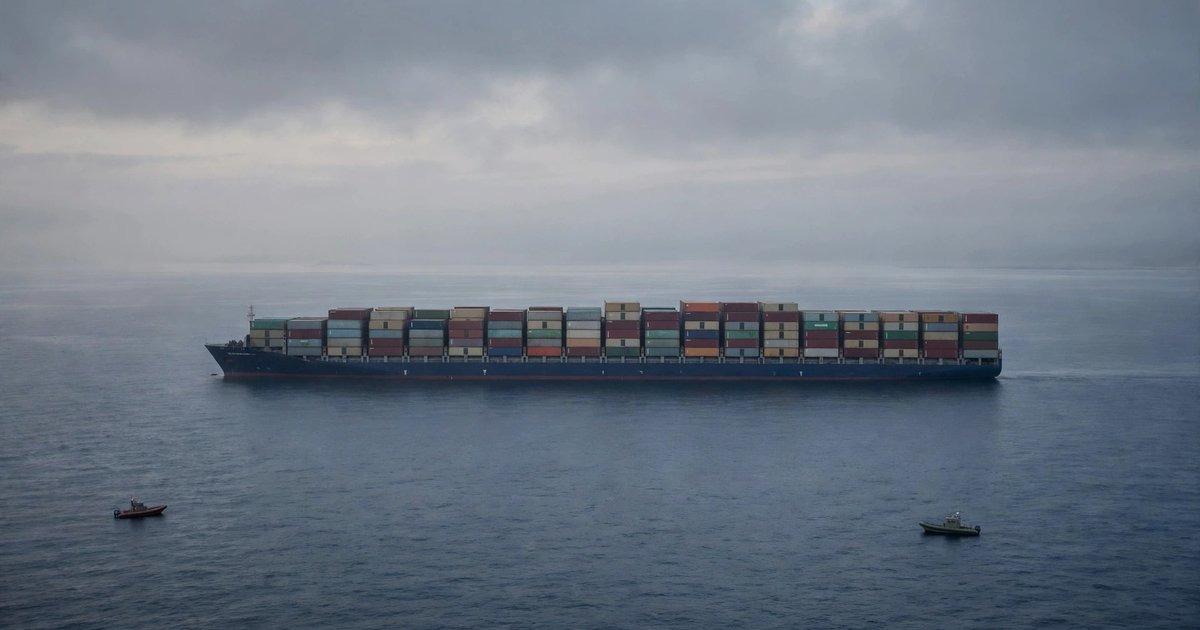
The Black Sea drone attack on the container ship Contship Jet on 28 October 2026 ended with all 18 crew members rescued, even though the vessel itself did not survive. Three sea drones struck the Liberian-flagged ship around noon local time, about 21 nautical miles south-east of Shabla, near Cape Kaliakra in north-eastern Bulgaria, while it was sailing from Haifa in Israel to Constanţa in Romania with 421 containers on board. The crew abandoned the damaged vessel, which was listing heavily after a fire started on board, and Bulgarian naval and border-police vessels took all 18 sailors — 14 Filipinos and four Ukrainians — to Varna. None was injured, according to Bulgarian National Radio. Bulgarian authorities confirmed on the morning of 29 October that the ship sank around midnight. Who carried out the attack has not been established.
What happened in the Black Sea drone attack?
Bulgaria’s Defence Minister, Dimitar Stoyanov, told reporters that three naval drones hit the Contship Jet in Bulgaria’s exclusive economic zone. The first strike came at about noon, followed by two more strikes, according to Rear Admiral Kiril Mihaylov, commander of the Bulgarian Naval Forces. A French maritime patrol aircraft operating over the western Black Sea detected the approaching drones, warned ships in the area over Channel 16 and passed the information to Bulgarian forces. Mihaylov credited the warning with helping the crew to abandon ship in time. The Bulgarian Navy said its vessels evacuated eight seafarers directly and found ten more in the ship’s lifeboat; all 18 were in good condition. The Defence Ministry said the rescue was complete by 1:45 p.m. local time.
The Contship Jet was a Greek-owned container ship sailing under the Liberian flag, managed by Contships Management and operating a route for the charterer ZIM, which confirmed the attack and the evacuation. It was carrying 421 containers. What those containers held has not been confirmed: the Associated Press reported that it was not immediately clear what the containers were carrying, and later reports differed over whether containers that fell overboard held flammable or hazardous material. That uncertainty matters, because at least 20 containers went overboard and navigation warnings were issued for drifting containers in the area. Yavor Dimitrov, director of the Black Sea Basin Directorate, denied reports that hazardous substances had been found in the containers and said seawater samples would be taken off Cape Kaliakra. The regional governor of Varna, Mario Smarkov, declined to comment on fallen containers or environmental risk until inspections had been carried out.
On the evening of 28 October, the vessel was still afloat and drifting southwards, according to Bulgarian reports, with a heavy list after three impacts and a fire. By the following morning the position had changed. Maritime trade publication Splash247 reported that Bulgarian authorities confirmed that morning that the ship sank around midnight east of Varna, after the damage proved too extensive for the vessel to be stabilised. Bulgarian maritime reports carried the same account, citing the regional administration. The sinking did not change the human outcome — the crew had already been rescued — but it turned a damaged-ship incident into a wreck and cargo-recovery operation, with drifting containers to be tracked and, where possible, recovered.
Why the Black Sea drone attack matters for shipping
The location explains part of the political sensitivity. The attack took place in Bulgaria’s exclusive economic zone, outside its territorial waters. In an exclusive economic zone, a coastal state has rights over natural resources and certain activities, but foreign ships retain freedom of navigation, and the zone is not sovereign territory in the way territorial waters are. Bulgaria’s Chief of Defense has said the country may engage threats only within its territorial waters, and that the drones in this incident did not enter those waters. That distinction does not make attacks on merchant ships lawful — the three ministers meeting in Sofia condemned them — but it shapes what a coastal state says it can and cannot do on its own, and why Bulgaria has asked NATO allies for help with surveillance and air defence.
For shipping, the immediate question is risk rather than blame. The western Black Sea carries commercial traffic between Black Sea ports and the wider world, and a series of attacks in a few weeks forces shipowners, charterers and insurers to weigh route choices, crew safety and the cost of disruption against the need to keep goods moving. A single drifting wreck or a field of drifting containers can also close or complicate a stretch of sea for other vessels until it is surveyed and cleared. None of that requires a confirmed attacker to matter: the pattern itself changes how crews and companies plan voyages through these waters, and it is why the ministers’ joint statement focused on surveillance, early warning and information sharing as much as on condemnation.
Who is blamed — and what is still unproven
No government or armed group has publicly presented evidence identifying who launched the three drones that hit the Contship Jet, and the Bulgarian naval commander said the drones’ origin was unknown. That has not stopped wider blame. Ukraine has blamed Russia for earlier attacks on commercial vessels in the region, while Moscow has denied involvement, according to Reuters. Bulgarian Prime Minister Rumen Radev told parliament earlier in October that the logic of the attacks pointed in Russia’s direction, while adding that Bulgaria could not prove it. A Bulgarian shipping agency owner told Bulgarian National Radio that the drones were Russian — one commercial view, not an official finding. Readers should keep those positions separate: a political assessment, a denial and a single businessman’s claim are not the same as evidence about this strike.
Separately, Russia’s Defence Ministry claimed on 28 October that its drones had struck an unidentified dry cargo vessel heading towards Chornomorsk, alleging it was carrying supplies for Ukrainian forces, and announced another attack the following morning on a cargo ship bound for Odesa. Splash247 reported that neither claim had been independently verified and that Russia had provided no vessel identities. Those claims therefore cannot be treated as confirmation about the Contship Jet, whose identity, position and rescue are documented by Bulgarian authorities and the ship’s managers. Until investigators publish findings, the honest position is that responsibility for this attack remains unproven.
A pattern of Black Sea drone attacks in October 2026
The Contship Jet was not the first merchant vessel hit in these waters in October 2026. Earlier in the month, Black Sea drone strikes sank a cargo ship off Bulgaria, with 11 sailors reported missing. In a separate incident, two tankers caught fire in Romanian Black Sea waters, with sailors missing. NATO’s response included patrol aircraft and drones sent to the Black Sea after the deadly shipping attacks. The pattern, rather than any single strike, is what prompted Bulgaria to seek allied help.
Counts of the October attacks differ because they cover different areas and periods, and they should not be added together. Reuters reported that at least six merchant vessels had been attacked off Bulgaria in recent weeks, and that government statements indicated that around two dozen international seafarers had likely been killed or remained missing in related incidents. The Associated Press, reporting the Contship Jet rescue, put the toll in the exclusive economic zones of Bulgaria and Romania this month at two people dead and at least 25 others missing. Prime Minister Radev, speaking more widely, said eight commercial vessels had been struck or caught in drone-related incidents off Romania and Bulgaria between 5 and 23 October. The shared point across all three counts is the same: this was one incident in a sustained series, not an isolated accident.
Bulgaria had already acted before the Contship Jet attack. On 16 October, Reuters reported that Bulgaria had formally asked NATO to deploy combat aircraft and anti-drone systems after the series of attacks, and that Sofia had proposed a moratorium on attacks on civilian ships in the Black Sea. NATO Secretary General Mark Rutte met the Bulgarian prime minister and the Romanian president and said NATO would continue to work closely with allies in the Black Sea, adjusting deterrence and defence as needed. The Contship Jet attack, on the day the three Black Sea neighbours met, tested whether that coordination was working — and the rescue, at least, showed Bulgarian, French and allied surveillance and naval assets combining in time to save the crew.
What the three NATO allies agreed in Sofia
The timing of the attack was striking. As the Contship Jet was being hit, the defence ministers of Bulgaria, Romania and Turkey were meeting in Sofia to discuss Black Sea security. After the talks, the three NATO allies condemned the attacks on commercial vessels, called for an immediate halt to attacks threatening commercial ships, maritime infrastructure and the safety of maritime activities, and agreed to strengthen information sharing, maritime situational awareness and early-warning capabilities. They also reaffirmed an existing Black Sea mine-countermeasures initiative involving the three countries, a reminder that drifting mines remain a separate hazard for civilian shipping in these waters.
Turkey’s defence minister, Yaşar Güler, stressed that Turkey had implemented the Montreux Convention governing warship passage through the Turkish Straits since the start of the war, and confirmed that the current arrangements would remain in place. Romania’s defence ministry said the ministers had discussed closer intelligence sharing, improved maritime surveillance and better coordination between their naval forces. France’s contribution was already visible in the rescue itself: Reuters reported that France had moved an Atlantique 2 maritime patrol aircraft to an air base in Romania on 18 October to conduct surveillance missions until 6 November, and it was a French patrol aircraft that first detected the drones approaching the Contship Jet.
What happens next after the Contship Jet sinking
Three questions now decide what this incident becomes. First, what do Bulgarian inspections and seawater sampling find about the fallen containers and any environmental risk? Second, does any investigation publish evidence about where the drones came from and how they reached a ship in Bulgaria’s exclusive economic zone? Third, do the Sofia commitments turn into visible surveillance and protection for the next merchant ship on the same route? Until those questions are answered, the Contship Jet story rests on what is documented: three strikes, a fire, a heavy list, 18 people rescued without injury, a ship lost around midnight, and a pattern of attacks that three NATO allies have now publicly promised to confront together.
For crews sailing the western Black Sea, that promise will be judged by the next voyage, not by the statement. For everyone else following the story, the distinction to hold onto is between what happened — documented by Bulgarian authorities, the ship’s managers and the rescued crew’s safe arrival in Varna — and what is still claimed without proof. The Black Sea drone attack on the Contship Jet is a confirmed rescue and a confirmed sinking; the identity of the attacker is not yet confirmed, and it should not be reported as if it were.
Sources: Associated Press and Reuters reporting on the drone attack on the Contship Jet off Bulgaria on 28 October 2026 and on the rescue of its 18 crew members; Bulgarian National Radio (BNR) reporting on the rescue, the crew’s arrival in Varna and the naval commander’s statement that the drones’ origin was unknown; Maritime Executive and Splash247 reporting on the attack, the listing vessel and Bulgarian authorities’ confirmation on 29 October that the ship sank around midnight; Novinite and Bulgarian maritime reporting on the rescue timeline and drifting containers; Shipping Telegraph and Romanian Defence Ministry reporting on the Sofia trilateral meeting of Bulgaria, Romania and Turkey; Reuters reporting on 16 October on Bulgaria’s request to NATO.