
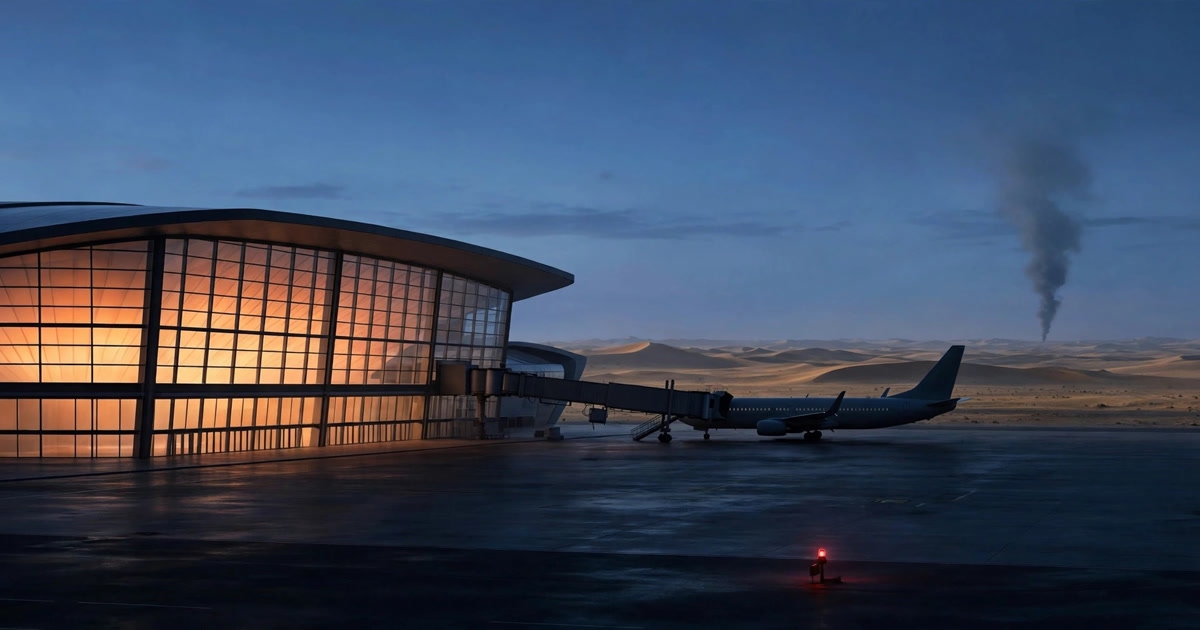
Two people were killed and eight others were injured in a strike on King Fahd International Airport in Dammam, Saudi Arabia, on Wednesday evening, the kingdom's civil aviation authority confirmed on Thursday — the latest deadly attack in a rapidly escalating campaign against Saudi airports and energy infrastructure that has now pushed the United States to pull its diplomats out of the kingdom.
Saudi Arabia's General Authority of Civil Aviation (GACA) announced the casualties in a statement posted on X, saying the airport was targeted on the evening of Wednesday, October 21. According to the authority, the attack claimed the lives of two people — a Saudi citizen and an Indian resident — while the eight injured — whose conditions ranged from minor to critical — were taken to hospital for treatment. GACA initially reported one death and confirmed the second the following day. The injured were one Saudi, two Indian residents, two Yemeni residents, two Bangladeshi residents and one Nepalese resident, according to Reuters. GACA said airport operations had resumed and air traffic had returned to normal. GACA said the attack also caused damage to airport property and that the full extent was still being assessed, promising further updates. Flight-tracking service Flightradar24 reported that aircraft were being diverted away from the airport after the incident.
In a separate incident on the same day, Saudi Arabia's Energy Ministry said air defences intercepted a drone attempting to strike a facility at the Shaybah oil field in the country's southeast, near the border with the United Arab Emirates. Falling debris from the interception struck a contractor's vehicle outside the facility's perimeter, setting it on fire. The ministry said two people — a Filipino national and a Nepali national — were killed, and two others — a Pakistani national and an Indian national — were injured. Operations at the field were unaffected, according to the ministry, which did not identify who had launched the drone. The statement was posted on the ministry's official X account.
The two attacks came hours after Washington took its most urgent step yet in response to the deteriorating security situation. The US State Department on Wednesday ordered the departure of non-emergency US government employees and their family members from Saudi Arabia, State Department spokesperson Tommy Pigott said in a post on X, citing growing Houthi attacks on civilian airports and other critical infrastructure that have caused 'civilian casualties and severe travel disruptions'. US officials told Reuters that family members would also be withdrawn from a number of other US missions in the region, although Pigott publicly framed the order as applying to Saudi Arabia only. Washington had returned some diplomatic personnel to the region in recent months after many were pulled out when Tehran launched attacks on US facilities following the start of the US-Israeli war on Iran in late February.
Energy markets reacted immediately. Oil prices rose on Thursday, with Brent crude futures climbing $1.29, or 1.2 percent, to $110.11 a barrel at 00:34 GMT, while US West Texas Intermediate gained 97 cents to $98.12, Reuters reported. The moves extend a brutal year for crude: Brent has surged dramatically amid disruptions to Persian Gulf oil flows, and Kpler data shows at least 18 attacks on shipping over the past two weeks. LSEG analysts have warned that Iran is now targeting tankers well beyond the Strait of Hormuz, reaching into the Gulf of Oman and jeopardising Gulf crude loadings and the ship-to-ship transfers that support regional loadings.
The Dammam strike continues a pattern of attacks that has made October the deadliest month for Saudi aviation infrastructure in over a decade. On October 10, strikes on Riyadh's King Khalid International Airport killed around a dozen people and injured more than 300 — the deadliest attack on the kingdom in a decade — and a follow-up strike there the next day killed one more person. Riyadh's airport reopened for domestic flights on Wednesday, but major carriers including Lufthansa and Air France have cancelled service through mid-November. The House of Saud reported earlier strikes on Dammam's airport on October 11 and October 20, while last month debris from an intercepted Houthi drone killed a Yemeni resident of Saudi Arabia — the first civilian casualty since the Houthis increased their attacks, according to AP. Earlier this month, a limited fire broke out in an administrative building at Aramco's Eastern Province facilities.
Yemen's Houthi movement claimed the Dammam strike as part of four missile and drone attacks against Saudi Arabia over the past 48 hours, its military spokesman Yahya Sarea said on Thursday, also claiming strikes on Abha airport, the Defence Ministry in Riyadh and Aramco facilities in Yanbu. Saudi authorities did not confirm every claimed operation, and did not identify the perpetrators in their initial statement on the Dammam incident. Yemen's Iran-aligned Houthis have been behind the wider October campaign against Saudi airports, energy sites and shipping — including the Kuwait-flagged tanker M/T Al Dasma, which was hit by an unidentified projectile in the Strait of Hormuz on October 21 with 21 Indian seafarers aboard, all safe. The fighting in Yemen has opened a new front in the regional conflict that began with the US-Israeli war on Iran in late February, breaking a four-year truce. LINKHORMUZ On the same day as the Saudi attacks, Iranian media reported explosions in Sirik in southern Iran, with the nature and origin unknown; Iran's Foreign Minister Abbas Araqchi told the Financial Times that Iran was fully prepared to defend itself, while President Masoud Pezeshkian said the US could not expect dialogue while blockading and threatening Iran.
Analysts say the convergence of the airport killings, the Shaybah deaths and the US departure order marks a dangerous new phase. Saudi Arabia has responded to Houthi attacks with strikes on missile launcher sites and says it has intercepted many ballistic missiles fired by the group, while the United States has weighed direct action and Britain has sent RAF Typhoons to fly defensive missions over the kingdom. For travellers, the immediate fallout is severe: repeated airport strikes, diverted flights, cancelled international service and a US government officially telling its own people to leave. IndiGo extended its Riyadh flight cancellations to 31 October and suspended its Jeddah, Dammam and Madinah routes to 27 October, with Akasa Air taking similar steps. For energy markets, the risk premium embedded in a $110 Brent barrel shows little sign of fading while attacks on Gulf infrastructure continue.
What is certain is that the casualty figures — two killed and eight hurt in Dammam, two killed and two hurt at Shaybah — come from official Saudi statements, not independent verification, and the full picture of who launched the attacks and with what weapons remains unresolved. With the US drawing down its diplomatic footprint, oil prices climbing and neither side signalling de-escalation, the kingdom's security crisis looks set to dominate the region's — and the world's — news agenda in the days ahead.
Sources: Reuters, AP, ANI, AFP, Al Jazeera, Saudi General Authority of Civil Aviation (GACA), Saudi Ministry of Energy, US State Department, Flightradar24, Kpler, LSEG.