
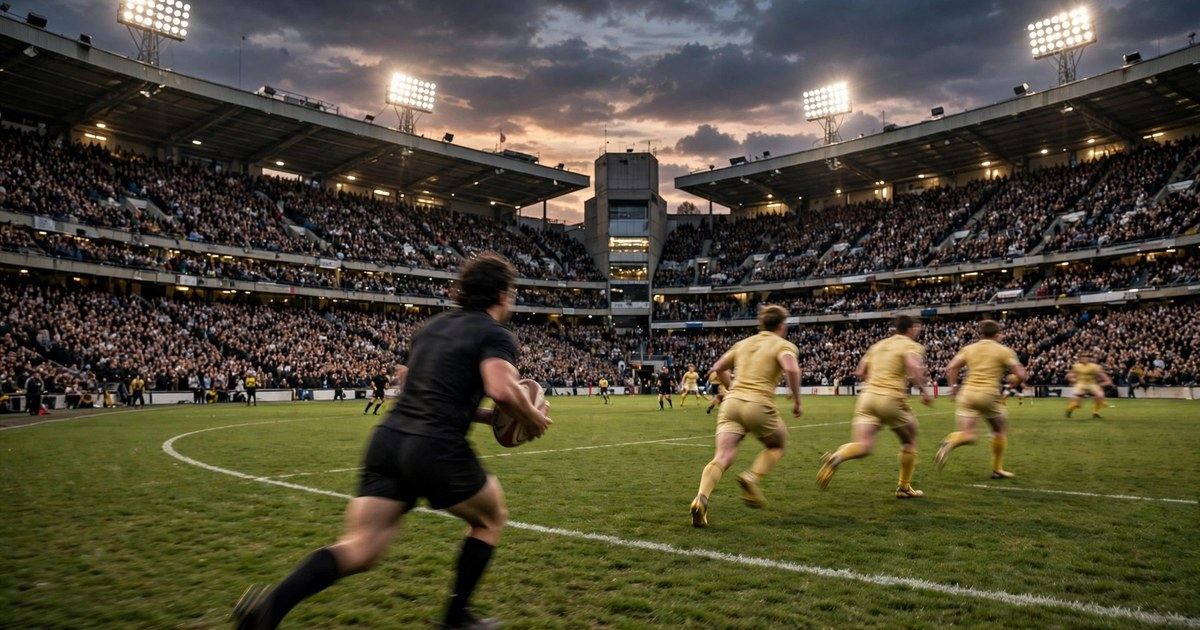
There was no contest, and there was no comeback. The New Zealand All Blacks produced one of the most devastating halves of rugby in the modern history of the trans-Tasman rivalry on Saturday, 17 October 2026, scoring six tries before halftime on their way to a 43-21 win over the Australia Wallabies at Stadium Australia in Sydney. The result completed a clean sweep of the 2026 Bledisloe Cup, extended New Zealand's winning streak over Australia to 13 matches, and kept the Cup in New Zealand hands for a 24th consecutive year. The match was trending per news coverage across Australia, New Zealand and international rugby outlets within minutes of full time, and the first half in particular is already being discussed as one of the great Bledisloe performances.
The series itself had already been decided before kickoff in Sydney. New Zealand won the first test 50-19 at Eden Park in Auckland a week earlier, a result covered in our report on the All Blacks retaining the Bledisloe Cup in Auckland. That meant the Cup was safely in New Zealand's keeping for another year no matter what happened in Sydney. But the second test still mattered: pride, momentum, the streak, and the state of the rivalry were all on the line. What followed was a first-half blitz that settled all of it inside 40 minutes.
What happened
New Zealand beat Australia 43-21 at Stadium Australia in Sydney on Saturday, 17 October 2026, in the second test of the 2026 Bledisloe Cup. The All Blacks led 36-7 at halftime after scoring six tries in the opening 40 minutes, and although Australia outscored the visitors 14-7 after the break, the Wallabies never came close to threatening the result. The crowd of 73,000 watched a match that was, in effect, decided before the halftime whistle, with referee Luke Pearce overseeing a contest that turned into a showcase of New Zealand's power, pace and precision.
The win is New Zealand's 13th in a row over Australia, a streak that now stretches across six years. It also means the Bledisloe Cup remains with New Zealand for a 24th straight year. For Australia, the defeat capped a two-test series in which they were outscored by a combined 53 points, the highest aggregate margin in a two-match Bledisloe series. The previous highest was a combined 44 points back in 1996, when the Wallabies lost 43-6 in Wellington and 32-25 in Brisbane. By that measure, this was the most one-sided Bledisloe series of the modern era.
The first-half blitz
The All Blacks exploded out of the blocks. Winger Josh Moorby scored the first try in the 12th minute after captain Codie Taylor broke through the Australian line. Flanker Peter Lakai then set up veteran fullback Beauden Barrett, scored one himself, and replacement back Rieko Ioane crossed soon after to make it 22-0 inside the first 26 minutes. In a whirlwind of offloads, New Zealand had four tries on the board before Australia had found any answer.
Australia did get on the board just before the half-hour mark. Flyhalf Declan Meredith got a pass away in the tackle to send lock Jeremy Williams over for a try. But Williams was sin-binned at the other end of the field two minutes later, and the All Blacks made the extra man count at once. Number eight Wallace Sititi immediately scored the fifth try, and Beauden Barrett added a sixth, his second of the match, off an intercept to send New Zealand into the break with a 36-7 lead. Six tries, 36 points, and a match that was effectively over at halftime.
The numbers only tell part of the story. New Zealand overwhelmed the Wallabies with power, pace and precision in the opening 40 minutes, to borrow the description in the Reuters match report. Australia showed some flashes of backline brilliance, particularly later in the game, but struggled to get hold of the ball for prolonged periods and were unable to match the accuracy or clinical finishing of the All Blacks. As one News Corp reporter put it during the broadcast, the first half ranked as one of the worst opening halves the Wallabies have ever produced at home. Former Wallaby Tim Horan summed up the helplessness on commentary: “You know what's coming and you just can't stop them.”
The second half
Moorby struck again within three minutes of the restart, faking out the defence for his second five-pointer and stretching the lead further. Australia finally finished off a backline move for fullback Tom Wright to go over, and the Wallabies outscored New Zealand 14-7 after the break. But the damage had been done long before. The massive halftime lead let the All Blacks rest a number of players after the break, including winger Will Jordan, who was replaced by debutant Chay Fihaki, and the visitors were able to take a back seat in the second half with the result secure.
New Zealand's dominance was all the more impressive given the disruption before and during the match. The All Blacks lost Jordie Barrett to a calf injury before kickoff and another centre, Quinn Tupaea, early on with a concussion. Despite losing two midfielders, the visitors overwhelmed the Wallabies with the depth and cohesion of their squad. Captain Codie Taylor, who had set the tone with his early line break for Moorby's opener, said afterwards: “I'm really proud of the boys, the way we came out in that first half. It was a real challenge for us this week to make sure we backed up a really good performance from last week, and I thought we were awesome in that first 40.”
Records and streaks
The 43-21 result added several lines to the Bledisloe Cup record book. The 13-match winning streak is one of the longest runs of dominance by either side in the fixture's history, and it has now been six years since Australia last beat New Zealand. The 24-year hold on the Cup is a remarkable stretch of sustained superiority in a rivalry that was once one of the most fiercely contested in world rugby. The Bledisloe Cup, first contested in 1931, has been held by New Zealand continuously since 2003.
The aggregate margin tells its own story. Across the two tests in 2026, New Zealand outscored Australia 93-40, a combined margin of 53 points. That surpasses the previous record for a two-match Bledisloe series, the 44-point combined margin from 1996. The 50-19 win in Auckland had already been emphatic; the 43-21 win in Sydney confirmed that the gap between the sides is currently as wide as it has ever been. For context on how dominant a sweep like this is in world sport, even a sweep to reach a World Series rarely comes with this kind of cumulative margin.
What it means for the Wallabies
For Australia, the defeat raises uncomfortable questions about the state of the rivalry and the team's direction. After a period of promise under new coach Les Kiss, whose first five matches in charge of the Wallabies produced an unbeaten run, the bubble has well and truly burst. The casual Australian fan will always judge the Wallabies by how they fare against the All Blacks, and this latest showing confirmed that the Wallabies are struggling badly against their oldest rivals.
Wright, the Wallabies fullback, said his side had “faced the music” after the horror 50-19 loss in Auckland. After Sydney, the reckoning will be louder. There was once a time when 13 consecutive defeats to the All Blacks would have been considered unacceptable. Spread over six years, the underwhelming run of results has passed with barely a raised eyebrow, and some commentators now wonder whether the once-great rivalry between the two rugby nations is in peril. The second-half improvement in Sydney offers something to build on, but a moral victory in a 22-point defeat is thin consolation.
The broader context matters too. Rugby in Australia is in a crowded sporting marketplace, and the Rugby League World Cup has also been running across Australia and New Zealand this month. The Wallabies need results against New Zealand to hold the public's attention, and two heavy defeats in two weeks will not help. Rebuilding will require more than effort: it will require the kind of clinical finishing and defensive steel that New Zealand displayed in Sydney.
What it means for the All Blacks
For New Zealand, the sweep is a statement. Backing up a 50-19 win with a 43-21 win, on the road, in front of 73,000 hostile fans, shows a team operating at a very high level. The first-half performance in Sydney was the kind of rugby the All Blacks had hoped to produce in their earlier tour of South Africa: high-tempo, breadth-of-the-field attacking rugby built on offloads, support lines and relentless pressure. In Sydney, it all came together.
The depth on display was equally encouraging. Losing Jordie Barrett before kickoff and Tupaea early on would have derailed many teams. New Zealand barely missed a beat, with the likes of Lakai, Sititi and Ioane all crossing for tries and the bench contributing smoothly. The performance of Taylor, the captain, was central: his early break set up the opener, and his leadership steadied the side through the disruptions. The All Blacks now head into the rest of their season with momentum, confidence and a record that underlines their place at the top of the trans-Tasman game.
What happens next
The 2026 Bledisloe Cup is complete, with New Zealand winning the two-test series 2-0. The Cup stays in New Zealand for a 24th straight year. For Australia, the focus now turns to rebuilding ahead of their remaining fixtures and, longer term, to closing a gap that has grown to historic proportions. For New Zealand, the sweep is a platform: the challenge now is to carry this form into their next assignments and to keep the standards that produced one of the great Bledisloe first halves.
For fans, the rivalry's next chapter cannot come soon enough. Australia will need to find answers, and New Zealand will need to prove that this was not a peak but a baseline. If the Wallabies are to end the 13-match streak, they will have to do what they could not do in Sydney: hold the ball, match the All Blacks' accuracy, and survive the opening 40 minutes. On the evidence of 17 October 2026, that is a long way from a formality.
Why it matters
Sporting rivalries are defined by their great days, and 17 October 2026 will be remembered as one of the All Blacks' great days in Sydney. The 43-21 win was not just a victory; it was a demonstration of the gap between the two teams, a record-setting aggregate margin, and a first half that will be replayed for years. For Australia, it was a wake-up call. For New Zealand, it was confirmation. And for rugby fans everywhere, it was a reminder of why the Bledisloe Cup still matters: because on days like this, it produces rugby of the highest order.