
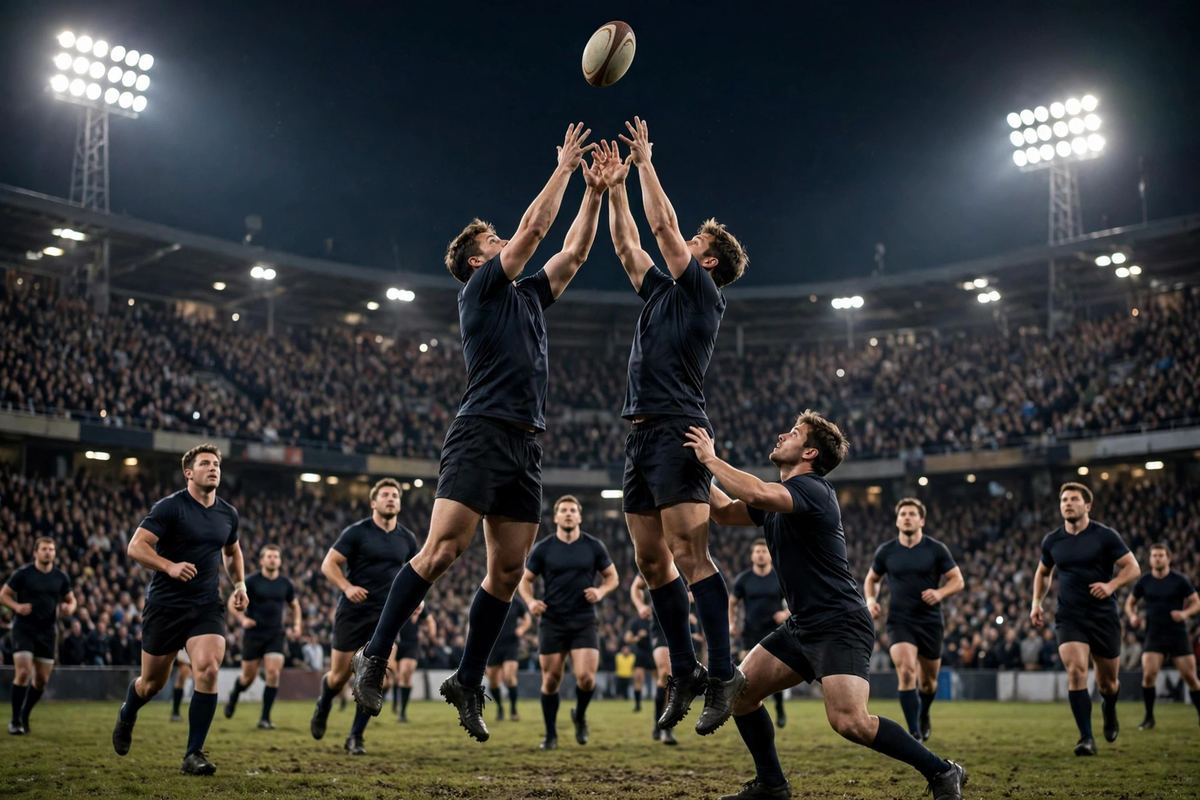
The All Blacks are keeping the Bledisloe Cup. New Zealand defeated the Wallabies 50-19 at Eden Park in Auckland on the weekend of October 10-11, 2026, securing the famous trans-Tasman trophy for a 23rd consecutive year. The win also extended the All Blacks' extraordinary unbeaten run at Eden Park to 54 Tests, a fortress record that continues to grow.
The scoreline only tells part of the story. New Zealand led just 17-14 at half-time in a genuinely competitive first half, before running in five tries after the break to blow the game open. Fly-half Damian McKenzie starred in the number ten jersey, and the try-scorers included Peter Lakai and Tupou Vaa'i. The second-half surge underlined the gap that has defined this rivalry for more than two decades: the Wallabies can compete, but sustaining it against the All Blacks over eighty minutes at Eden Park remains one of world rugby's hardest assignments.
What is the Bledisloe Cup?
The Bledisloe Cup is the trophy contested between the New Zealand and Australian men's rugby union teams, the All Blacks and the Wallabies. It is named after Lord Bledisloe, a former Governor-General of New Zealand, who presented the cup in 1931. Since then it has been played for as part of the annual meetings between the two nations, which today sit inside the Rugby Championship, the southern hemisphere's premier international tournament featuring New Zealand, Australia, South Africa and Argentina.
Unlike a one-off final, the Bledisloe Cup is decided across the All Blacks-Wallabies meetings in a given season. The holder retains the cup unless the challenger beats them, so a drawn series is enough for the holder to keep it. That holder-takes-all structure is one reason long reigns are possible: to take the cup back, Australia must not merely compete with New Zealand but actually beat them in a year where the All Blacks have held the trophy since 2003.
The rivalry: more than a century of trans-Tasman rugby
New Zealand and Australia first met in a Test match in 1903, and the rivalry has been one of the defining fixtures in world sport ever since. The two nations share geography, a sporting culture, and a healthy mutual obsession, and rugby union has always been the stage where that plays out most fiercely. For Australia, beating the All Blacks is the ultimate prize in the sport; for New Zealand, the Wallabies are the opponent every All Black measures himself against.
The balance of power has swung over the decades. Australia enjoyed golden eras, notably the 1980s and the early 2000s, when the Wallabies were world champions and genuine equals of the All Blacks. But since 2003, when New Zealand last lost the Bledisloe Cup, the trophy has stayed black. That 23-year hold is one of the great records in international sport — comparable in longevity to the great dynasties of other codes, a reminder of how consistently New Zealand has produced world-class sides across multiple generations of players. Long-running trophy contests are part of what makes sport memorable across borders, much like baseball's own famous championship tradition covered in this site's guide to the 2026 World Series, where history and pressure shape every edition.
Eden Park: the fortress
The 2026 match was played at Eden Park in Auckland, and the venue is as much a part of this story as the trophy. The All Blacks have now gone 54 Tests without defeat at Eden Park, a streak that stretches back decades. New Zealand simply do not lose there. The combination of a passionate home crowd, the travel burden on visiting teams, and the All Blacks' own history of rising to the occasion in Auckland has turned the ground into world rugby's most intimidating away fixture.
For the Wallabies, Eden Park represents a psychological barrier as much as a physical one. Australia have beaten the All Blacks in New Zealand on rare occasions elsewhere, but Auckland has been a graveyard for visiting Australian sides for a generation. Every Bledisloe campaign that runs through Eden Park effectively requires the Wallabies to do the one thing no team has managed in 54 attempts.
What happened in the 2026 decider
New Zealand went into the match dealing with significant absences. Ruben Love was missing after ankle surgery that rules him out for the year, Richie Mo'unga and Ardie Savea were unavailable, and captain Scott Barrett failed a late head-injury assessment. On paper, the All Blacks were under-strength.
The Wallabies, coached by Les Kiss, took full advantage in the first half and trailed only 17-14 at the break. For forty minutes, the contest looked genuinely alive. But the second half was a different story. New Zealand cut loose with five tries after half-time, turning a tight Test into a 50-19 rout. Damian McKenzie's performance at fly-half stood out as the individual story of the match, while Peter Lakai and Tupou Vaa'i were among the players who crossed the try line in the scoring spree.
The pattern will be familiar to anyone who has watched this rivalry in recent years: the Wallabies competitive early, the All Blacks' depth and intensity decisive late. Australia's challenge faded as New Zealand's bench and fitness told, and the final margin — 31 points — reflected the dominance of the second half rather than the balance of the first.
Why it matters
Twenty-three consecutive years of holding one trophy is a record that transcends rugby. It means that no current Wallaby was born into a world where Australia held the Bledisloe Cup — or at least, very few Australian supporters under the age of thirty have any living memory of it. An entire generation of Australian rugby fans has grown up knowing only All Blacks dominance in this fixture.
For New Zealand, the streak is a point of national pride and a standard every All Blacks squad is expected to protect. Each year's defence adds pressure, because the longer the run continues, the bigger the story becomes when it eventually ends. The 54-match Eden Park unbeaten run is similarly self-reinforcing: the longer it goes, the more visiting teams arrive half-beaten by the legend of the place.
There is also a development angle. Sustained success at Test level reflects the depth of New Zealand's rugby systems — the pipeline of players who can step into the All Blacks jersey when stars are missing. This weekend's team was without several senior names and still won by 31 points. That depth is the engine of the 23-year streak.
Key facts
Final score: All Blacks 50, Wallabies 19, at Eden Park, Auckland. Half-time score: 17-14. Second-half tries: five by New Zealand. Standout: Damian McKenzie at fly-half. Try-scorers included Peter Lakai and Tupou Vaa'i. Consecutive Bledisloe Cup holds for New Zealand: 23, dating back to 2003. Consecutive Tests unbeaten at Eden Park: 54. New Zealand absentees: Ruben Love (ankle surgery, out for the year), Richie Mo'unga, Ardie Savea, and Scott Barrett (late head-injury assessment failure). Wallabies coach: Les Kiss.
What happens next
The Bledisloe Cup now stays in New Zealand for another year, but the rivalry's next great chapter is already on the calendar. The 2027 Rugby World Cup is about a year away, and the All Blacks and Wallabies are set to meet in Sydney at that tournament. A World Cup meeting on Australian soil would be the Wallabies' grandest possible stage to strike back — and the All Blacks' chance to extend their dominance into rugby's biggest event.
Between now and then, both teams will continue their development under their respective coaches. For Les Kiss and the Wallabies, the challenge is clear: close the second-half gap that turned a competitive 17-14 half-time contest into a 50-19 defeat. For New Zealand, the task is to keep the standard that has held the Bledisloe Cup for 23 years and the Eden Park fortress for 54 Tests. The trophy's story continues — and in Sydney in 2027, the Wallabies will get their most dramatic opportunity yet to rewrite it.