
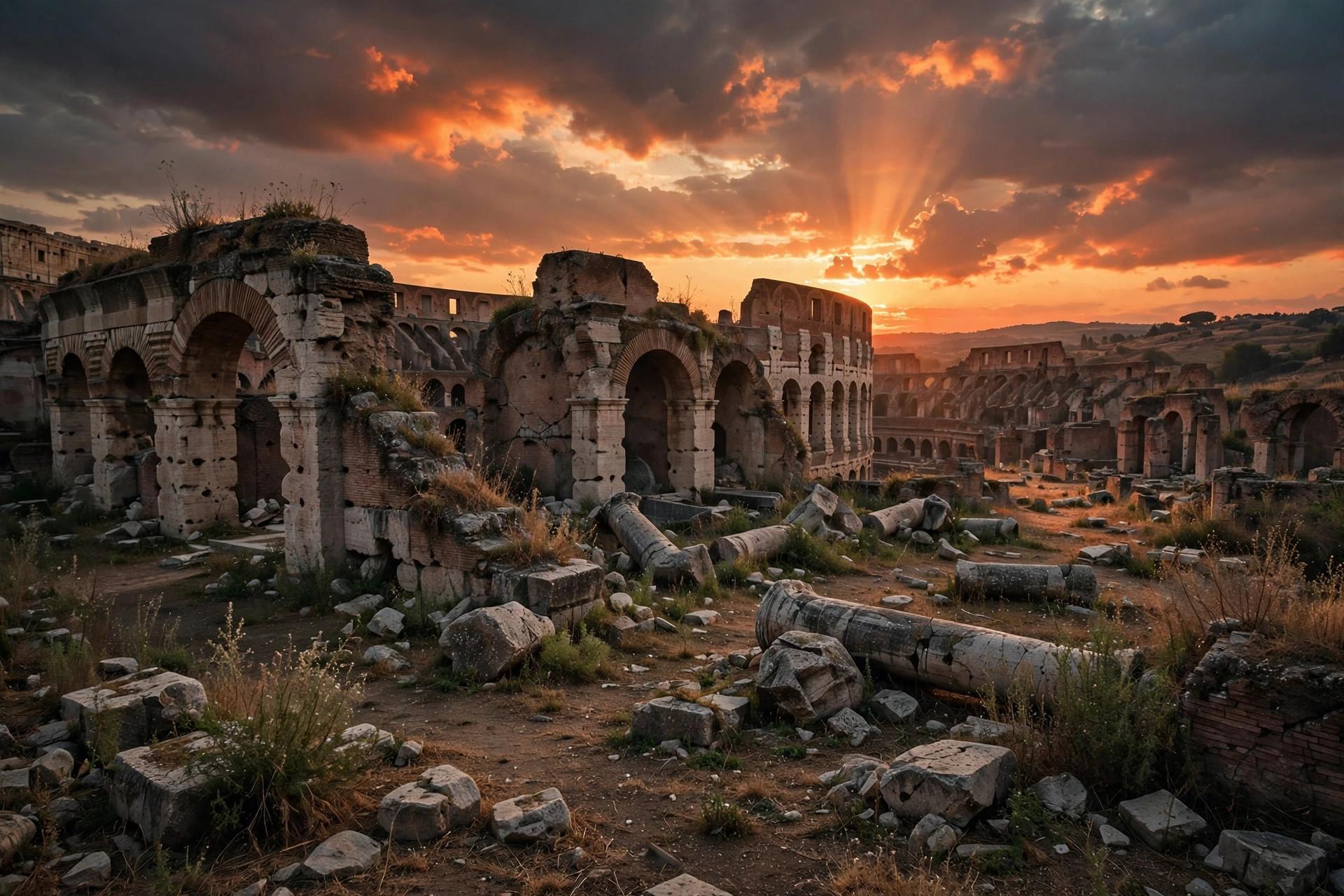
For centuries, the Roman Empire was the most powerful state in the Western world. At its height, it stretched from Britain to Egypt and from Spain to Syria, governing an estimated 50 to 90 million people. Roman law, language, roads, and engineering shaped the foundations of modern Europe. And then, slowly and then all at once, it fell apart. The traditional date given for the fall of the Western Roman Empire is 476 CE, but the real story is far more complicated — and far more interesting — than a single year.
Historians have debated the causes of Rome's decline for over a thousand years. Was it barbarian invasions? Corrupt emperors? Economic collapse? Disease? The honest answer is that it was all of these, interacting over centuries. This article walks through the major causes, the key events, and the legacy Rome left behind.
Rome at Its Peak
To understand the fall, it helps to understand what fell. During the reign of Trajan (98–117 CE), the empire reached its greatest territorial extent. The Mediterranean was effectively a Roman lake. A vast network of paved roads — some 50,000 miles of them — connected distant provinces. Aqueducts carried fresh water into cities. Roman citizenship, once limited to Italians, gradually expanded, and in 212 CE the emperor Caracalla granted citizenship to nearly all free men in the empire.
This was the world of the Pax Romana, the Roman Peace, a roughly 200-year period of relative stability that began with Augustus. Trade flourished. Cities grew. Literature, architecture, and law advanced. But beneath the surface, structural weaknesses were already forming — weaknesses that would take centuries to become fatal.
Political Instability and the Crisis of Leadership
One of Rome's deepest problems was that it never solved the question of how power should transfer. The empire was, in theory, ruled by an emperor; in practice, emperors were frequently made and unmade by the army. During the Crisis of the Third Century (235–284 CE), Rome saw more than 20 emperors in 50 years. Most died violently — assassinated, executed, or killed in battle.
This constant turnover had real consequences:
- Short-term thinking: Emperors focused on surviving the year rather than planning for decades.
- Civil wars: Rival generals repeatedly marched on Rome, devastating the countryside and draining the treasury.
- Divided attention: While Romans fought Romans, pressure built on the frontiers.
The emperor Diocletian (284–305 CE) tried to fix the system by splitting administration of the empire and creating the Tetrarchy — rule by four. It brought temporary stability, but it also formalized a division between East and West that would eventually become permanent. For a deeper look at how divided powers rise and fall, see our guide on why the Berlin Wall was built — another story of a divided world.
Economic Troubles: Inflation, Taxes, and Trade
Rome's economy ran into serious trouble from the third century onward. The empire's expansion had slowed, which meant fewer conquests bringing in loot and slaves — two traditional sources of wealth. At the same time, the costs of the army and bureaucracy kept rising.
Emperors responded by debasing the currency: reducing the silver content of coins while declaring them worth the same. The result was predictable — inflation. By the late third century, prices had soared and confidence in Roman money had collapsed. Diocletian even issued an Edict on Maximum Prices in 301 CE, fixing the prices of over a thousand goods. It failed; goods simply disappeared from markets instead.
Heavy taxation crushed small farmers, many of whom abandoned their land or became tenant laborers tied to large estates. Trade networks frayed as roads became unsafe. The wealthy East, centered on Constantinople, fared better — it had richer farmland and more resilient trade — but the West grew steadily poorer. Browse more stories of civilizations under strain in our History category.
The Army: Rome's Strength Becomes Its Weakness
The Roman legions had built the empire, but by the late empire the army itself had changed. Citizens were increasingly reluctant to serve, so Rome relied heavily on foederati — barbarian tribes hired as federate troops. These soldiers were effective fighters, but their loyalty was to their own chieftains and their pay, not to Rome.
Worse, the army had become a political kingmaker. Soldiers expected cash bonuses (donatives) whenever a new emperor took power, creating a cycle: generals promised money, troops proclaimed them emperor, and the treasury emptied further. The late Roman army was also increasingly defensive in posture — spread thin along enormous frontiers, it could rarely concentrate force where it was needed most.
Barbarian Invasions and the Migration Period
The peoples Rome called barbarians — Goths, Vandals, Franks, Huns, and others — were not simply mindless destroyers. Many had lived alongside Rome for generations as traders, soldiers, and farmers. But starting in the late fourth century, large-scale migrations put enormous pressure on the empire's borders.
A key trigger was the arrival of the Huns from the Central Asian steppe. Their westward push displaced the Goths, who sought refuge inside Roman territory. In 376 CE, Emperor Valens allowed tens of thousands of Goths to cross the Danube — then Roman officials mistreated them so badly that they revolted. At the Battle of Adrianople in 378 CE, the Goths annihilated a Roman army and killed Valens himself. It was the worst Roman defeat in centuries and a psychological shock from which the West never fully recovered.
In the decades that followed, the pattern repeated: the Visigoths sacked Rome itself in 410 CE — the first time the city had fallen to a foreign enemy in 800 years. The Vandals took North Africa, Rome's breadbasket, cutting off the grain supply. By mid-century, Attila's Huns were ravaging the Balkans, Gaul, and Italy. Rome was no longer defending an empire; it was managing a retreat.
The Division: East Thrives, West Withers
In 285 CE, Diocletian formally divided the empire into eastern and western halves for administrative purposes. Theodosius I was the last emperor to rule both halves; after his death in 395 CE, the split became permanent.
This division mattered enormously. The Eastern Empire — later called the Byzantine Empire — was wealthier, more urbanized, and anchored by the superbly defensible city of Constantinople. The West was poorer, more rural, and exposed to invasions across the Rhine and Danube. When crisis came, the East could buy off or defeat attackers; the West increasingly could not. The two halves drifted apart culturally and politically, cooperating less and less.
476 CE: The Conventional End
By the 470s, the Western emperor controlled little more than Italy itself. Germanic generals effectively ran the army, and the imperial court at Ravenna was a shadow of its former self. In 476 CE, the Germanic chieftain Odoacer deposed the teenage emperor Romulus Augustulus and declined to appoint a successor. Instead, he sent the imperial regalia to the Eastern emperor Zeno in Constantinople, acknowledging him as sole emperor.
Historians traditionally mark this moment as the fall of the Western Roman Empire. But it is worth noting how undramatic it was: no great final battle, no burning capital. Much of Roman administration, law, and culture continued under Odoacer and later under the Ostrogoth king Theodoric. The transformation was gradual — which is why some historians argue the empire did not so much fall as evolve into something new.
Why the East Survived Another Thousand Years
The Eastern Roman (Byzantine) Empire survived until 1453, when Constantinople fell to the Ottoman Turks. Its longevity highlights what the West lacked: a defensible capital with massive walls, a professional bureaucracy that kept collecting taxes, a strong navy, and enough wealth to pay armies and bribe enemies. The East also faced somewhat less relentless pressure from migrations. The contrast shows that Rome's fall was not inevitable — it was the result of specific vulnerabilities meeting specific pressures.
The Legacy of Rome
Rome fell, but it never really disappeared. Its legacy is everywhere:
- Law: Roman legal principles underpin the civil law systems of continental Europe and Latin America.
- Language: Latin evolved into French, Spanish, Italian, Portuguese, and Romanian, and contributed thousands of words to English.
- Government: Concepts like the senate, republic, citizenship, and written constitutions trace back to Rome.
- Engineering: Roman concrete, arches, and aqueducts influenced building for two millennia.
- Religion: Christianity spread through the empire's roads and cities and became its official religion in the fourth century.
The fall of Rome remains history's greatest case study in how complex societies decline — not from a single blow, but from the slow accumulation of political, economic, and military failures. It is a story worth studying not just for what happened, but for what it teaches about the fragility of even the mightiest institutions.