
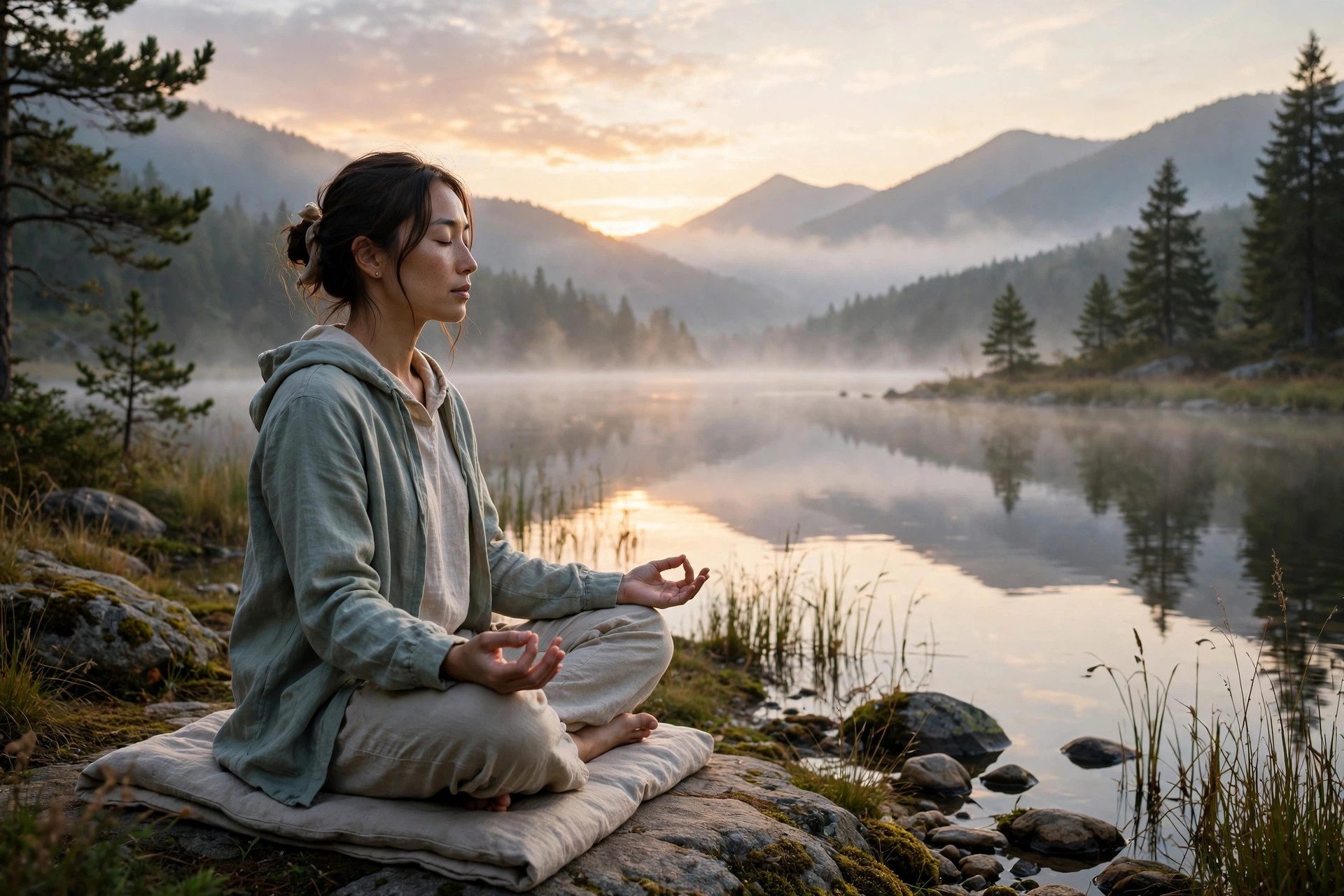
Mindfulness is the practice of paying deliberate attention to the present moment — your breath, your body, your surroundings — with an attitude of curiosity rather than judgment. In a world engineered to fragment your attention, it is a trainable skill for noticing where your mind actually is, and gently bringing it back. This guide explains what mindfulness is, where the idea comes from, what research suggests it can and cannot do, and how to start a practice that fits an ordinary busy life.
What mindfulness is (and isn't)
Mindfulness is not emptying the mind, achieving permanent calm, or thinking positive thoughts on command. Thoughts will arise — planning dinner, replaying conversations, worrying about tomorrow. The practice is noticing that you have drifted, without scolding yourself, and gently returning attention to the present. It is a skill that improves with repetition, not a switch that flips on.
It also is not relaxation, exactly. You may feel calmer after practising, but the goal is awareness: seeing your thoughts, emotions and bodily sensations clearly as they happen, rather than being yanked around by them. A useful shorthand from teachers of the practice: mindfulness is paying attention, on purpose, in the present moment, non-judgmentally.
Where the idea comes from
Mindfulness has deep roots in contemplative traditions, particularly Buddhism, where present-moment awareness has been cultivated for over two millennia. Its modern, secular form largely traces to the late 1970s, when researcher Jon Kabat-Zinn developed Mindfulness-Based Stress Reduction (MBSR) — an eight-week structured program — at a US medical centre, stripping the practices of religious framing so they could be studied and taught in hospitals.
MBSR's apparent success with chronic-pain patients sparked decades of clinical research, followed by offshoots such as Mindfulness-Based Cognitive Therapy (MBCT), which combines mindfulness with cognitive-behavioural techniques and is now recommended in some clinical guidelines for preventing relapse in recurrent depression. What began as a hospital program is now taught in schools, workplaces, prisons and sports teams worldwide.
What the research suggests
Reviews of clinical studies suggest mindfulness-based programs can help reduce symptoms of stress, anxiety and depression for many people, and may improve attention and emotional regulation. Effects are generally modest — comparable to other behavioural interventions, not miraculous — vary between individuals, and depend heavily on the quality of the program and the consistency of practice.
Brain-imaging studies have reported structural and functional changes associated with long-term meditation practice, particularly in areas linked to attention and emotional processing, though this research is still developing and findings are sometimes overstated in media coverage. The honest summary: mindfulness is one of the better-studied self-care practices, with real but limited benefits, and it works best as part of a broader approach to wellbeing — alongside sleep, movement and social connection — rather than as a cure-all.
Mindfulness is a complement to — not a replacement for — professional mental-health care, a point worth stating plainly given how often it is marketed as a fix for serious conditions.
Core practices, step by step
You do not need special equipment, an app subscription or a silent retreat. These four foundational practices cover nearly everything beginners need:
1. Breath awareness (5 minutes)
- Sit comfortably with your back reasonably straight, feet on the floor.
- Close your eyes or soften your gaze downward.
- Notice the physical sensation of breathing — air at the nostrils, the rise and fall of the chest or belly. Don't control the breath; just observe it.
- When you notice your mind has wandered (it will, within seconds), silently note "thinking" and return attention to the breath.
- Repeat until your timer ends. The returning — not the staying — is the actual exercise.
2. Body scan (10–15 minutes)
Lie down or sit comfortably. Slowly move your attention through the body — feet, legs, torso, hands, arms, shoulders, neck, face — spending 20–30 seconds on each region, simply noticing sensations: warmth, tension, tingling, or nothing at all. There is no need to change anything you find; observation is the whole task. Many people use this as a wind-down before sleep, and it pairs well with the habits in our complete guide to better sleep.
3. Mindful walking (5–10 minutes)
Walk slowly in a quiet space. Pay attention to the mechanics: heel lifting, weight shifting, foot meeting the ground. When the mind drifts to your to-do list, return to the soles of your feet. This is an excellent option for people who find sitting still agitating.
4. Mindful eating (one meal or snack)
Eat one thing slowly and with full attention: notice colours, textures, temperature and flavours as they change. Put utensils down between bites. Most people are startled by how little they normally taste their food — and by how satisfying a single mindful snack can be. It is also a gentle entry point to balanced eating in general: attention makes portions and flavours easier to judge.
Bringing mindfulness into an ordinary day
Formal practice builds the skill; informal practice is where it pays off. Small, realistic integrations work better than ambitious routines most people abandon by Thursday:
- Two-minute resets: between meetings or tasks, take six slow breaths while noticing the feeling of your feet on the floor. Short and regular beats long and occasional.
- A mindful morning anchor: attach 3 minutes of breath awareness to an existing habit — right after brushing your teeth, before checking your phone. Habit-stacking like this is one reason the routines in our guide on building a morning routine actually stick.
- Single-tasking windows: choose one daily activity — washing dishes, commuting, drinking tea — and do it with full attention instead of half-attention plus a podcast. This is also the core idea behind digital minimalism: reclaiming attention from devices.
- The pause before reacting: when irritation spikes — a rude email, a traffic jam — notice the physical sensation (tight chest, heat in the face) before responding. That gap between stimulus and response is where mindfulness earns its keep.
Common obstacles (and fixes)
| Obstacle | What's actually happening | What helps |
|---|---|---|
| "My mind won't stop thinking" | Completely normal — minds generate thoughts the way hearts beat | Stop trying to empty it; practise noticing and returning. Counting breaths (1–10, then restart) gives the mind a light job. |
| Restlessness or boredom | The nervous system protesting stillness | Try mindful walking instead of sitting; shorten sessions to 3 minutes and build up. |
| Falling asleep | Often a sign of genuine tiredness, not failure | Practise sitting upright earlier in the day; treat the drowsiness as information about your sleep needs. |
| "Am I doing it right?" | Performance anxiety applied to a non-performance activity | If you noticed you were distracted and came back, you did it right. That is the entire mechanism. |
| No time | Mindfulness feels like one more obligation | Attach micro-practices to existing habits rather than scheduling new ones. |
Mindfulness vs meditation: what's the difference?
The terms overlap but are not identical. Meditation is the broader category: structured practices for training attention and awareness, of which mindfulness is one style (others include focused-concentration, visualisation and movement-based practices like yoga). Mindfulness specifically means non-judgmental present-moment awareness — and it can also describe a quality you bring to ordinary activities, no cushion required. All mindfulness meditation is meditation; not all meditation is mindfulness.
How mindfulness connects to sleep, movement and mood
Mindfulness works best as part of a foundation, not a standalone fix. Poor sleep shreds attention — which is why a calming body scan is a staple of sleep hygiene — and regular movement reliably improves mood and stress resilience; even a beginner running routine can do more for anxiety than meditation alone for some people. Ancient philosophies reached similar conclusions by different routes: the Stoic practice of examining your judgments about events is, in many ways, mindfulness' philosophical cousin. Think of these as mutually reinforcing habits rather than competing options.
A note of care
For most people mindfulness is safe, but intensive practice can occasionally stir up difficult emotions, and silent retreats have triggered distress in vulnerable individuals. Anyone experiencing significant distress, trauma symptoms or a mental-health crisis should seek support from a qualified professional rather than relying on self-guided practice alone. If a practice consistently makes you feel worse, stop — mindfulness should be approached with the same common sense as exercise: beneficial in the right dose, worth discussing with a professional when something feels wrong.
A Complete 5-Minute Practice for Your First Session
The practices above each train one skill. This short routine strings them into a single five-minute session — a good way to start, and a template you can reuse daily. Set a gentle timer so you are not watching the clock.
- Minute 1 — Arrive. Sit comfortably with your feet flat on the floor. Let your eyes close or rest softly on one spot. Take three slow breaths, and notice the physical points of contact: feet on floor, body on chair, hands in lap.
- Minutes 2–3 — Follow the breath. Breathe naturally and rest your attention on the coolness at the nostrils or the rise and fall of the belly. When you notice the mind has wandered — it will — name it silently ("thinking") and return. Each return is one repetition of the exercise, not a failure of it.
- Minute 4 — Widen to body and sounds. Let attention expand from the breath to the whole body sitting, then to sounds near and far. You are not trying to empty the mind, just to notice whatever is present without chasing it.
- Minute 5 — Close deliberately. Return to the breath for three final cycles. Notice how body and mind feel compared with five minutes ago, open your eyes, and take one slow breath before standing up.
Five minutes done daily teaches more than an hour attempted once a month. If five minutes feels long, start with the first two and build up over a week — the structure scales in both directions.
Starting today
Begin absurdly small: three minutes of breath awareness, once a day, for one week. Same time, same place, timer on your phone. If you miss a day, simply resume — the practice of beginning again is the practice. After a week, most people know whether they want to continue, extend sessions, or try a structured eight-week program. The barrier was never knowledge; it is repetition. Start with three minutes.
This article is for general information only and is not medical or therapeutic advice.
New research underlines how deeply the body clock affects mood: scientists have identified a circadian depression subtype that may explain why standard antidepressants fail many patients.
Mindfulness in Simple Terms: A 30-Second Definition
Mindfulness in simple terms means noticing what is happening right now — your breath, your body, the sounds around you — without judging it or getting dragged away by it. When your mind wanders, which it will, you gently bring it back. That is the whole practice. It is not emptying your mind, achieving calm on demand, or becoming a different person. It is a small, repeatable act of attention, done many times a day if you like, or once, sitting quietly, if that is all you have time for.
Mindfulness Meditation: Three Ways to Begin
Three simple mindfulness meditation practices cover most beginners' needs. First, breath awareness: sit comfortably, notice the sensation of breathing, and return attention to it whenever the mind drifts. Second, the body scan: move attention slowly from your feet to the top of your head, noticing sensations without trying to change them. Third, mindful walking: walk slowly and notice each step, the ground underfoot, and the movement of your body. Five minutes of any of these, done daily, is a better start than an ambitious hour attempted once and abandoned.