
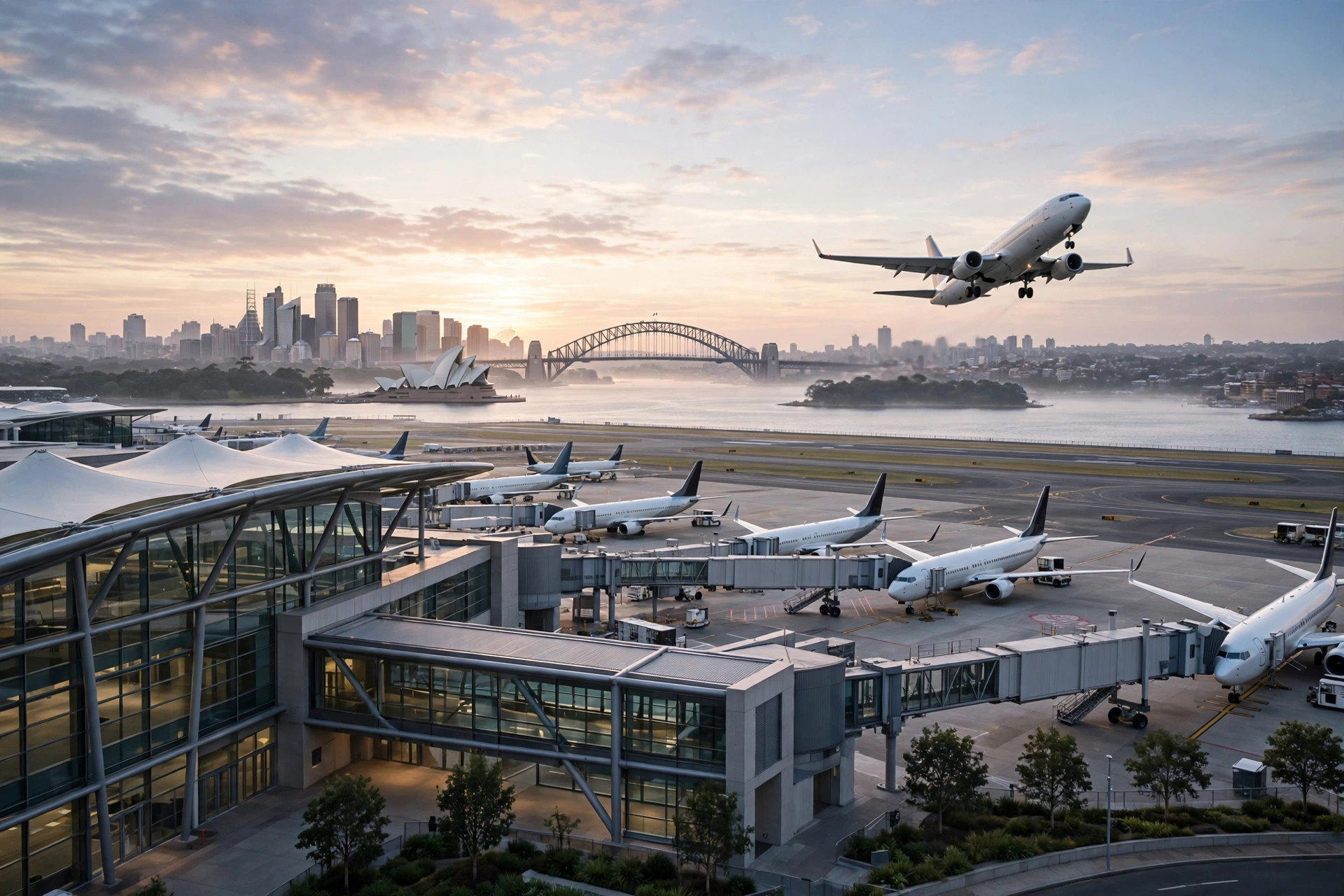
The Western Sydney Airport opens to passengers on Sunday, 25 October 2026, marking the start of commercial flights from Australia's first airport designed from the outset to operate around the clock. Located at Badgerys Creek, about 44 to 45 kilometres west of Sydney's central business district, the airport's official name is Western Sydney International (Nancy-Bird Walton) Airport, with the code WSI. Its opening is a major moment for Western Sydney, a region that has grown rapidly and that has long relied on Sydney's existing Kingsford Smith Airport, and it introduces a second international gateway for Australia's largest city.
Background: why the Western Sydney Airport opens now
Sydney Kingsford Smith Airport, known by the code SYD, has served as the city's main airport for decades, but it operates under a curfew from 11pm to 6am, which limits overnight flights. That restriction reflects the airport's proximity to residential areas and the long-standing balance between aviation needs and community noise concerns. Western Sydney International has been planned as a complement to that airport, not as a simple replacement, with no curfew so that flights can operate through the night. That difference is central to its purpose: freight, late-night arrivals, early departures and services that do not fit within a curfew window can all be accommodated at the new airport.
The airport is named for Nancy-Bird Walton, a pioneering Australian aviator, which connects the new facility to the history of Australian flight. The choice of Badgerys Creek as the site reflects decades of planning about where a second Sydney airport could be built with room to grow, with road and future rail connections and with space for freight and commercial development around it. The first stage of the airport is designed for a capacity of 10 million passengers a year, a scale that allows it to begin as a meaningful second gateway while leaving room for expansion as demand grows. Its runway measures 3,700 metres, long enough to handle a wide range of aircraft types, including the larger jets used on international routes.
Getting to a new airport matters as much as the terminal itself, and the opening arrangements reflect that. The M12 motorway provides a toll-free road connection, free WSI Link buses are running for passengers, and a Sydney Metro line serving the airport is due in 2027. That combination — road access from day one, bus services to help passengers without cars, and a metro line to follow — is intended to make the airport usable from its first day while its longer-term public transport link is completed. Freight operations, meanwhile, began earlier, from 27 July 2026, so cargo activity was already under way before the first passenger flights.
Western Sydney Airport opens: the first day of passenger flights
The first passenger flight is Jetstar flight JQ362 to the Gold Coast, scheduled for 11am Australian Eastern Daylight Time on opening day, operated by an Airbus A320. Choosing a domestic leisure route for the first departure is a practical as well as symbolic decision: the Gold Coast is a popular destination, the aircraft type is familiar to Australian travellers, and a daytime first flight allows the airport's systems, staff and passengers to experience the new terminal in a controlled way. Jetstar is also operating flights to Melbourne and Brisbane on day one, giving the airport a spread of initial domestic destinations across three states.
International services follow quickly. Air New Zealand is scheduled to begin Auckland services from 26 October, the day after opening, linking Western Sydney directly with New Zealand's largest city. Singapore Airlines is scheduled to begin daily services to Singapore from 23 November 2026, providing a major Asian hub connection and an onward gateway to destinations across Asia and Europe. Those early international routes matter because they establish the airport as an international facility from its first weeks, not only as a domestic terminal waiting for overseas services. They also give Western Sydney residents direct access to two important nearby markets without travelling to the existing Sydney airport first.
For passengers, a new airport brings both excitement and practical questions: how to get there, how early to arrive, where to check in, and how the terminal feels compared with the airport they know. Opening-day operations are always a learning experience for staff and travellers alike, and the airport's early weeks will be watched for how smoothly check-in, security, baggage and boarding work at scale. The fact that freight operations have been running since July may help, because some of the airport's broader systems have already been tested, but passenger operations bring their own rhythms and peak pressures, especially around popular departure times.
Why the Western Sydney Airport opens matters for Sydney and Australia
The most immediate benefit is choice and capacity. A second airport gives airlines more room to add services, gives passengers more departure options, and gives Western Sydney — home to a large and growing population — an airport closer to where many people live and work. For businesses in the west, the airport can reduce travel time to flights, support jobs in aviation, logistics, hospitality and related services, and make the region more attractive for investment. For the city as a whole, spreading aviation activity across two airports can ease pressure on the existing airport and on the roads and transport links that serve it.
The 24-hour operation is the feature that most distinguishes the new airport from Sydney's existing gateway. Without a curfew, airlines can schedule late-night and early-morning services that would otherwise be impossible, freight operators can move goods at hours that suit supply chains, and passengers with connecting flights or unusual schedules gain options that a curfew airport cannot offer. That flexibility is particularly valuable for international services, where departure and arrival times are often dictated by conditions at the other end of the route, and for cargo, where overnight movement can be essential. Over time, the ability to operate around the clock may shape which airlines and routes choose Western Sydney over other Australian airports.
There is also a longer-term planning significance. Major airports are rarely built quickly, and their locations shape urban growth for generations. By placing a major airport in the west, planners are signalling that Western Sydney's growth is expected to continue and that infrastructure should follow population, not only serve the established centre. The metro line due in 2027, the toll-free motorway and the bus services are all part of that picture: an airport is not an isolated building, but a node in a transport network, and its success will depend on how easily people and goods can reach it from across the metropolitan area.
Key facts: Western Sydney Airport opens
- Opening to passengers: Sunday, 25 October 2026.
- Location: Badgerys Creek, about 44-45 kilometres west of Sydney CBD.
- Official name: Western Sydney International (Nancy-Bird Walton) Airport; code WSI.
- First flight: Jetstar JQ362 to the Gold Coast, 11am AEDT, Airbus A320.
- Day-one Jetstar destinations: Gold Coast, Melbourne and Brisbane.
- Curfew: None at WSI; Sydney Kingsford Smith (SYD) has an 11pm-6am curfew.
- International starts: Air New Zealand Auckland from 26 October; Singapore Airlines daily Singapore from 23 November 2026.
- Capacity and runway: First stage 10 million passengers a year; runway 3,700 metres.
- Freight: Freight operations from 27 July 2026.
- Access: M12 toll-free, free WSI Link buses, Sydney Metro line due 2027.
The New Zealand connection also links to wider trans-Tasman travel stories, including recent India-New Zealand sporting coverage, while the Singapore service connects with regional travel interest reflected in coverage of Singapore conditions. Readers interested in Australian conditions more broadly may also find the Australian weather warnings guide useful.
What happens next after the Western Sydney Airport opens
In the weeks after opening, the key test will be reliability: whether flights depart and arrive on time, whether baggage and passenger processing work smoothly, and whether ground transport keeps pace with demand. Airlines will watch load factors — how full their flights are — and passenger feedback before deciding whether to add frequencies or new destinations. Air New Zealand's Auckland start and Singapore Airlines' November start will be early indicators of international demand, and their performance may influence whether other carriers commit to Western Sydney services. The airport's operators will also be learning from day-to-day operations and adjusting staffing, signage and services in response.
Looking further ahead, the arrival of the Sydney Metro line in 2027 is likely to be the next major milestone, because a direct rail link changes how many people can reach the airport without a car. Beyond that, expansion will depend on demand: the first-stage capacity of 10 million passengers a year provides headroom, but sustained growth would eventually require further terminal and airfield development. For now, however, the story is simpler and more immediate. After years of planning and construction, Western Sydney has its own international airport, operating around the clock, with its first passengers boarding a flight to the Gold Coast on a Sunday morning. How that first day goes will set the tone, but the airport's real test — and its real contribution — will unfold over the months and years of regular service that follow.