
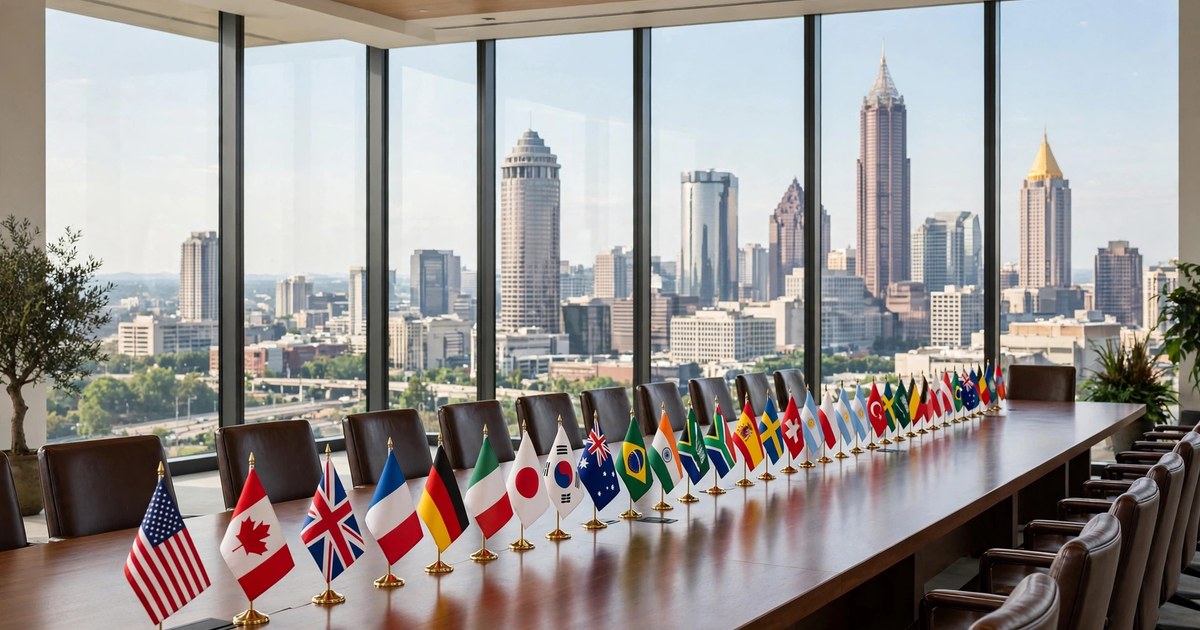
The G20 Atlanta meeting 2026 opened on Friday, 30 October 2026, bringing the foreign ministers of the world's 20 largest economies to Atlanta, Georgia, for two days of talks shaped by two wars, an energy price shock and a widening rift over Russia's place at the table. Hosted by United States Secretary of State Marco Rubio, the meeting is the first major ministerial gathering of the American presidency of the G20, and it is meant to set the agenda for the leaders' summit that President Donald Trump will host in Miami in December.
The timing could hardly be more charged. Brent crude was trading above $116 a barrel as the ministers arrived, the Strait of Hormuz remained under strain after a week of tanker attacks, and the United States was openly warning Gulf partners about possible military action against Iran after next week's midterm elections. Against that backdrop, the question hanging over Atlanta is not whether the G20 can agree on everything, but whether it can still agree on anything at all.
What Is the G20 Atlanta Meeting 2026?
The G20 Atlanta meeting 2026 is a two-day gathering of foreign ministers and senior representatives from the Group of 20, held on 30 and 31 October 2026 in Atlanta, Georgia. The United States holds the rotating presidency of the G20 in 2026, and the Atlanta meeting is its first big ministerial-level test, a rehearsal for the leaders' summit scheduled for 14 and 15 December 2026 at Trump National Doral in Miami, Florida.
The G20 brings together 19 countries plus the European Union and the African Union, and its members account for about 85 percent of global economic output and roughly three quarters of world trade, according to the German government. That weight is why a foreign ministers' meeting matters even when no treaty is signed: the group's communiques and chair's summaries set the tone for how the world's biggest economies handle energy, trade and shipping in the months that follow.
Washington has framed its presidency as a return to the group's "core mission" and "back to basics", centred on economic growth, deregulation, innovation, energy and trade, rather than on the broader political declarations of recent years. The G20 Atlanta meeting agenda reflects that framing, with practical cooperation on energy, food security, supply chains and freedom of navigation at the top of the list.
Who Is Attending the G20 Atlanta Meeting?
Nearly every G20 member sent its foreign minister or a senior representative, but the guest list itself tells the story of a divided group. Russia's Foreign Minister Sergey Lavrov arrived in Atlanta on Friday, according to the Russian state news agencies TASS and Sputnik, and he is expected to use his speech to argue against international sanctions and to promote a multipolar world order. His presence is the most sensitive part of the meeting: he is a sanctioned minister sitting at the table with the allies of Ukraine, days after deadly Russian strikes on Ukrainian cities.
China's Foreign Minister Wang Yi stayed away, sending Executive Vice Foreign Minister Ma Zhaoxu instead. That absence was read in diplomatic circles as Beijing's signal that it sees the American-chaired G20 as a stage rather than a forum. The European Union is represented by its foreign policy chief, Kaja Kallas, who is expected to press for continued support for Ukraine and for holding Russia accountable for its invasion.
India's External Affairs Minister S. Jaishankar arrived in Atlanta on 30 October for the meeting and for a series of bilateral engagements, the Ministry of External Affairs confirmed. Also attending are the foreign ministers of Germany, France, Poland, Canada, Turkey, Britain, Australia and Japan. Türkiye's Foreign Minister Hakan Fidan is expected to raise Gaza, the dispute between the United States and Iran, and attacks on shipping in the Black Sea, the Strait of Hormuz and the Bab el-Mandeb Strait.
Two notable absences underline the tensions: Ukraine, which is not a G20 member but has been invited to past gatherings, was not invited this year, and South Africa was also left off the guest list.
G20 Atlanta Meeting Agenda: Energy, Shipping and Supply Chains
The official agenda for the G20 Atlanta meeting centres on energy security, food security, resilient supply chains and freedom of navigation, according to the US State Department. American officials want the group to adopt a joint position on protecting global trade routes and keeping energy supplies secure, with the Strait of Hormuz, the Red Sea, the Black Sea and the South China Sea all named as waterways of concern.
The Hormuz question is the most urgent item. A tanker was hit by explosive devices attached by a small boat in the strait on Friday, according to the British military's United Kingdom Maritime Trade Operations centre, and Iran's Revolutionary Guards said three tankers had struck sea mines earlier in the week. Four oil tankers caught fire in the Strait of Hormuz in that earlier incident, and Brent crude has climbed to about $116 a barrel, on track for a fourth consecutive monthly gain. For energy-importing countries, including India, Japan and much of Europe, the security of that narrow waterway is not an abstraction: it is the route for a large share of the world's oil and liquefied natural gas.
The Houthi attacks on Saudi Arabia add to the pressure. On Thursday the Houthis said they had attacked the Ras Tanura refinery, the Rabigh refinery and an Aramco facility at Abqaiq, while a Saudi-led coalition said it had intercepted missiles fired towards Riyadh. The Ras Tanura refinery attack pushed oil prices to $116, and the Atlanta discussions are expected to weigh how much further disruption global energy markets can absorb. The United States has also warned Gulf partners about possible strikes on Iran after the midterm elections, a warning that gives the energy debate in Atlanta a sharper edge. Washington has warned the Gulf of Iran strikes after the midterms, and several delegations, including Saudi Arabia's, are watching that timeline closely.
Beyond energy, the G20 Atlanta meeting is expected to discuss US tariffs, China's activities in the South China Sea, and the economic consequences of the wars in Ukraine and Iran. The United States has also highlighted reliable energy access for emerging technologies, including artificial intelligence, as a theme of its presidency.
Why Lavrov's Presence Is the Most Watched Part of the Meeting
Lavrov's attendance dominates the coverage of the G20 Atlanta meeting for a simple reason: it forces the group to confront a contradiction it has lived with since 2022. Western governments want Russia isolated over its invasion of Ukraine, yet the G20's own rules give Moscow a seat, and the United States, as chair, invited Lavrov and arranged for him to attend despite his sanctioned status.
The Associated Press reported that Pentagon officials have in recent weeks asked several European governments to tone down their public rhetoric about the threat from Russia, arguing that some statements have undermined continental security. That report captures the split inside the Western camp itself: European governments want to maintain pressure on Moscow and keep assistance flowing to Kyiv, while Washington is emphasising the prospects for a diplomatic solution and has spoken of a possible round of Moscow-Kyiv-Washington talks in November.
Lavrov is expected to argue that sanctions are illegitimate instruments of pressure and to press for language on freedom of navigation that China has already rejected at the finance ministers' meeting. Whether the chair's summary can paper over those differences will be one of the clearest measures of the meeting's success.
Quad Foreign Ministers Meet on the Sidelines
On the sidelines of the G20 Atlanta meeting, the foreign ministers of the Quad, the partnership of India, the United States, Australia and Japan, are holding their third ministerial gathering of the year. Rubio is hosting Jaishankar, Australia's Penny Wong and Japan's Motegi Toshimitsu for talks expected to focus on regional and maritime security and economic resilience.
The Quad last met at ministerial level in New Delhi on 26 May 2026, so Atlanta marks a notably quick third meeting in a single year. Australia used the occasion to announce that it had joined the European Union-led "No Fees/No Tolls" pledge, opposing unlawful fees and tolls on shipping that would undermine freedom of navigation. The pledge connects directly to the G20's own agenda: if Houthi attacks and Hormuz disruptions push shipping costs up, the countries that depend on those sea lanes pay the price.
Jaishankar's schedule underlines how crowded the diplomatic calendar has become. After Atlanta he travels to Antigua and Barbuda to lead India's delegation at the Commonwealth Heads of Government Meeting from 1 to 4 November 2026.
What the G20 Atlanta Meeting Will Not Produce
Diplomatic observers do not expect the G20 Atlanta meeting to produce a comprehensive joint declaration. With the wars in Ukraine and Iran unresolved, China and Russia at odds with Washington over sanctions and sea-lane language, and a US midterm election days away, the conditions for consensus are poor. Instead, the United States is expected to issue a chair's summary reflecting the discussions and its own priorities for the G20 process.
That is a weaker outcome than a joint declaration, but it is not meaningless. A chair's summary still records where the group agreed, on energy cooperation and supply chains, for example, and where it did not. It also sets the negotiating baseline for the Miami leaders' summit in December, where Trump will host the heads of government at his Doral golf club. If Atlanta produces even a narrow agreement on keeping sea lanes open, that language is likely to reappear in Miami.
Why the G20 Atlanta Meeting Matters for Oil Prices and Everyday Life
For readers far from the conference rooms, the G20 Atlanta meeting matters because its agenda is, in effect, the price of fuel, food and freight. When tankers are attacked in the Strait of Hormuz and refineries are targeted in Saudi Arabia, Brent crude rises, and that rise feeds through to petrol and diesel prices, airline fares, shipping costs and the price of imported goods within weeks. The ministers in Atlanta are, among other things, deciding whether the world's biggest economies can coordinate a response that keeps those costs from climbing further.
The meeting also matters as a test of whether the G20 still works. The group was built for moments like this, when a financial or energy shock needs a coordinated answer. If the foreign ministers leave Atlanta with nothing more than a chair's summary and a photograph, the December summit in Miami will carry a heavier burden, and the markets will read the silence as a signal that no coordinated response is coming. If they manage even a modest agreement on energy and shipping, it will be the first sign in months that the world's largest economies can still act together while fighting two wars.
The G20 Atlanta meeting sessions continue on Saturday, 31 October, and the chair's summary is expected once the talks conclude. Worldlession will update this article as the outcomes are announced.
Sources: Associated Press; Reuters; US Department of State; TASS; Sputnik; Ministry of External Affairs of India; The Hindu.