
Background
Yemen's civil war is one of the longest-running and most complex conflicts in the modern Middle East. It began in 2014, when the Houthi movement — an armed group rooted in Yemen's north — seized the capital, Sanaa, and forced the internationally recognized government into exile. In March 2015, a coalition led by Saudi Arabia intervened militarily with the stated goal of restoring that government and pushing back Houthi control.
The United Arab Emirates quickly became the coalition's second most important partner. While Saudi Arabia led the air campaign and backed forces loyal to the recognized government, the UAE focused on the ground: funding, training and equipping southern Yemeni fighters, including the Giants Brigades (known in Arabic as Al-Amaliqa), a force drawn largely from southern Yemen that became one of the most effective anti-Houthi units, particularly along the Red Sea coast.
But the alliance was never a simple one. The UAE's closest Yemeni partners have ties to the Southern Transitional Council (STC), a separatist movement that wants an independent state in southern Yemen — which was a separate country before unification in 1990. Saudi Arabia, by contrast, officially supports a unified Yemen under the recognized government. For years the two allies managed this tension. In January 2026, it snapped: the UAE withdrew from Yemen operations after a dispute over the STC's secession push, during which Saudi forces bombed UAE arms shipments. A Reuters investigation in February then reported that Saudi Arabia had allocated nearly $3 billion to cover salaries that the UAE had previously paid — a measure of just how deep the rupture ran.
For months afterward, the anti-Houthi coalition operated in a visibly strained state. Saudi Arabia carried much of the financial and military burden alone, while southern forces that had depended on Emirati backing faced an uncertain future. The reported October agreement, if it holds, would be the first significant step toward repairing that breach.
What Happened
On October 17, 2026, The Guardian reported that the UAE had agreed to resume funding selected southern Yemeni forces — notably the Giants Brigades — that are fighting the Houthis, while Saudi Arabia had agreed to provide air cover for those forces. The report cited sources inside Yemen familiar with the arrangement.
An important caveat runs through this story: neither Riyadh nor Abu Dhabi has publicly confirmed the agreement. The details come from unnamed sources rather than official announcements, so the funding restart and the air-cover commitment should be treated as reported, not confirmed, until either government speaks on the record.
Timing added weight to the report. On October 18, the UAE's state news agency WAM announced that UAE President Mohammed bin Zayed had met Saudi Defence Minister Prince Khalid bin Salman in Abu Dhabi to discuss regional security. No official statement linked the meeting to the Yemen arrangement, but the encounter between the two countries' top security figures, one day after the Guardian report, was widely noted as a sign that high-level coordination between the two capitals is active.
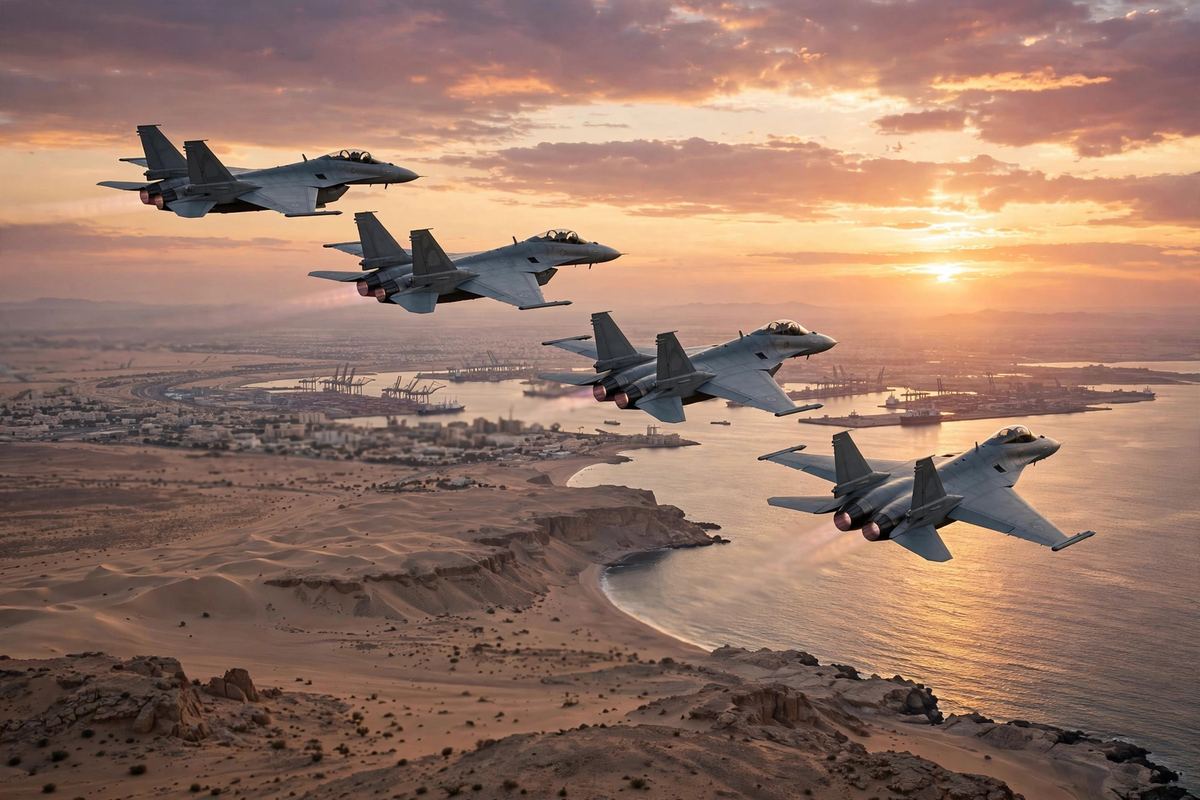
In practical terms, the reported deal would restore a division of labor that defined the coalition at its most effective: Emirati money and backing for capable southern ground forces, paired with Saudi air power overhead. The Giants Brigades, as the named beneficiary, sit at the center of this picture — a force with a track record against the Houthis and long-standing ties to Emirati support networks.
Why It Matters
The backdrop to this reported thaw is a sharp escalation by the Houthis. Recent weeks have seen daily drone and missile attacks on Saudi airports and energy infrastructure, a sustained campaign that has strained Saudi air defenses and rattled regional markets. The conflict has also edged closer to civilian aviation: Houthi missiles struck near Aden airport, close to a departing Yemenia passenger plane, and an earlier strike on Aden's presidential palace killed five people.
Against that pressure, a reunited coalition matters for several reasons. First, it could change the military balance in southern Yemen. Funded, well-supplied ground forces operating under friendly air cover are a far more potent combination than either element alone — and the Giants Brigades have demonstrated what that combination can achieve in past campaigns.
Second, it signals Gulf unity at a moment when disunity has been costly. The months-long rift gave the Houthis room to press their advantage while the coalition's two pillars worked at cross-purposes. A genuine reconciliation would close that gap and present a more coherent front, both militarily and diplomatically.
Third, the deal tests whether the underlying disagreement has really been resolved. The UAE's southern partners and their secessionist sympathies were the cause of the January rupture. Resuming funding for the same southern forces without a new political understanding with Riyadh could simply rebuild the old fault line. Whether the October arrangement includes any fresh accommodation on the southern question — or merely papers over it — is one of the key unknowns.
Finally, there is the humanitarian dimension. Yemen remains one of the world's worst humanitarian crises, with millions dependent on aid. Any shift in the military balance — escalation or de-escalation — carries direct consequences for civilians, aid access and the prospects, however distant, of a negotiated settlement. Readers following the wider regional picture may also want context on related flashpoints, from strikes on Saudi energy infrastructure to Saudi retaliation against Houthi targets.
Key Facts
The story, as reported, rests on a short chain of events. In January 2026, the UAE withdrew from Yemen operations after Saudi forces bombed Emirati arms shipments amid a dispute over the Southern Transitional Council's secession push. In February, Reuters reported that Saudi Arabia allocated nearly $3 billion to replace UAE-funded salaries. On October 17, The Guardian reported — citing sources in Yemen — that the UAE had agreed to resume funding selected southern Yemeni forces, notably the Giants Brigades, with Saudi Arabia providing air cover. On October 18, UAE President Mohammed bin Zayed met Saudi Defence Minister Prince Khalid bin Salman in Abu Dhabi for talks on regional security, according to the state agency WAM.
What is confirmed versus what is reported deserves emphasis. Confirmed: the January withdrawal, the February Reuters reporting on Saudi spending, and the October 18 leadership meeting in Abu Dhabi. Reported but unconfirmed: the funding resumption and the air-cover commitment themselves. The distinction matters because both governments have, in the past, let Yemen-related arrangements proceed quietly without public acknowledgment.
The escalation context is likewise grounded in reported events: daily Houthi drone and missile attacks on Saudi airports and energy sites, missiles landing near Aden airport in proximity to a departing Yemenia passenger plane, and the earlier Aden presidential palace strike that killed five. These incidents frame the urgency behind the reported rapprochement — and explain why developments such as attacks on Riyadh's airport and Gulf calls for joint security have been trending in regional coverage.
What Happens Next
The immediate question is whether either government confirms the arrangement — or whether, as with past Gulf understandings, it proceeds without public acknowledgment. Official confirmation would signal a durable political commitment; continued silence would suggest a more tentative, reversible step.
Watch next for signs of implementation. Funding agreements of this kind leave traces: renewed recruitment or mobilization by the Giants Brigades, fresh supplies reaching southern units, and coordinated air activity over front lines where those forces operate. The Houthi response will also be telling — whether the group treats the reported thaw as a provocation to escalate or as a reason to recalculate.
The southern political question looms over everything. If the STC interprets renewed Emirati funding as a green light for its secession agenda, friction with Riyadh could resurface quickly. If, instead, the funding comes with understandings that keep southern ambitions in check, the coalition may have found a more stable formula. Either way, the January rift showed how fast the partnership can fracture when the two capitals read southern Yemen differently.
Beyond the battlefield, diplomats and analysts will be watching for ripple effects: whether the thaw extends to other files where Riyadh and Abu Dhabi have diverged, how it affects back-channel discussions about Yemen's future, and what it means for civilians caught between the front lines. For now, the story stands as a reported turning point in one of the region's most consequential rivalries-turned-partnerships — significant if true, and worth following closely either way.
Sources: The Guardian, Al Mayadeen — October 2026