
The sprint begins
Three weeks before the United States midterm elections, President Donald Trump has taken to the road with one of the most intense campaign schedules of his second term: a six-rallies-in-six-days swing through Alaska, Arizona, Montana, Georgia and Kentucky. The tour, described in news coverage as his "pretend I'm on the ballot" pitch, is designed to turn out Republican voters in a midterm year when the president himself is not a candidate. On Wednesday, October 14, the tour reached Bullhead City, Arizona, and Kalispell, Montana, two stops that illustrate the two very different jobs the president is trying to do at once: defend a swing state where his party is on the defensive, and energise a friendly district where turnout, not persuasion, is the main task.
The timing matters. Early voting in Arizona began on October 7, and in a state where roughly 80 percent of voters cast their ballots by mail, the campaign's final weeks are less about changing minds from scratch and more about making sure supporters actually return their ballots. Nationally, the election on November 3 will decide control of the House of Representatives and the Senate, along with governor's offices and state legislatures across the country. Midterm elections historically punish the president's party, and this cycle has been no exception in the polling: reports on the tour note that the president's approval rating has sunk amid the war in Iran and a tariff agenda that has increased everyday costs.
What happened in Arizona
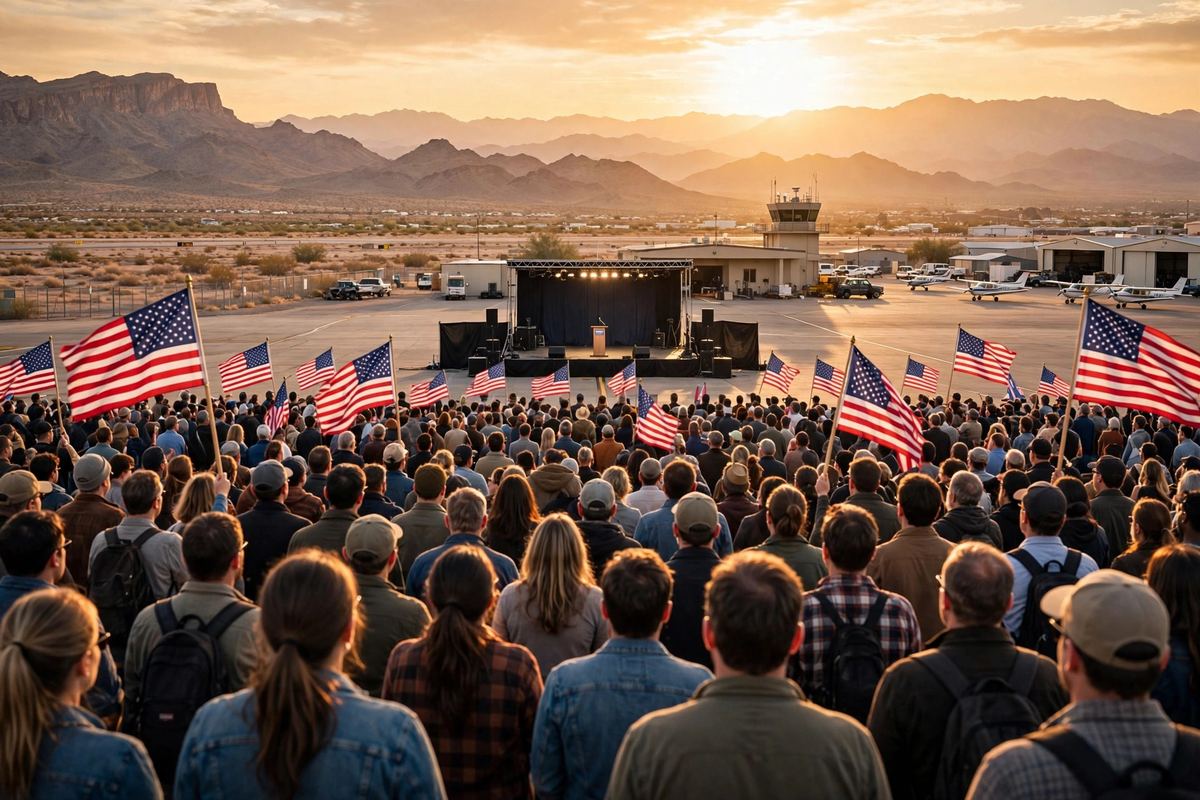
The Arizona stop took place at Laughlin Bullhead International Airport in Bullhead City, in ruby-red Mohave County. Doors opened at 9:30 a.m. local time, with the president speaking in the early afternoon. The choice of location was deliberate in a particular way: Mohave County is one of the most Republican corners of Arizona. Trump received more than 77 percent of the vote there in 2024 and previously headlined a rally there in 2020. It was his third trip to Arizona during his second term, following a September 2025 memorial service in Glendale and an April 2026 event in Phoenix.
The rally's stated purpose was to support Republican candidates headed by Representative Andy Biggs, who is seeking the governorship against Democratic incumbent Katie Hobbs. Yet the day also exposed the tension inside the Arizona Republican campaign. According to reporting in the Arizona Republic, the Republican nominees in Arizona's two most competitive House races did not attend the Bullhead City rally. Aides said Jay Feely and Representative Juan Ciscomani were busy elsewhere, with Ciscomani's office citing long-planned commitments in the Tucson area. Democrats have spent heavily tying both men to the president, and a HighGround poll released October 13 pointed to a difficult cycle for Arizona Republicans, with unenthusiastic Republican voters and independents favouring Democrats in key races. Three weeks out, distance from the president appeared to be the campaign strategy in Arizona's swing seats, even as the president drew a large crowd in a friendly county.
During his remarks, Trump defended his tariff agenda, which has become one of the most controversial parts of his presidency. "I impose a 50 percent tariff on foreign copper and as a result Arizona's historic copper is roaring back to health," he said, according to live coverage. He also took credit for the growth of the state's semiconductor sector and argued that tariffs, had they been imposed earlier, would have kept big manufacturers from moving abroad. On the war in Iran, which has pushed gas prices up by roughly 40 percent in Arizona, he claimed Iran had been two weeks away from completing a nuclear weapon when the United States attacked, said the war would end "very soon," and promised that when it ends, gasoline prices would fall "to even lower than it was before," calling the higher prices a "very small price" to pay.
On to Montana the same day
After Bullhead City, the president flew on to Kalispell, in western Montana, to campaign for Aaron Flint, the Republican nominee in Montana's 1st Congressional District, who faces Democrat Sam Forstag. The Montana rally was scheduled for the evening at the Majestic Valley Arena. The district leans Republican — Trump won the county by more than 65 percent in 2024 — but the stop fits the same pattern as Arizona: use the president's drawing power to lift turnout in a race his party wants to lock down. Earlier stops on the swing included Wasilla, Alaska, on October 13, with Georgia and Kentucky still to come.
The broader picture described by national reporting is of a Republican campaign playing defence. Republicans have been halting national spending in some House races in New Jersey and Iowa, a sign that the map is shrinking, while Democrats have been racing to raise money for candidates who looked like long shots earlier in the year. The president's tour is the counterweight: a burst of energy intended to change the mood of the final three weeks and to remind core supporters that the election is effectively already under way.
Why midterms turn on turnout
American midterm elections are famous for one pattern above all: the party that holds the White House usually loses ground. That is partly because the president's supporters, having won two years earlier, are less motivated to vote again, while the opposition is energised. It is also because midterms are often read as a verdict on the president's first two years. This year, that verdict is tangled up with two issues that cut across party lines: the cost of living and the war in Iran. Gas prices, grocery bills and tariff-driven price increases are the daily evidence voters weigh, and both parties have spent the autumn arguing over who is to blame.
That is why the president's message on the tour has combined defence and promise: defence of tariffs as a tool that revives industries such as copper and semiconductors, and promises that the costs voters feel now will be followed by relief. His line to supporters — to vote as though he were on the ballot — is an attempt to solve the classic midterm problem by personalising an election in which his name does not appear. Whether that works depends less on the size of rally crowds in friendly counties than on whether swing voters in places such as Arizona's competitive House districts, who did not show up to hear him, decide to vote at all.
What to watch next
The remaining stops in Georgia and Kentucky will test the same theory in different terrain. Georgia is a genuine battleground with statewide races that could help decide Senate control; Kentucky offers a friendly stage for the base. Beyond the rallies, three things will shape the final stretch: early-voting returns in states such as Arizona, where ballots are already being cast; whether Democrats can convert their fundraising advantage into turnout in House districts Republicans have begun to abandon; and whether the president's promises on gas prices and the Iran war hold up in the news cycle. A further signal came from the Texas Senate race, where a Marist poll reported by CNN showed Democrat James Talarico and Republican Ken Paxton separated by only two points, well within the margin of error — a reminder that even races in traditionally Republican states are competitive this year. The sprint will end, but the counting will not begin in earnest until November 3. For more on how the administration's trade and economic agenda is playing into the campaign, see our explainers on the president's resource and trade claims and September's inflation figures, and on the campaign's advertising effort in taxpayer-funded pro-Trump ads.
Key facts
- Election Day for the US midterms is November 3, 2026; early voting in Arizona began October 7.
- Trump's six-rallies-in-six-days swing covers Alaska, Arizona, Montana, Georgia and Kentucky.
- The Arizona rally was held at Laughlin Bullhead International Airport in Mohave County, where Trump won more than 77 percent in 2024.
- The Montana stop backed Aaron Flint in the 1st Congressional District against Democrat Sam Forstag.
- Arizona's two most competitive House Republican nominees did not attend the Bullhead City rally, per the Arizona Republic.
The president stirred controversy in the region in another way too, demanding that neighbouring New Mexico rename itself 'New America'.