
What happened
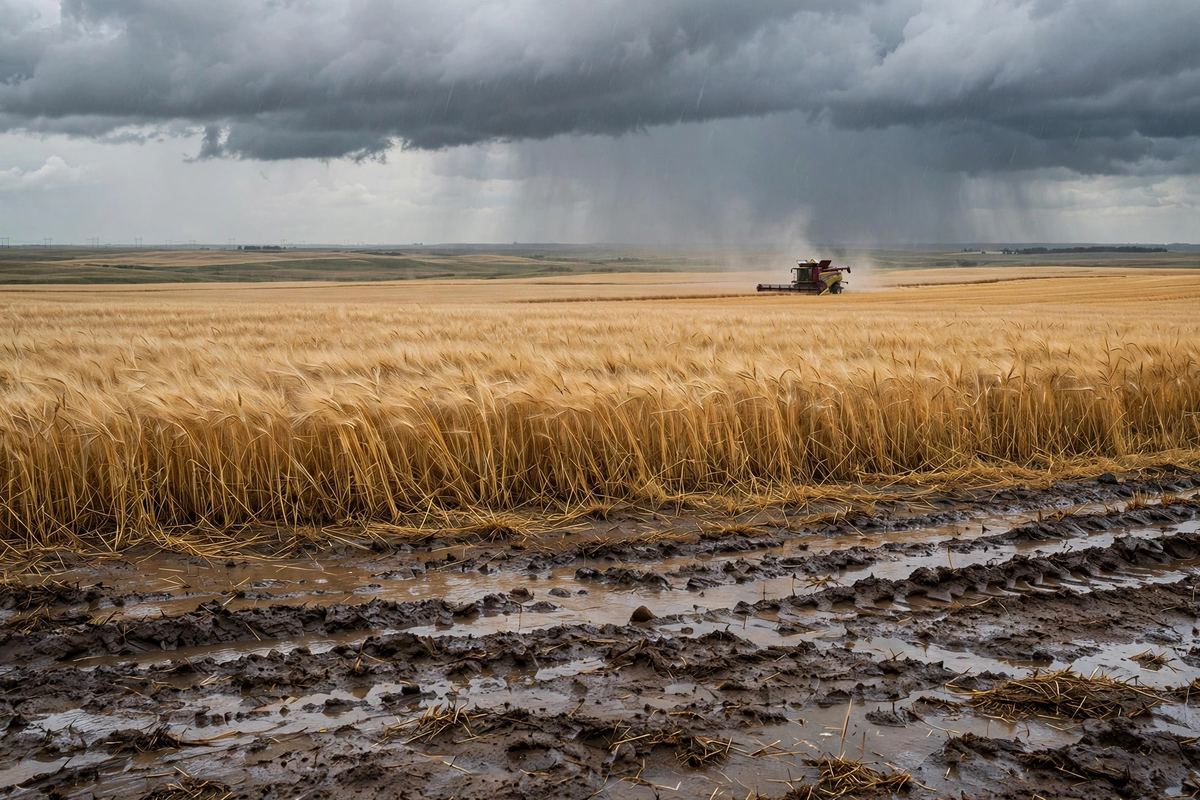
Canadian farmers struggled to bring in this year's crops after an unseasonably wet September, and farmers and crop quality assessors are now reporting damage to pulse crops and spring wheat in one of the world's top-five wheat exporters. Farmers were weeks behind their usual harvesting progress in many Prairie provinces from the beginning of September through early October, normally the driest time of the growing season. By September 21, Saskatchewan's harvest was just 41% complete, compared with a five-year average of 82%. Most farmers have since finished harvesting, but the crop many brought in was degraded from the top-quality prospect they had at the end of August. What had promised to be an excellent harvest became a salvage operation.
The damage is visible at the Canadian Grain Commission's headquarters in Winnipeg, where inspectors have been poring over samples of spring wheat that suffered sprouting, likely making that crop unworthy of food grade, and of red lentils that were bleached and shrivelled by the September rains. Sprouting happens when mature grain gets wet and begins to germinate in the field or in storage: the kernels soften, enzymes break down starches, and the grain loses the qualities millers need for bread and pasta flour. Bleaching and shrivelling in lentils reduce their appearance and cooking quality, which lowers their market grade. None of this means the crop is worthless, but it does mean farmers get paid less for it, and some of it will be downgraded to animal feed rather than sold for human food.
Manitoba farmer Eric McLean's experience captures the season. He had what he thought were great wheat and oats crops in his fields in August, but now a few of them are write-offs, he thinks. "There's an adjuster coming here within the hour," he said, hoping crop insurance would cover some of his losses. Fields he managed to harvest in early September between rains produced good crops, but those left out suffered. That timing lottery, between neighbours and even between fields on the same farm, is the defining feature of a wet harvest: the rain does not destroy everything evenly, it punishes whoever could not get into the field in time. Climate change is increasing the frequency of exactly this kind of disruptive weather, with warmer air holding more moisture and producing heavier rainfall events.
Why it matters beyond the Prairies
Canada's role in global food markets is far larger than its population suggests. The country is the world's biggest exporter of durum wheat, the hard wheat used to make pasta; of canola, used as vegetable oil; and of pulse crops such as lentils, which are a mainstay food in India and the Middle East. Its spring wheat crop is valued by global bread-makers for its protein content and baking quality. When Canadian quality falls, millers and food manufacturers in dozens of countries feel it, either through higher prices or through having to blend in lower-quality grain. Reuters reported that a lack of quality crops from Canada could contribute to tighter global wheat stocks and broadly higher food prices amid wars in Ukraine and the Middle East, which have already disrupted grain flows from the Black Sea.
The timing compounds the problem. Ukraine's grain exports have been disrupted by war, and Middle East shipping routes have been hit by attacks in the Strait of Hormuz and the Red Sea. Global wheat stocks were already under pressure before Canada's wet harvest, so the loss of top-quality Canadian grain removes one of the few buffers the market had. The effect on retail food prices will not be immediate or uniform: wheat is a small share of the cost of a loaf of bread, and supply chains hold months of inventory. But over the coming year, buyers in import-dependent countries, particularly in the Middle East and South Asia, are likely to pay more for the quality they need, and some will have to accept lower grades. For households already squeezed by energy-driven inflation, that is unwelcome news.
There is also a domestic dimension. Canadian farmers face not just lower prices for downgraded grain but higher costs: grain that comes in wet must be dried before it can be stored safely, and drying costs money. Some farmers will face insurance claims, and the quality provisions of provincial crop insurance are now at the centre of this year's claims. Saskatchewan's harvest was 41% complete as of September 21 against a five-year average of 82%, and in Manitoba, 43% of the crop had been harvested by the same date, with spring cereal quality good in early-harvested fields but sprouting and weathering in more recently harvested crops. In Alberta, the harvest was 23% complete as of September 15, compared with a five-year average of 58%. The pattern was consistent across all three Prairie provinces: behind schedule, and worse the longer the crop stood in the rain.
Is this a one-off, or a pattern?
A single wet September does not prove a trend, but it fits a pattern that agronomists have been warning about for years. Warmer air holds more moisture, which means rainfall events are becoming more intense, and the growing season is becoming more erratic. Farmers who once counted on a dry September to bring in the harvest now face a higher chance of rain at exactly the wrong moment. At the same time, the breeding that has made modern crops more resilient has limits: as one analyst put it, crops have been bred to perform under non-optimal conditions, and there is greater resiliency than many feared. Some analysts have even suggested that the damage to grain quality might not be as bad as initially feared, with the Canadian Grain Commission's early quality reports not indicating a disaster.
That cautious optimism is worth noting, because it tempers the worst-case reading. The Canadian Grain Commission says it is too early to comment definitively on crop quality, but its wheat and durum quality reports do not indicate a major disaster. Analysts at FarmLink Marketing Solutions and Exceed Grain Marketing have both suggested that quality results may be better than feared in mid-September, when the rain seemed endless. The harvest is not a total loss; it is a downgrade. But a downgrade still costs farmers money, and it still tightens global supplies of top-quality grain. The distinction between "not a disaster" and "fine" is where most of this year's story lives.
What happens next
Official government and industry estimates reflecting the damage will not come until mid-November, when quality assessments are complete. Until then, the market is trading on samples, surveys and anecdotes. Farmers will be filing insurance claims, drying grain and deciding how much of their downgraded crop to sell as feed. Buyers in India, the Middle East and elsewhere will be adjusting their sourcing, and the India-Canada trade relationship, which includes pulses as a significant item, will be one channel through which the effects flow. Households can expect the impact to show up gradually, in the price of pasta, bread and lentils, rather than in a sudden spike. And for farmers, the lesson of 2026 is the same one every wet harvest teaches: the crop is only as good as the weather that lets you bring it in.
The longer-term response is adaptation: better drainage, more drying capacity, varieties bred for sprouting resistance, and insurance products that reflect the new weather reality. Canada's Prairie farmers have adapted before, and they will adapt again. But the wet harvest of 2026 is a reminder that even the world's most productive farmland is at the mercy of the sky, and that a few weeks of rain at the wrong time can ripple from a Manitoba field to a dinner table on the other side of the world. Readers looking for practical ways to manage rising food costs can find tips in the guide to saving money on groceries.