
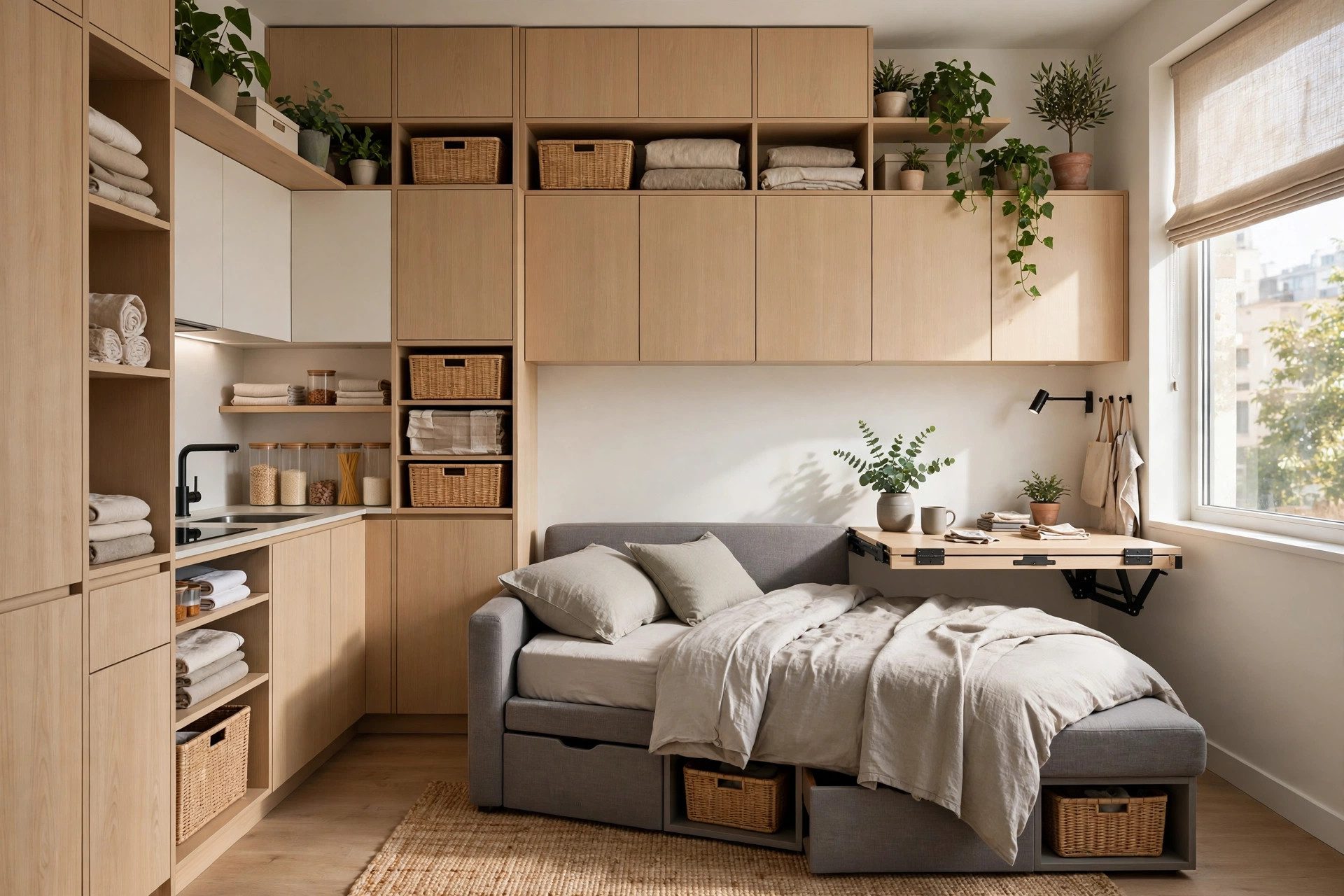
More people than ever live in small spaces — studio apartments, tiny homes, compact city flats. Small doesn't have to mean cramped. With smart furniture choices, vertical thinking, and a few design principles, even 400 square feet can feel spacious, organized, and genuinely comfortable.
This guide covers proven space-saving strategies: multi-functional furniture, vertical storage, visual tricks that expand a room, and room-by-room ideas that work in real homes.
The Mindset: Small Space Principles
Successful small-space living rests on three principles. First, every item must earn its footprint — single-purpose objects are luxuries small homes can't afford. Second, think in cubic feet, not square feet — walls and ceilings are storage waiting to happen. Third, visual calm equals perceived space — clutter shrinks rooms psychologically before it does physically.
Multi-Functional Furniture: The Core Strategy
- Storage ottomans and benches — seating, footrest, coffee table, and hidden storage in one.
- Murphy beds and sofa beds — reclaim 30+ square feet of floor during the day; modern wall beds are far more comfortable than old fold-outs.
- Drop-leaf and extendable tables — dine for two daily, expand for six when guests come.
- Nesting tables — pull apart when needed, stack when not.
- Loft beds — in rooms with decent ceiling height, sleeping above frees the entire footprint below for a desk or lounge.
- Storage beds — drawers or hydraulic lift-up platforms turn dead under-bed space into dresser-equivalent storage.
Go Vertical: Walls Are Square Footage
Floor space is finite; wall space is abundant. Floor-to-ceiling shelving draws the eye up and makes ceilings feel higher. In kitchens, magnetic knife strips, hanging pot racks, and wall-mounted spice shelves free entire cabinets. Pegboards — in offices, craft areas, even kitchens — offer endlessly reconfigurable storage.
Don't forget the backs of doors: over-door organizers work in bathrooms, bedrooms, and pantries. And the space above door frames can hold a shallow shelf for rarely used items.
Visual Tricks That Make Rooms Feel Bigger
Light and Color
Light colors reflect more light and recede visually; paint walls and ceiling the same light shade to blur boundaries. Maximize natural light — sheer curtains instead of heavy drapes — and add mirrors opposite windows to double the effect.
Furniture Scale and Placement
Choose furniture with visible legs — seeing floor underneath creates an illusion of space. A few larger pieces feel calmer than many small ones (visual fragmentation shrinks rooms). Float furniture slightly off walls where possible; a few inches of shadow adds depth.
Declutter Ruthlessly
In small spaces, every object is visually louder. The decluttering principles in our home guide matter doubly here: open surfaces should be at least half clear.
Room-by-Room Ideas
The Living Area
Mount the TV on the wall instead of a media console. Use a loveseat rather than a full sofa if the room is narrow. A round dining table fits tight corners better than a rectangular one and seats more per inch of perimeter.
The Kitchen
Small kitchens reward verticality: stackable shelves inside cabinets double capacity; a rolling cart adds prep space that tucks away. Keep counters near-empty — appliance garages or cabinet storage for the toaster and mixer transform the feel. A fold-down wall table can serve as a breakfast bar.
The Bedroom
Under-bed storage is the bedroom's secret weapon — drawers, vacuum bags for seasonal clothes, or a full storage bed. Wall-mounted nightstands (floating shelves) free floor space. If the closet is tiny, a freestanding garment rack with a curtain looks intentional and adds capacity.
The Bathroom
Over-toilet shelving exploits dead space. A mirrored medicine cabinet replaces both mirror and storage. Shower caddies that hang from the showerhead or tension-rod corner shelves multiply storage without drilling. Decant products into matching bottles — visual uniformity reads as tidiness.
The Entryway
Even a 2-foot entry needs a system: wall hooks for coats and bags, a slim shoe rack or cabinet, and a small tray for keys. Without a landing zone, clutter migrates into the living space.
Zoning: Defining Areas Without Walls
Studio apartments need psychological separation between sleeping, working, and relaxing. Use rugs to anchor zones, open shelving units as permeable dividers, curtains on ceiling tracks for flexible privacy, and lighting — a warm lamp over the "living room," a task light at the "office." Each zone should have its own light source.
Storage Everywhere: Hidden Opportunities
- Stair space (in multi-level tiny homes): drawers built into stair risers.
- Window sills: deep sills become display shelves or herb gardens.
- Under-stair closets: often the largest hidden volume in a small home.
- Furniture backs: the back of a bookshelf facing a room can hold hooks or a fold-down desk.
- Ceiling-mounted racks in kitchens and garages for bikes and seasonal gear.
Budget-Friendly Upgrades With Big Impact
You don't need a renovation budget to transform a small space. A large mirror ($30–60) opposite a window is the single highest-impact upgrade per dollar — it doubles light and visually doubles the room. Peel-and-stick wallpaper or a bold accent wall adds depth and personality without landlord conflicts. Swapping a single harsh overhead bulb for three warm light sources (a floor lamp, a table lamp, string lights) instantly makes a small room feel layered and intentional rather than flat.
Textiles do heavy lifting too: a properly sized rug (large enough that front furniture legs sit on it) anchors a zone and makes the floor area feel generous, while matching curtain panels hung high and wide make windows — and the whole wall — feel larger. Even small moves compound: decanting pantry goods into uniform jars, corralling bathroom products onto a single tray, and hiding cables behind a $10 cord cover each remove one more source of visual noise.
Common Small-Space Mistakes
- Buying storage before decluttering — containers organize clutter; they don't remove it.
- Dark, heavy furniture that visually anchors and shrinks the room.
- Pushing everything against walls — counterintuitively, floating pieces can make rooms feel larger.
- Ignoring lighting layers — a single overhead light flattens space; add floor, table, and task lighting.
- No designated homes for items — in small spaces, "I'll put it away later" becomes permanent clutter within days.
Small Living, Big Life
The best small homes aren't shrunken versions of big ones — they're designed around how their owners actually live. Less space to clean, lower costs, and forced intentionality about possessions are genuine advantages, not consolation prizes. Start with one change — a mirror, a storage ottoman, a cleared counter — and watch the room transform. Browse more in our home & living collection.