
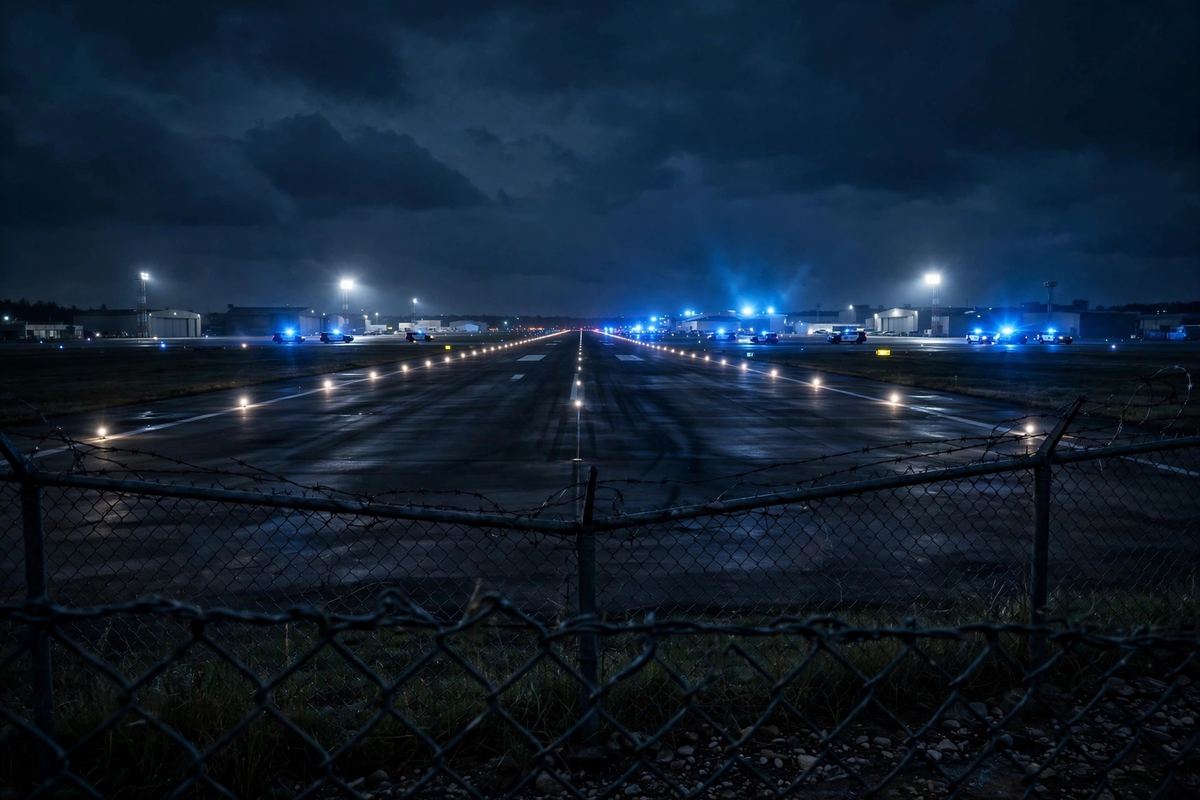
In the early hours of the morning, a phone call to police about three suspicious vehicles heading toward a military airbase triggered a major counter-terrorism operation in the English countryside. By dawn, five men had been arrested near RAF Fairford on suspicion of explosives offences, homes in a nearby village had been evacuated, and the British government was publicly pointing the finger at Iran — a claim Tehran firmly denies. Here is a clear, step-by-step explanation of what happened, what the key terms mean, and what could happen next.
What is RAF Fairford, and why does it matter?
RAF Fairford is a Royal Air Force station in Gloucestershire, in the west of England. Although it carries an RAF name, it functions as a standby and forward operating base for the United States Air Force, and it has hosted American heavy bomber aircraft during overseas deployments. The base is part of the long-standing military partnership between the United Kingdom and the United States, under which American forces operate from several British sites.
Bases like Fairford are protected by strict security perimeters, and because of the aircraft, personnel, and operations connected to them, they are treated as high-value and sensitive sites. That strategic importance is exactly why any security incident in the area draws an immediate and large-scale response from police and the security services.
What happened on the night of the arrests
According to police accounts, the incident began shortly after midnight. At around 12:45 am, officers received a call reporting three suspicious vehicles heading in the direction of RAF Fairford. Police responded to the report, and five men were arrested near the airbase.
The men were arrested on suspicion of explosives offences — a serious category of criminal offence under UK law that covers the possession, manufacture, transport, or handling of explosive substances with unlawful intent. Following the arrests, homes in the nearby village of Whelford, Gloucestershire, were evacuated as a precaution while officers carried out searches. British intelligence later shared with European counterparts that the suspects had attempted to target American bombers with small drones fitted with explosives, though only petrol cans were found in the suspects' vehicles, according to Le Monde. Evacuations of this kind are a standard safety measure: until officers are certain that no dangerous materials are present at a location, nearby residents are moved out of harm's way while specialists do their work.
What do 'explosives offences' mean under UK law?
The United Kingdom treats offences involving explosives with exceptional seriousness, and several different laws can apply depending on the circumstances. The Explosive Substances Act 1883, for example, makes it an offence to possess or make explosives with intent to endanger life or damage property, while the Terrorism Act 2000 covers acts connected to terrorism, including the possession of articles for terrorist purposes.
It is important to understand that an arrest is not the same as a charge or a conviction. In the UK, police can arrest a person on reasonable suspicion that an offence has been committed; investigators then gather evidence before prosecutors decide whether anyone should be formally charged. This is a core part of how the rule of law works in a democracy: everyone is presumed innocent until proven guilty, and the state must build its case through evidence.
The Iran allegation — and Tehran's denial
One of the most politically charged aspects of the case is the British government's statement that Iran had a role in the alleged plot. Iran has firmly denied any involvement. This kind of allegation-and-denial pattern is common in international security incidents: governments sometimes publicly attribute plots to foreign states based on intelligence they do not fully disclose, while the accused state rejects the claim.
Readers should treat such claims carefully. An official allegation is not the same as a proven fact established in court, and intelligence assessments can later be confirmed, qualified, or withdrawn as investigations progress. The diplomatic dimension matters too: accusations between states can affect embassies, sanctions discussions, and wider foreign policy, which is why governments weigh their public statements carefully.
A separate arrest in London
Alongside the five arrests near the airbase, a 27-year-old British-Iranian national was arrested in London on suspicion of terrorism offences. Police have not publicly detailed how, if at all, this arrest connects to the Fairford operation, and investigators typically keep such links undisclosed in the early stages of a case to protect the integrity of their inquiries.
The dual nationality of the suspect has drawn attention because of the broader context of UK-Iran tensions, but again, the facts of any individual case must be established through investigation and, if charges follow, through the courts — not through speculation about a person's background.
Why were suspects released on bail? Trump's reaction explained
US President Donald Trump commented on the case, saying the suspects had been 'looking to do big damage' and expressing surprise that they had been released on bail. His reaction highlights a common public misunderstanding of how bail works.
In the UK, being released on bail (or released under investigation) does not mean a suspect has been cleared. It means investigators need more time to gather evidence — forensics on seized vehicles and devices, for example, can take days or weeks — and a court or senior officer has decided the person can be released under conditions while inquiries continue. Bail conditions can include surrendering a passport, observing a curfew, or reporting regularly to a police station. If evidence emerges, suspects can be re-arrested and charged.
Counter-terrorism investigations often involve this pattern: early arrests to disrupt a suspected plot and secure evidence, followed by releases while painstaking forensic and digital analysis continues. Protecting the public from online radicalisation and digital attack planning is part of the same picture — see our guide on how cybersecurity protects people and infrastructure.
Why this case matters
There are several reasons this incident has drawn international attention:
- Critical infrastructure: An alleged plot targeting a military airbase strikes at national defence assets, which is why the response was so large and rapid.
- The US-UK alliance: Because Fairford hosts US Air Force operations, the case touches the military partnership between two close allies — which helps explain why the US president commented on it.
- The Iran dimension: If the allegation of Iranian involvement is substantiated, it would mark a serious escalation; if not, the episode still strains diplomatic relations.
- Public safety: The evacuation of Whelford homes is a reminder of how counter-terrorism operations directly affect ordinary communities.
What happens next?
Several tracks will now unfold in parallel. The criminal investigation continues: forensic examination of the vehicles, phones, and properties searched, after which prosecutors will decide whether to charge any of the arrested men. The diplomatic track will see the UK and Iran trade statements, and possibly actions, depending on what evidence emerges. Security reviews around RAF Fairford and similar installations are likely, as authorities examine how the suspects allegedly approached the base and whether perimeter defences need strengthening.
Prosecutors have now decided. On 27 October, two men aged 24 were charged under the National Security Act 2023 and appeared at Westminster Magistrates' Court: Mohmed Ahmad Abdulkarim, charged with conduct likely to assist a foreign intelligence service — which Counter Terrorism Policing said it believed to be Iran — and Nouman Essghir, charged with entering RAF Fairford, a prohibited place, on 22 August, for a purpose prejudicial to the UK. Essghir remains in custody until a hearing on 20 November; Abdulkarim was released on bail. The UK also imposed sanctions on two Iranians, including Ruhollah Bazghandi, described as the suspected mastermind of the Fairford operation and a senior IRGC counter-espionage figure. The charges are accusations, not findings of guilt.
For more explainers on major October 2026 stories, see our guide to the Delhi Jantar Mantar protest.
The strain on Britain's security services is showing elsewhere too: a police officer was shot in Nottingham city centre, with four people arrested.