
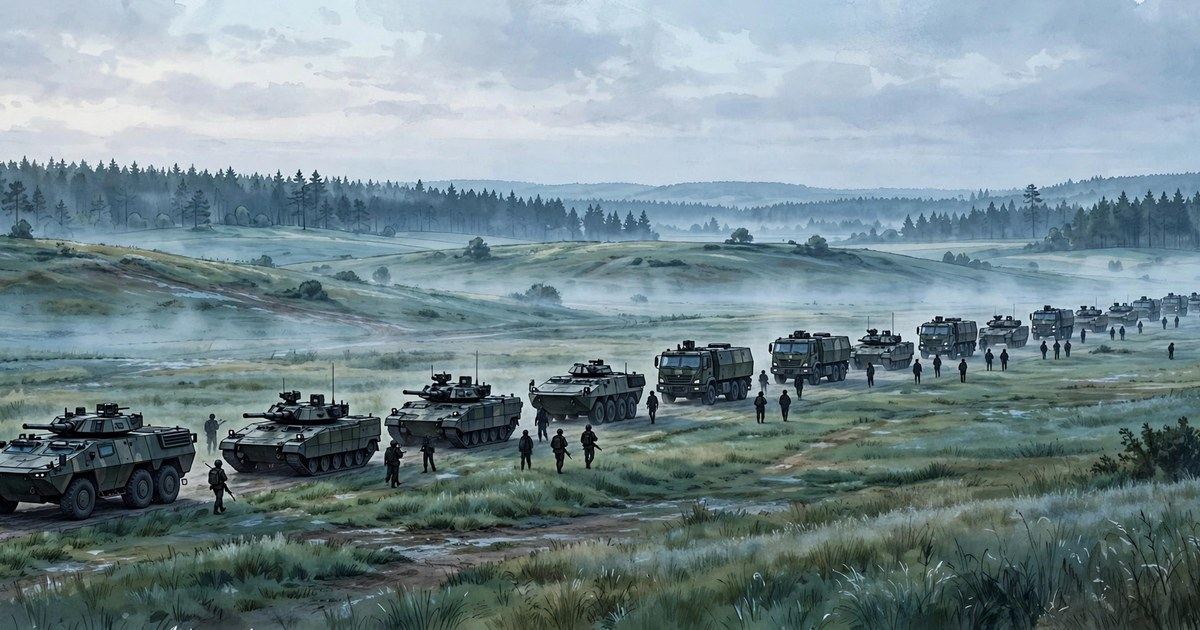
At least 1,500 troops from Britain, France and Germany will take part in major military exercises in Poland this November, rehearsing the movement of a multinational force into Ukraine following a potential ceasefire with Russia, according to reports trending per news coverage on 18 October 2026.
The exercises were first reported by The Times on 17 October and confirmed by British Defence Secretary Wes Streeting during his first visit to the United States. Speaking in Washington DC, Streeting said thousands of military personnel would take part in the November drills, which are designed to test preparations for supporting Ukraine's postwar security, military training and reconstruction.
What the exercises will test
According to The Times, the wargame will simulate the deployment of multinational units into a single territory, rehearsing the practical requirements of moving personnel, vehicles, fuel, food and other essential supplies across borders. Defence officials said the drills would test rapid deployment capabilities, logistics, command coordination and cooperation between units from different countries operating side by side.
A source in the British defence ministry told The Times the exercise would practice a scenario in which "multinational forces are stationed together in a single territory." Polish forces will join the 1,500 troops from the United Kingdom, France and Germany, and Polish Prime Minister Donald Tusk has described the presence of French and British troops as "crucial" for confronting the Russian threat.
The Coalition of the Willing
The November manoeuvres form part of the Coalition of the Willing initiative, a grouping of European countries working on potential security guarantees for Ukraine once fighting ends. Plans for the exercises were agreed at a coalition summit in July, where European leaders discussed what an international security contingent for Ukraine could look like.
UK Defence Secretary Streeting framed the exercises as the centrepiece of Britain's leadership of the coalition: "Ukraine is the front line for freedom everywhere, and it's absolutely vital that they prevail against Putin's aggression. We're planning for the peace and freedom we want to see through our leadership of the coalition of the willing."
The exercises represent the first large-scale rehearsal of the coalition's postwar plans. Officials stress that the November drills do not amount to a final decision on deploying European troops to Ukraine — but they are a concrete step toward making such a deployment operationally possible.
Why the timing matters
The announcement lands at a delicate moment for transatlantic relations. The exercises follow a turbulent stretch in which the Pentagon abruptly cancelled a planned deployment of roughly 4,000 American troops to Poland — a rotational armoured brigade that had already begun moving equipment from Texas — a decision that caught Pentagon officials and European allies by surprise, according to Politico reporting. Trump has also faced criticism for his handling of the war: he attacked Ukrainian President Volodymyr Zelenskyy this week, saying he was "not a big fan" and claiming Zelenskyy was "more difficult to deal with than Putin," and signed an executive order putting a hold on a new sanctions package targeting the Russian economy.
President Trump has since said the United States will send an additional 5,000 troops to Poland, a commitment announced on Truth Social that he tied to America's relationship with Polish President Karol Nawrocki. The back-and-forth has left European capitals uncertain about long-term American force posture on the continent — a vacuum the European-led exercises in Poland are designed, in part, to address.
Russia's view and the diplomatic picture
Moscow has long warned that the deployment of Western troops to Ukraine — even after a ceasefire — would be unacceptable. Kremlin officials have repeatedly said any NATO military presence on Ukrainian territory would be treated as a threat to Russian security — a line NATO's top commander has warned would be "utterly futile" to test militarily, as covered in NATO's warning to Moscow. The European exercise is therefore as much a signal as a rehearsal: it tells Moscow that European powers are seriously planning for a postwar security architecture in which Ukraine has credible guarantees.
Diplomatically, the exercises run alongside renewed talk of a possible trilateral meeting between Donald Trump, Vladimir Putin and Volodymyr Zelenskyy, which Zelenskyy says Washington is working on for the G20 summit in Miami this December. The contrast is striking: while diplomats chase a negotiated end to the war, European militaries are preparing for the day after.
What to watch next
Several questions will shape how significant the November exercises prove to be. First, how large will the final force package be, and whether the "thousands" Streeting mentioned turn out to be substantially more than the 1,500 troops reported by The Times. Second, whether other coalition partners announce their own contributions before the drills begin. And third, how Moscow responds — a sharp rhetorical or military reaction could itself escalate tensions around NATO's eastern flank.
The exercises also test a deeper strategic question: whether Europe can credibly provide security guarantees for Ukraine at a moment when Washington is rebalancing its commitments — with US forces also stretched by the US-Israeli war against Iran, which is consuming American attention and resources. The November wargame in Poland will not answer that question definitively, but it will be the first concrete demonstration of what a European answer might look like.
Europe's broader defence push
The Poland wargame does not stand alone. It is part of a wider European effort to assume greater responsibility for the continent's security at a time of profound uncertainty about the future of American guarantees. European defence spending has risen sharply since 2022, and several capitals have begun talking openly about what analysts call "strategic autonomy" — the ability to act without relying on Washington.
The exercise also sends a message to Kyiv itself. Ukrainian officials have long argued that any ceasefire without credible security guarantees would simply give Russia a pause to rearm. By rehearsing a multinational deployment now, Britain, France and Germany are showing Ukraine that Europe intends to stand behind whatever settlement emerges — and showing their own publics that the commitment is real, not rhetorical.
There are limits to what a wargame can demonstrate. Logistics exercises cannot resolve the political disagreements that have slowed the coalition's planning, from questions about rules of engagement to how a European force would respond if it were attacked. And no amount of rehearsal can substitute for the hard diplomatic work of ending the war in the first place. But as European troops move across Polish training grounds this November, the message — to Moscow, to Kyiv and to Washington — will be unmistakable: Europe is preparing to take responsibility for its own security future.
Sources: The Times (via United24 Media, 17 Oct 2026); Defence24 (17 Oct 2026); UK Defence Secretary statements in Washington (17 Oct 2026); Politico via Opera News (US troop cancellation); MogazMasr/RepublicanNation (Trump 5,000 troop announcement).