
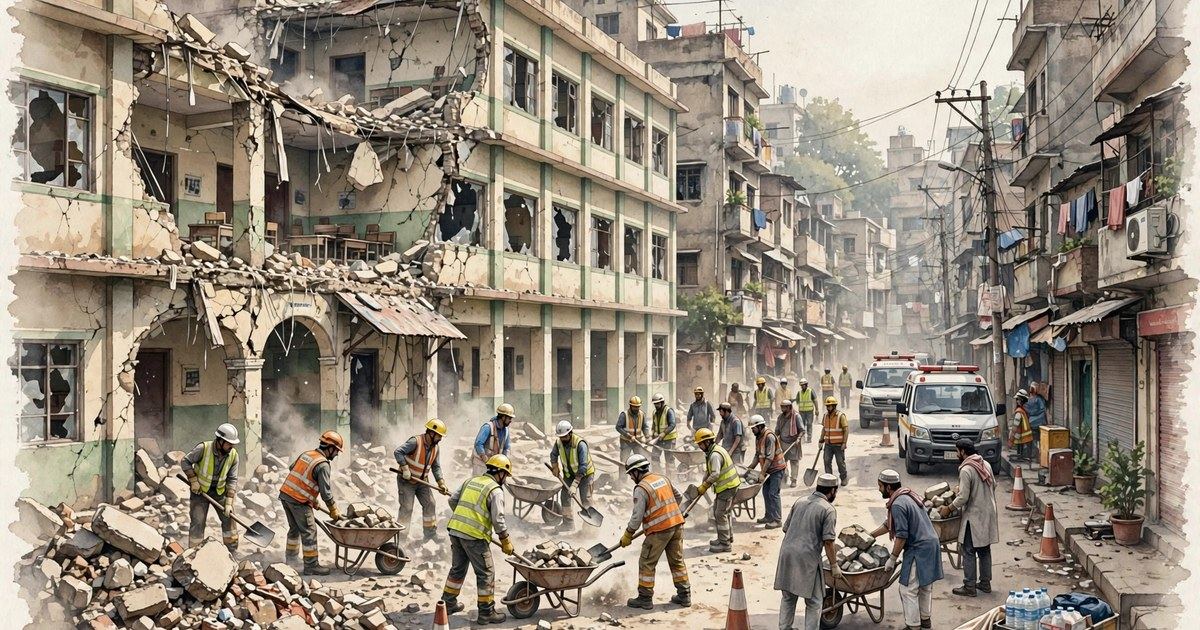
On Thursday morning, October 15, 2026, children at a private school in Peshawar, northwestern Pakistan, were sitting in their classrooms when the roof above them gave way. Within seconds, an ordinary school day in the city's Dir Colony neighbourhood became one of the deadliest school disasters in Pakistan this year. At least 28 people were killed, most of them children aged 13 or younger, and more than 40 others were injured, according to hospital officials and emergency services cited in news coverage.
The story, trending per news coverage across the Associated Press, CNN, Reuters and other outlets, has drawn grief and anger across Pakistan — and a familiar, painful question: why do school roofs keep collapsing on children in Pakistan?
What Happened on Thursday Morning
The collapse happened during classes at the Al-Khair school — described in reports as Al-Khair Public School and as the Al-Khair Education Center — in Dir Colony, in central Peshawar, the capital of Khyber Pakhtunkhwa province. According to rescue officials cited by Reuters, the roof of an upper floor collapsed onto the floor below, which then caved in on the students in the classrooms underneath. Rescue 1122 spokesman Bilal Ahmad Faizi described teams arriving to find one roof collapsed onto another, crushing the classroom below and trapping children inside.
Peshawar police chief Mian Saeed told Reuters that he feared the death toll could rise, saying that just 47 of the 110 students in three classrooms at the time had been accounted for as rescued at that stage. An injured teacher, Mahwish Zaman, told the Associated Press from her hospital bed that the school had an estimated 1,200 students enrolled from nursery through fifth grade. That figure describes the school's overall enrolment, not the number of children in the collapsed section, and officials have not said how many pupils were in the building as a whole when the roof fell.
Early reports put the death toll at 10, then 17, then 20, as rescuers pulled more victims from the rubble. By Thursday afternoon, hospital officials and emergency services were reporting at least 28 dead — at least 27 children and at least one teacher — with some outlets reporting a total of 29 as the count continued to move. The variation is normal in the first hours of a disaster of this kind: different agencies count at different moments, and some victims are counted at the scene while others are counted after reaching hospital. What has not changed across the reporting is the core fact: the dead were overwhelmingly young children.
The Rescue Operation
Local residents were among the first to reach the school, in a congested neighbourhood where narrow streets quickly filled with ambulances, rescue vehicles and anxious parents. Rescue 1122 teams arrived within minutes of being alerted, according to accounts from the scene cited by the Associated Press. District emergency officer Iftikhar Khan said rescuers had pulled at least 45 children from the rubble. The operation involved 16 ambulances, two disaster-response vehicles and more than 60 rescue personnel, according to emergency officials cited by Agence France-Presse, and Pakistan Army personnel were reported to be working alongside civilian teams in a joint operation.
The rescue was hampered by the very conditions that made the building dangerous. Narrow streets around the school restricted access for heavy machinery, and the debris had to be cleared carefully by hand in places so that rescuers did not injure anyone still trapped beneath it. Hours after the collapse, officials said everyone trapped beneath the rubble had been pulled out and crews were clearing the remaining debris, though hospitals continued to warn that the toll could still rise because some of the injured were in critical condition.
Outside the school and at Lady Reading Hospital, Peshawar's main public hospital, anguished parents searched for information about their children, unsure whether they had survived. One father, Mohammad Khan, told reporters his son had survived because he had stepped out of his classroom to drink water. Others were not so fortunate, and the scenes of families waiting outside the hospital became one of the defining images of the day.
The Victims and the Hospital
Lady Reading Hospital declared an emergency to cope with the influx of casualties. Hospital spokesperson Mohammad Asim confirmed that all the children killed or injured were aged 13 or younger, and said some of the injured were in critical condition. Most of the dead were brought to the hospital already dead, while dozens of wounded children were treated there. CNN, citing hospital spokesperson Asim Khan, reported 47 children injured; other outlets put the injured figure at more than 40 or more than 50. The precise injured count, like the death toll, varied between agencies as the day went on, but every account agrees that the casualty list was dominated by primary-school-age children.
Six girls were among the dead in the earliest Associated Press account, and later reports described both male and female pupils among the victims. Two teachers were reported dead in some accounts, and one teacher in others — another sign that the toll was still being reconciled as rescue and hospital records were compared. What is clear is that at least one teacher died alongside her pupils, and that an injured teacher survived to describe the collapse to reporters.
What Caused the Collapse? What Investigators Say So Far
No final cause has been established, and investigators have ordered a full inquiry. But two factors have already been named by officials: heavy rain and a weak building.
Rescue services told CNN that heavy overnight rainfall had caused the roof of the school building to become unstable before it later collapsed. Separately, Peshawar police chief Mian Saeed said the building had a weak structure, describing an overweight roof with construction carried out on top of a weak structure — a combination he said caused the collapse. That distinction matters. Rain may have been the trigger, but the police account suggests the building was already vulnerable: extra weight on a structure that could not safely carry it, in a building whose underlying construction was weak.
Those two explanations are not in conflict. A roof that is already overloaded or poorly built is far more likely to fail when it is soaked by heavy rain, when water adds weight, seeps into cracks, weakens mortar and concrete, and exposes every flaw in the original construction. Investigators will now have to establish what Thursday's rain actually did to the Al-Khair building, what condition the building was in before the rain, and who was responsible for knowing about it.
The provincial government has formed a committee to investigate the cause of the collapse. Khyber Pakhtunkhwa Governor Faisal Karim Kundi expressed sorrow over the deaths and sought a report from the relevant authorities, directing officials to provide the best possible medical care to the injured children. Provincial government spokeswoman Samar Haroon Bilour said the government was using all available resources to bring those trapped beneath the rubble to safety, directed hospital officials to provide prompt medical care, and praised rescue workers for their swift response.
Arrest and Investigation
Peshawar police arrested the owner of the school in connection with the collapse, police chief Saeed Ahmed said, adding that the building was structurally weak. The owner had not been formally charged at the time of the reports, and the arrest should be understood as part of the investigation rather than as a finding of guilt. Police and the provincial inquiry committee are examining the circumstances of the collapse, including the building's construction, its licensing and inspection history, and whether additional storeys or structures were added to a building that could not support them.
One of the key questions for the inquiry is the school's inspection record. Private schools in Pakistan's cities frequently operate out of converted houses or purpose-built blocks in dense neighbourhoods, and regulation of their structures is uneven — strong on paper at the licensing stage, thinner on the inspections that should follow over a building's life, according to analysis of the sector. Heavy seasonal rain is the recurring stress test, and it tends to find the weakest buildings. Whether the Al-Khair building had been inspected, when, and what any inspection found are questions the inquiry will have to answer.
For context on how Khyber Pakhtunkhwa is governed at the moment, the province has recently been under emergency rule — a backdrop that makes the question of who is accountable for building safety and school oversight even more pressing. Readers can find background in our earlier explainer: Pakistan Imposes Emergency Rule in Khyber Pakhtunkhwa: Governor's Rule Explained.
Official Reaction
President Asif Ali Zardari called the incident a "heart-wrenching tragedy" that had plunged the nation into shock, and called for a comprehensive investigation into the cause of the deadly collapse. In a statement from his office, he said the entire nation shared the grief of the affected families, and stressed the need to ensure that school buildings meet safety standards to prevent similar tragedies. Prime Minister Shehbaz Sharif expressed deep sorrow over the loss of life, extended his condolences to the bereaved families, and prayed for strength for those who had lost children.
The statements from the president and prime minister follow a pattern seen after previous school collapses: grief, condolences, and a call for investigation. The test, as families in Peshawar and safety campaigners will now point out, is whether this investigation produces changes that outlast the news cycle — published findings, named accountability, and inspections that actually close or repair dangerous schools before the next roof falls.
Why School Buildings Keep Collapsing in Pakistan
Building collapses are a common problem in Pakistan. Construction standards in the country are often poorly enforced, and many structures are built with substandard materials, according to the Associated Press and CNN. Safety regulations are frequently ignored to reduce costs, and the result is a stock of buildings — including schools — that look solid until they are stressed by rain, age, or additional construction.
The Peshawar collapse is not an isolated incident. On June 30, 2026, the Associated Press reported that a roof collapse at a tutoring centre under construction in Lahore killed at least 14 schoolchildren, with the owner of that centre and another person arrested. In July, a roof collapse at a tutoring centre in Lahore killed four pupils, according to reports citing the Associated Press. Earlier incidents cited in Pakistani press coverage include children killed when a school wall collapsed near Umerkot and when a classroom roof collapsed at a private school in Dera Ghazi Khan. The details vary from case to case, but the underlying pattern described by officials and reporters is consistent: weak structures, poor materials, weak oversight, and rain or extra weight as the trigger.
Schools are especially vulnerable for three reasons. First, they concentrate large numbers of children in a small number of rooms, so a single roof failure can kill dozens at once. Second, private schools in dense urban neighbourhoods often operate in buildings that were never designed as schools, or that have been extended upward to fit more pupils without a matching upgrade to their foundations and load-bearing walls. Third, the people inside — young children — cannot assess risk for themselves or evacuate quickly when a structure begins to fail. That is why school-building safety is treated in most countries as a special category, with stricter inspection rules than ordinary commercial buildings. In Pakistan, campaigners argue, that special treatment exists on paper far more reliably than it does in practice.
The collapse also comes weeks after another disaster that raised the same questions about safety enforcement: a fire tore through a hospital in the capital, Islamabad, killing at least 14 newborns, according to CNN, and sparking widespread anger and multiple arrests. The two tragedies are different in kind — one a fire, one a structural collapse — but they point to the same underlying failure: institutions that care for the most vulnerable people, babies and schoolchildren, operating in buildings and systems where safety checks did not prevent catastrophe.
School tragedies involving children are, sadly, a recurring subject of news coverage around the world, from accidents on school outings to violence in classrooms. Our earlier reporting on a school outing that ended in tragedy can be read here: Israeli School Hike Blast: Unexploded Munition Kills Teen. The debate over how schools are funded and overseen is also a live issue in other countries, as our explainer on France's school protests shows: France School Funding Protests: Why 250,000 People Marched.
What Happens Next — and What Prevention Would Look Like
Three processes now run in parallel. The police inquiry — with the owner in custody — will decide whether criminal charges follow. The education authority's report will give the first official account of the school's licensing and inspection history. And a building survey will determine whether other schools in Peshawar are ordered to repair, restrict, or close their premises. For the families of Dir Colony, those findings will arrive after the burials.
If Pakistan is to break the pattern, safety experts and campaigners say the steps are well known, even if they are politically difficult. First, every school building should face a structural audit — not a paperwork check, but an engineer's inspection of foundations, walls, roofs and load-bearing capacity — before the rainy season, with the results made public. Second, licensing should be tied to passing that inspection: a school that fails should not be allowed to keep children in the building while it appeals. Third, there must be a clear rule against adding storeys or heavy structures to buildings that were not designed to carry them, enforced with closure, not just fines. Fourth, heavy-rain triggers should exist: after sustained overnight rain, schools in vulnerable buildings should be checked before children are allowed back inside, rather than after a collapse. And fifth, inspection records should be public, so parents can see whether their child's school has been inspected, when, and what was found.
None of those steps would have been easy to implement before Thursday. All of them are harder to argue against now. The question is whether the investigation into the Al-Khair collapse produces a report that names what failed — the building, the inspection system, or both — and whether that report is followed by closures and repairs, not just by condolences.
What We Still Don't Know
Several important facts remain unconfirmed. The final death toll is not yet settled: reports have ranged from 28 to 29, and hospitals have warned that some of the injured are in critical condition, so the toll may still rise. The exact sequence of the structural failure has not been established: whether the roof failed first, whether a wall gave way, or whether water damage over time had already weakened the structure before Thursday's rain. The school's inspection history has not been published. No charges have yet been filed against the arrested owner, and no official has yet said whether other schools in Peshawar will be closed or inspected as a result.
Worldlession will update this story as the investigation reports, the toll is confirmed, and officials announce whether charges will follow.
How many people were killed in the Peshawar school roof collapse?
At least 28 people were killed, including at least 27 children and at least one teacher, according to hospital officials and emergency services cited in news coverage. Some outlets reported a total of 29 as the count continued to move during the rescue. All of the children killed or injured were aged 13 or younger.
What caused the roof to collapse?
The cause is still under investigation. Rescue services told CNN that heavy overnight rainfall had made the roof unstable, while Peshawar's police chief said the building had a weak structure with an overweight roof and construction carried out on top of it. Investigators will have to establish how the rain and the building's pre-existing condition combined to cause the failure. No final determination has been announced.
Which school was it, and where is it?
The school is the Al-Khair school — described in reports as Al-Khair Public School and as the Al-Khair Education Center — in Dir Colony, in central Peshawar, the capital of Khyber Pakhtunkhwa province in northwestern Pakistan. It is a private school with an estimated 1,200 pupils from nursery through fifth grade, according to an injured teacher cited by the Associated Press.
Was anyone arrested after the collapse?
Yes. Peshawar police arrested the owner of the school in connection with the collapse, saying the building was structurally weak. The owner had not been formally charged at the time of the reports, and the arrest is part of an ongoing investigation. The provincial government has also formed a committee to investigate the cause.
Why do school buildings keep collapsing in Pakistan?
Building collapses are common in Pakistan, where construction standards are often poorly enforced, many structures are built with substandard materials, and safety regulations are frequently ignored to reduce costs, according to the Associated Press and CNN. Private schools often operate in converted or extended buildings in dense neighbourhoods, with uneven inspection over a building's life. Heavy seasonal rain then stresses the weakest buildings, and a single roof failure in a crowded school can kill dozens of children at once.
In China, a separate school scandal ended in court: a kindergarten lead-poisoning case saw the owner jailed for life after 247 children were poisoned.
Sources: Associated Press via NPR (October 15, 2026); CNN (October 15, 2026); Reuters via The Business Standard (October 15, 2026); Al Jazeera via Qazinform (October 15, 2026); The Times of India (October 15, 2026); Agence France-Presse via The Telegraph Nigeria (October 15, 2026); official statements from Pakistan's President and Prime Minister cited in news coverage.