
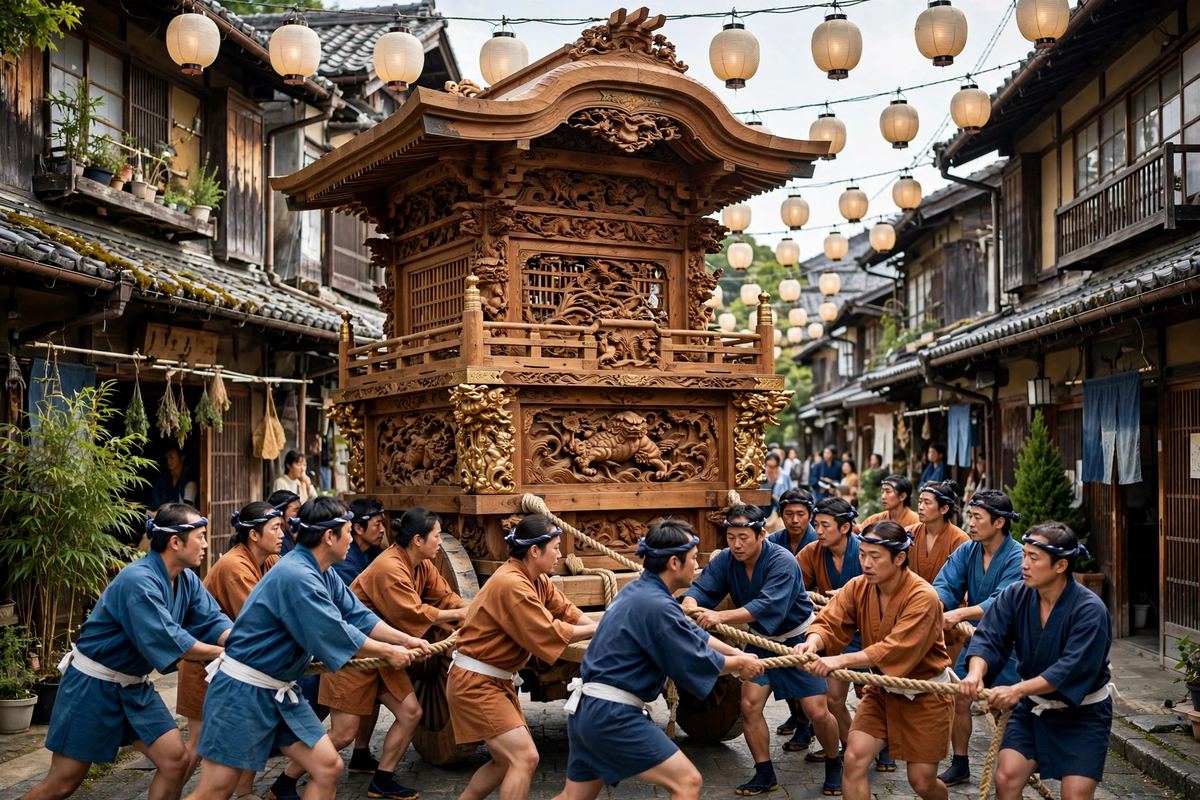
Every autumn in the Kansai region of Japan, neighbourhoods gather to haul enormous wooden floats through the streets in celebrations known as Osaka danjiri festivals. The events are loud, fast, and physically intense — and on 10 October 2026, two of them turned tragic. Within hours of each other, floats overturned at separate festivals in Osaka Prefecture, killing two participants and injuring sixteen others. The accidents have cast a shadow over one of Japan's most beloved autumn traditions and reopened a difficult conversation about safety.
What is a danjiri festival?
A danjiri (literally "float") is a large wooden festival cart, often weighing between two and four tonnes, that is pulled and pushed through the streets by teams of participants. Danjiri festivals are a hallmark of autumn in the Kansai region, particularly in and around Osaka. They are community rituals as much as spectacles: local neighbourhoods spend months preparing, decorating the floats with intricate wood carvings, and practising the coordinated hauling that the event demands.
The most famous of these celebrations take place in cities such as Kishiwada, Izumisano, and Izumiotsu in Osaka Prefecture, where the festivals draw large crowds of spectators. But the people at the heart of the festival are the participants themselves — dozens of men hauling ropes, pushing from the rear, and riding atop or alongside the float to guide its path. As with many great public festivals around the world, the danjiri season is about identity as much as entertainment: it binds a neighbourhood together and marks the turning of the year. Festivals everywhere work this way, shaping collective memory and belonging — a theme explored in depth in our guide to how festivals shape cultural identity.
The yarimawashi: the thrill at the centre of the festival
The defining moment of a danjiri festival is the yarimawashi — a high-speed right-hand turn in which the hauling team sprints with the float and whips it around a corner at full tilt. The float leans dramatically, sometimes seeming to balance on two wheels, while riders perch on its frame. It is the most exhilarating part of the festival and the part the crowds come to watch. It is also the most dangerous.
A multi-tonne wooden cart moving at speed and turning sharply concentrates enormous forces on the people guiding it. The teams train for this, but physics does not forgive error: if the turn is taken slightly too fast, or the weight shifts wrongly, the float can and does tip. Over the decades, danjiri festivals have occasionally produced injuries for exactly this reason, and every neighbourhood association is aware of the risk. The thrill of the yarimawashi is inseparable from its danger — and that is precisely why the 10 October accidents have hit the festival community so hard.
What happened on 10 October 2026
The first accident occurred at around 11:00 in the morning at the Nagataki intersection in the city of Izumisano. A wooden danjiri float overturned during a high-speed yarimawashi turn, crushing participants beneath it. A 51-year-old company executive, identified by MBS News as Takahiro Oku, was trapped under the float and later died in hospital. Seven other people were hospitalised, two of them with serious injuries.
Roughly two hours later, at around 1:20 in the afternoon, a second float rolled over during a right-hand turn at a festival in Izumiotsu, a neighbouring city in Osaka Prefecture. A 48-year-old man died after being trapped under the cart, and nine other men were injured. All of the casualties in both incidents were participants — the men hauling and riding the floats — not spectators watching from the sidelines.
Two deaths and sixteen injuries across two separate festivals on the same day, in the same prefecture, within hours of each other, is unprecedented in recent memory for the danjiri tradition. Both accidents followed the same pattern: a heavy float, a right-hand turn taken at speed, and a rollover that trapped the men working closest to the cart.
Why this matters: the safety debate
Japan's festivals are famously well organised, and danjiri associations have long maintained their own safety practices — marshals, practiced formations, and routines drilled over years. But a two-to-four-tonne float whipped through a corner at a sprint will always carry risk, and these twin accidents are the most serious the tradition has seen in years. The question now is not whether the yarimawashi is dangerous — everyone involved has always known it is — but whether the current precautions are enough.
There are no easy answers. Safety equipment can only go so far in an event whose very appeal is the spectacle of a massive wooden float leaning hard through a turn. Slow the turn down and the festival loses what makes it the festival; keep it as it is and accept that a misjudged moment can be fatal. This is the same tension faced by any traditional spectacle built around physical daring, from running-of-the-bulls events to high-wire walks — the line between honouring a tradition and protecting its participants.
For the neighbourhoods involved, the loss is personal. Danjiri teams are not professional performers; they are local residents — fathers, neighbours, coworkers — who give their time year after year. The men who died were not thrill-seekers chasing risk for its own sake. They were participants in a community ritual, doing what their neighbourhoods have done for generations.
Key facts
The essentials of 10 October 2026: two separate accidents, hours apart, at autumn danjiri festivals in Osaka Prefecture. In Izumisano, at about 11:00am at the Nagataki intersection, a wooden float overturned during a high-speed yarimawashi turn; 51-year-old company executive Takahiro Oku was crushed beneath it and later died in hospital, and seven others were hospitalised, two seriously. In Izumiotsu, at about 1:20pm, a second float rolled during a right-hand turn; a 48-year-old man died after being trapped under the cart, and nine other men were injured. All casualties were participants, not spectators. The floats involved weigh between two and four tonnes and are hauled through the streets by teams.
What happens next
Incidents of this severity in Japan are typically followed by police investigations into the circumstances of each accident, and local authorities and festival organisers will almost certainly review safety arrangements before the next festival season. In the past, serious danjiri accidents have led neighbourhood associations to adjust their practices — changing routes, modifying how turns are executed, or adding spotters and safety personnel around the floats.
What remains to be seen is how the two neighbourhoods respond in the longer term. Cancelling or fundamentally changing a centuries-old tradition is a decision no community takes lightly, and the danjiri festivals of Osaka Prefecture have deep roots. But the grief of 10 October will not fade quickly, and the families and teams affected will be central to whatever changes come.
For observers outside Japan, the tragedy is a reminder that the world's great festivals — however beautiful, however steeped in history — are sustained by real people taking real risks in public. The danjiri tradition will continue, because that is what communities do: they mourn, they adapt, and they return to the streets. The hope is that the adaptations that follow these accidents make the festivals safer without stripping them of what makes them matter to the people of Kansai.
The danjiri festivals belong to a packed autumn calendar in Japan and beyond — a season that also brings global celebrations such as Halloween, whose 2026 costume and decor trends are already taking shape.
Osaka Danjiri Festivals: History and Tradition
Danjiri festivals are among Japan's oldest community celebrations, with roots going back centuries. Neighbourhoods build and maintain their own floats — enormous wooden structures, elaborately carved and decorated — and the pride of each district rides on how its team performs. The best-known event is the Kishiwada Danjiri Festival in September, which draws huge crowds, but smaller festivals run across Osaka Prefecture through the autumn, each with its own local character and traditions.
Danjiri Festival Safety After the 2026 Accidents
The 2026 accidents have reopened a difficult conversation about how to keep the tradition alive while protecting participants. The yarimawashi turn — whipping a multi-tonne float around a corner at speed — is the heart of the spectacle and also its greatest risk. Safety debates since the accidents have focused on course design, crowd separation, training for hauling teams, and whether speed or route changes are needed at the most dangerous corners. Any changes will need to balance respect for a centuries-old tradition against the safety of the men who haul the floats.