
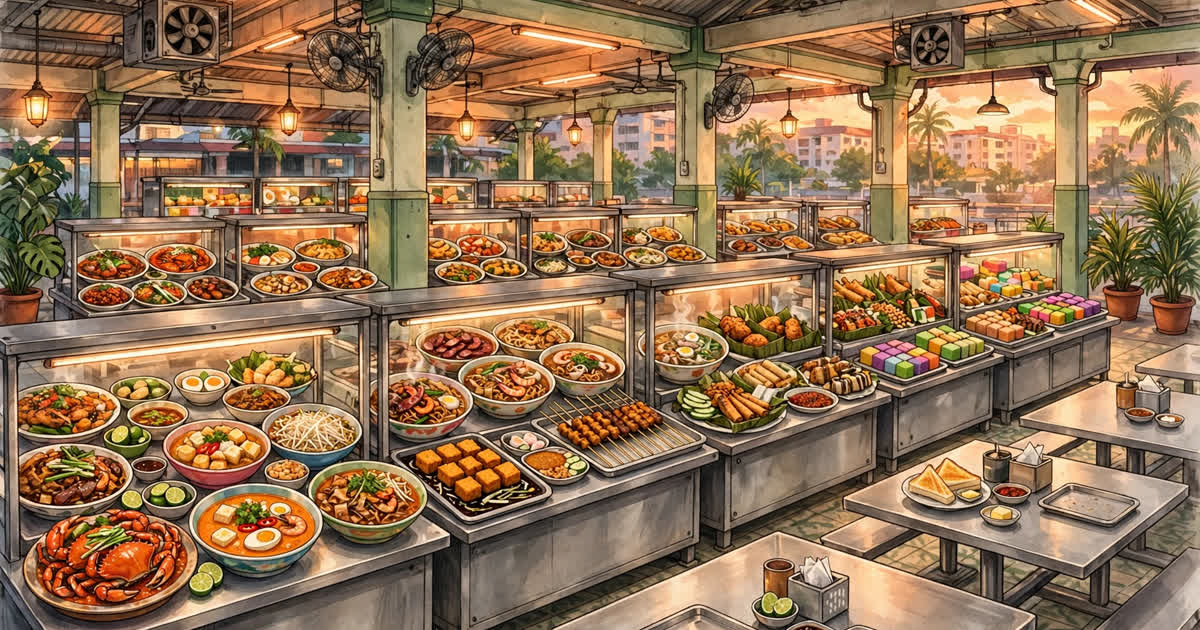
Singapore hawker centres is one of the most searched everyday topics in Singapore, and for good reason: getting it right saves money, time and frustration, while getting it wrong can be costly. This guide explains Singapore hawker centres in plain English, without jargon and without assuming any prior knowledge, so that newcomers and long-time residents alike can follow every step with confidence. Whether you are planning ahead, comparing options, or sorting out a problem that has already come up, the explanations below are designed to be useful on a first read and worth bookmarking for later.
Hawker centres are Singapore's great equaliser: open-air food halls where a minister and a student may queue at neighbouring stalls for the same $4 plate of chicken rice. The system grew from street vendors who were moved into regulated centres, and today each centre has its own character, from the satay street atmosphere of Lau Pa Sat to the old-school charm of Tiong Bahru Market. New restaurants, by contrast, offer air-conditioning, tasting menus and international flavours at far higher prices, and the smartest food lovers enjoy both worlds.
Before diving into the detail, it helps to see the whole picture. In Singapore, Singapore hawker centres touches everyday life in ways that are not always obvious at first glance, from household budgets and daily routines to longer-term plans. One useful starting point is this: chicken rice, laksa, char kway teow, nasi lemak and roti prata are the classic first-timer dishes. Keeping that in mind makes the choices below much easier to judge, because you can test each option against your own situation rather than following generic advice. The rest of this guide works through what the topic covers, how it works in practice, what to compare, the mistakes people most often make, and how to get the best result.
What Singapore hawker centres really covers
The first question most people ask about Singapore hawker centres is what it actually includes, and the answer is broader than the headline suggests. In Singapore, Singapore hawker centres is best understood as a set of related services, rules and everyday choices rather than a single product or a single office, and each part matters at a different moment. A second point worth noting early is that ordering means queueing at a stall, paying at the counter, and carrying your own tray to a table, which shapes how the rest of the system behaves. Once you see those parts separately, it becomes much easier to find the right help, the right form or the right provider instead of feeling lost in a maze of similar-sounding options.
It also helps to separate what is essential from what is optional. Some elements are required by law, by an employer, or by the practical realities of daily life, while others are conveniences that are worth paying for only if they genuinely fit your routine. People often overspend on the optional parts while overlooking a basic step that would have solved their problem for free, so working through the essentials first is almost always the smarter order. Taking notes as you go, and keeping copies of anything you submit, will save you from repeating work later.
How Singapore hawker centres works, step by step
Working through Singapore hawker centres is much less daunting when it is broken into a clear sequence. Start by confirming your own situation: what you need, what documents or information you already have, and what deadline, if any, applies. Then check the official source for Singapore rather than relying on a social media post or an outdated blog, because rules, fees and opening arrangements do change. A further practical detail is that the tissue-packet 'chope' custom reserves a seat, and returning trays is now expected practice, so building that into your plan early prevents the most common delays. With those facts in hand, you can complete the steps in order instead of jumping between half-finished attempts.
The middle steps are where most people get stuck, usually because a form asks for something they did not expect or because two different sources give conflicting advice. When that happens, pause and go back to the official guidance, and if a helpline or service centre exists, use it: a short clarification now is far cheaper than a rejected application later. Keep a simple record of dates, reference numbers and names, and always check the confirmation you receive before assuming a step is complete. For a related everyday money habit, see our guide on how fermentation creates flavour, which covers the basics that support almost any financial decision.
Singapore hawker centres: choices, costs and what to compare
When it comes to Singapore hawker centres, the cheapest headline option is not always the best value, and the most expensive one is not always the most reliable. Compare like with like: the same coverage, the same quantities, the same time period and the same conditions, and watch for extras that quietly change the total. In Singapore, one comparison that pays off repeatedly is this: the best stalls often have the longest queues, and the queue itself is a reliable quality signal. Writing the options side by side, even in a simple table on paper, makes differences obvious that are easy to miss when each offer is viewed on its own.
Costs also include time, travel and hassle, not just money. An option that looks slightly dearer but saves two trips across town, avoids a long queue, or can be managed entirely online may be the better deal overall. Equally, a free option is only free if it genuinely meets your need; a free service that does not cover your situation can end up costing more than a modestly priced one that does. Set a budget or a time limit before you start comparing, and be wary of pressure to decide on the spot, especially where a salesperson benefits from a quick yes.
Common mistakes with Singapore hawker centres
Most problems with Singapore hawker centres come from a small set of avoidable mistakes. The first is acting on outdated information, because a rule that was true two years ago may have changed, and a friend's experience in a different city or a different year may not apply to you. The second is leaving things to the last minute, which turns a routine task into an urgent one and removes the chance to fix a small error calmly. A third recurring issue in Singapore is that new restaurants range from casual cafes to fine dining, with reservations essential at popular openings, and people who plan around it tend to have a much smoother experience.
Another common error is sharing personal details or payments through unofficial channels. Always use the official website, office or verified provider, and be suspicious of messages that demand urgent payment or ask for passwords and one-time codes. If something feels off, stop and verify through a separate, trusted route before proceeding. Our guide to how chocolate is made explains the safety habits that protect you across many everyday online tasks, and they apply just as much here.
Getting the most from Singapore hawker centres
Once the basics of Singapore hawker centres are in place, a few habits will help you get lasting value from it. Review your arrangement at least once a year, or whenever your circumstances change, because the best option for a single person, a young family and a retiree can be quite different. Keep your documents organised and easy to find, note renewal or expiry dates in your calendar, and check whether a loyalty benefit, bundle or seasonal offer genuinely saves you money rather than locking you into something you no longer need. Small, regular reviews beat frantic overhauls.
Finally, share what you learn with the people around you, and keep learning from trusted local sources as the picture changes. Rules, prices and best options evolve, and the person who checks once a year will usually do better than the person who sets something up once and never looks at it again. Used thoughtfully, the topic of this guide becomes one less thing to worry about and one more part of daily life that simply works. That is the real goal: not perfection, but a calm, informed routine you can rely on.
The bottom line on Singapore hawker centres is simple: understand the basics, check the official source, compare properly, and review regularly. Do those four things and you will avoid most pitfalls while keeping the benefits that matter to you in Singapore.
Sources: official government and institutional guidance for Singapore, plus established reference sources on the topic. Always verify current rules, prices and schedules on the official source before acting, as details change.