
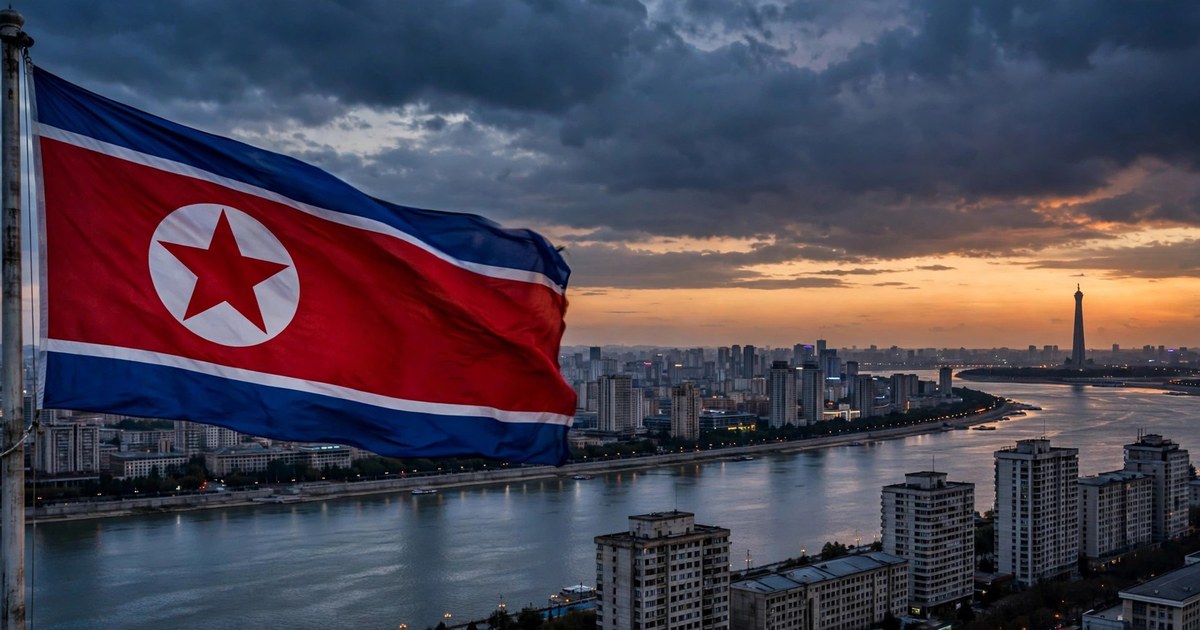
The North Korea new constitution is now public, and it redraws the country's most basic ideas about itself. The full revised text was posted on Naenara, the state's external propaganda website, on Wednesday, 11 November 2026 — the first time the document has been openly available in two years and eight months. The Supreme People's Assembly adopted the revision on 23 March 2026, but the constitution section of Naenara had been switched off since March 2024, so outsiders could not read the full text until this week. South Korea's Unification Ministry had already released its own copy of the revised text on 6 May. The changes are not cosmetic: the constitution names South Korea as a separate neighbouring state, drops every mention of reunification, gives Kim Jong Un explicit command over the country's nuclear forces, and shortens the national flag for the first time since North Korea was founded in 1948.
What changed in the North Korea new constitution
Four changes carry the weight of the revision, and each one is written into a numbered article of the text. Together they turn Kim Jong Un's declaration, made in late 2023, that the two Koreas are separate, hostile states into the country's highest law.
1. South Korea becomes a separate state. Article 2 defines North Korean territory as land bordering China and Russia to the north and the Republic of Korea — South Korea's formal name — to the south, together with the territorial waters and airspace based on that land. Every provision about national reunification has been removed, and the document's formal name has been shortened from "Socialist Constitution" to "Constitution", a title it had carried since 1972.
2. The flag gets shorter. Article 166 sets the national flag's height-to-width ratio at 1:1.65, replacing the 1:2 ratio in use since 1948. The design itself — a broad red band, narrow white stripes, blue bands and a red star in a white circle — is unchanged.
3. Nuclear command is written down. Article 89 makes Kim, as chairman of the State Affairs Commission, supreme commander of the armed forces and gives him explicit command over the country's nuclear forces. It also lets him delegate authority to use nuclear weapons to the national nuclear command organisation. Article 56 separately describes North Korea as a responsible nuclear weapons state and commits it to further developing nuclear weapons.
4. Kim's powers over the state widen. Article 86 identifies the State Affairs Commission chairman as head of state. The revision also gives him a veto over legislation and the power to remove lawmakers who lose "the confidence of the people", NK News reported.
Two passages that appeared in the version South Korea's Unification Ministry released in May are missing from the text Naenara published — part of Article 121, on decisions taken at Cabinet plenary meetings, and part of Article 156, on how lay judges are chosen for special courts. The Korea JoongAng Daily reported that it is unclear whether those passages were deleted in the revision or left out when the public version was edited.
The flag gets shorter: 1:2 to 1:1.65
Of the four changes, the flag is the one every North Korean will see. The new ratio makes the flag 17.5 percent narrower for the same height — a flag 100 centimetres tall would now be 165 centimetres wide instead of 200. It is the first change to the flag's proportions since the country was founded in 1948, 78 years ago, and the Korea JoongAng Daily reported that state media websites have already started using the new version.
The symbolism, as explained on Naenara, stays as it was. The red band stands for the blood shed by anti-Japanese revolutionary fighters during Japan's 1910–45 colonial rule; the white circle and white stripes stand for loyalty to the ruling party and its leader; and the blue stripes stand for anti-imperialist independence, world peace and friendship, and the republic's sovereignty.
The flag is not the first national symbol Kim has reworked. In 2024 North Korea revised the lyrics of its national anthem, replacing "three thousand ri", a reference to the whole Korean Peninsula, with "this world". Fyodor Tertitskiy, a lecturer at Korea University, told The Wall Street Journal the flag change was "another symbolic breakaway from the past".
Kim Jong Un's nuclear powers under the new constitution
The nuclear clauses are the part of the revision that other governments will read most closely. Until now, Kim's control of the arsenal rested on his position as leader and on party decisions. Article 89 now puts it in the constitution: the State Affairs Commission chairman commands the nuclear forces, and he may delegate the authority to use them to the state nuclear command organisation.
The text does not say when or how that delegation would happen, and it does not name a successor. What the North Korea new constitution does do is settle, in writing, that nuclear command runs through Kim and the body he chairs. Article 56 reinforces the point by describing North Korea as a responsible nuclear weapons state and committing it to further developing those weapons. The Stockholm International Peace Research Institute estimates the country holds around 50 assembled nuclear warheads.
That matters because the constitution is the one document every part of the North Korean state must follow. A speech can be walked back; a constitutional clause is meant to last. By writing nuclear command into it, Kim has made the arsenal part of the state's permanent structure rather than a policy of the moment.
Why Kim Jong Un dropped reunification
Reunification was in North Korea's constitution for more than half a century, and dropping it is the revision's biggest political statement. Kim announced the turn in late 2023, declaring that the two Koreas were separate, hostile states and that peaceful reunification was no longer the goal. The constitution section of Naenara went dark in March 2024, and the North Korea new constitution is the first full public confirmation of how far the change goes.
There are limits to what the text does. It does not call South Korea the country's "No. 1 hostile state" or its "invariable principal enemy", phrases Kim has used in speeches. It does not draw a border: Article 2 names South Korea as the country to the south but leaves the precise land and sea boundary unspecified. And it changes nothing about the reality on the ground — North and South Korea have operated as separate governments for decades and both joined the United Nations in 1991. What it changes is the claim: North Korea no longer presents itself, even on paper, as half of a nation waiting to be reunited. Tensions along the border have already reflected that shift, with Pyongyang threatening escalation at the demilitarised zone in October.
What happens next after the constitution change
The first test is visible and mundane: whether flags across North Korea are replaced with the shorter version, and how quickly. Naenara has not said when the new proportions will replace the old ones on flagpoles. The second is diplomatic. Leaders gather for the APEC summit in Shenzhen on 18–19 November, where Donald Trump is expected to meet Xi Jinping and Vladimir Putin; no meeting with North Korea is planned, according to the Korea JoongAng Daily, but the possibility of renewed US–North Korea talks was discussed when China's foreign minister Wang Yi met his South Korean counterpart in Beijing this week.
Seoul will be watching the two missing passages — Articles 121 and 156 — to see whether they reappear, and analysts will be reading the North Korea new constitution against the version the Unification Ministry released in May for any other quiet edits. Kim's last high-profile foreign trip, a visit to the Chinese border city of Dandong in October, showed how closely Beijing is tracking his moves. That Dandong visit was only explained to Seoul this week, when Wang Yi briefed South Korea's foreign minister on it. Meanwhile North Korea's missile programme continues: around 10 missiles were fired from Wonsan on 29 October, and a new air-defence system was test-fired in November.
Why the North Korea new constitution matters
Constitutions are not where news usually happens — they are where politics gets locked in. This revision locks in three things at once: that South Korea is a foreign country, not a lost half; that the nuclear arsenal answers to Kim and to a command structure he controls; and that the symbols of the state — flag, anthem, constitution itself — now describe a separate North Korea rather than a divided one. None of that fires a missile or moves a soldier. But it narrows what any future North Korean leader can say about reunification, and it tells South Korea, the United States and China that the two-state position is not a negotiating tactic. It is, as of this week, the law.