
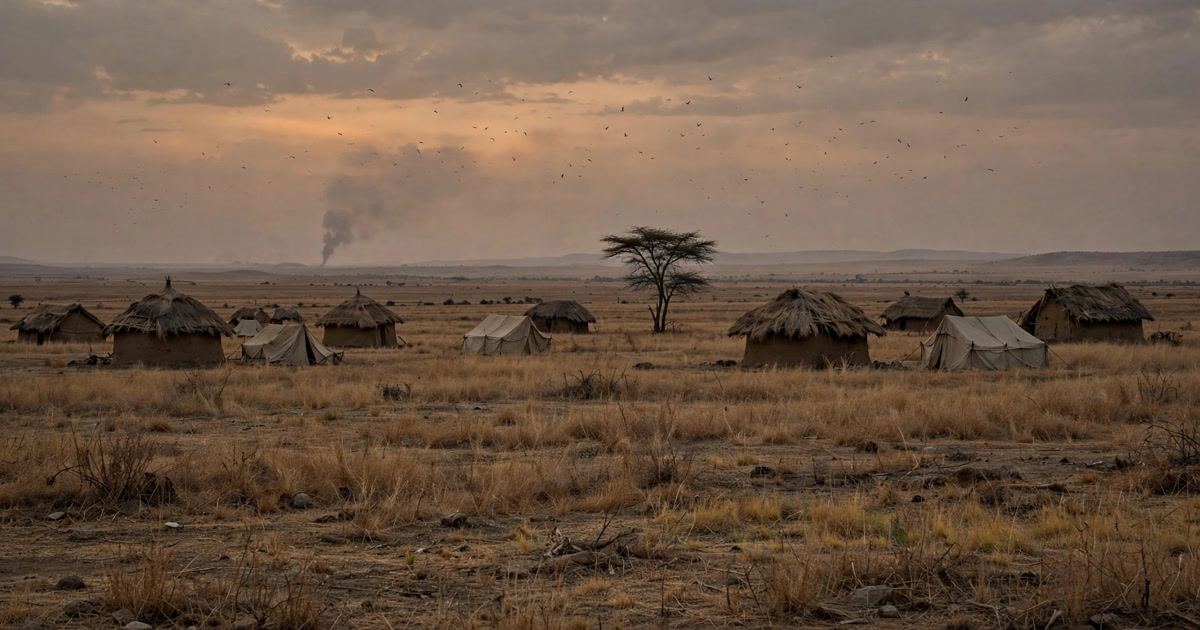
At least 48 civilians were killed in weekend attacks on camps in northeastern Mali's Menaka region, in what local sources describe as one of the deadliest assaults on civilians in the area in months. The development, trending per news coverage, has triggered a new wave of displacement and renewed alarm about the deepening crisis in the central Sahel.
The attacks took place on Sunday, October 18. According to security and community sources cited by the Agence France-Presse and Reuters, armed men arriving on motorcycles raided at least five localities in or around the village of Tinabow and the Tagadayat area, roughly 50 kilometres from the town of Menaka. The assailants opened fire indiscriminately on camps inhabited mainly by members of the Daoussahak (Idaksahak) community, setting homes ablaze and stealing livestock. Some victims died in the fires; others were shot.
The executive bureau of the Daoussahak community recorded at least 48 dead in Tagadayat alone, and the toll may be higher — two security sources and two local officials told Reuters on Tuesday that provisional counts ranged from 48 to more than 70. Another 11 people are missing, a local official told AFP. A local elected official estimated that more than 50 people, including women and elderly residents, had been killed. Hundreds of families have fled to the city of Menaka, and the Daoussahak community has demanded urgent humanitarian assistance for the displaced.
Who carried out the attacks?
Multiple local sources blamed the assault on the Islamic State group's Sahel branch — known as Islamic State Sahel Province (ISSP), also called Islamic State in the Greater Sahara. The Daoussahak community's executive bureau attributed the killings to the Islamic State, and the Collective for the Defense of the Rights of the People of Azawad, another civil organisation, said the operation bore the group's hallmarks. However, the Islamic State has not claimed responsibility for the violence, and the attribution could not be independently verified. A spokesperson for the Malian army and the Russian embassy in Bamako had not responded to requests for comment by Tuesday.
The choice of target appears deliberate. The Daoussahak community is where the armed Movement for the Salvation of Azawad (MSA) originated — a militia aligned with Mali's ruling military junta. In effect, a community that supplies fighters to a pro-government force was struck by the jihadists that force is fighting.
A retaliation spiral
Sources say the massacre was likely retaliation for recent operations by the MSA and their Russian backers. According to information gathered by African Insights from local sources in Menaka and the Niger border areas, events began on October 17, when MSA forces — reportedly with elements of Russia's Africa Corps — attacked In Araben, a town east of Menaka under Islamic State influence, shelling positions inside the town. The involvement of Russian forces and the scale of losses inside In Araben could not be independently verified.
Reuters' sources went further, saying the retaliatory attacks appeared to be a response to alleged abuses carried out the previous week by MSA militiamen and Africa Corps members against civilians suspected of informing for the Islamic State. A municipal official in Menaka said those militiamen "killed about a dozen people, set fire to houses, and stole other property." Mali's army, for its part, said it had carried out strikes on Saturday southwest of Menaka targeting "a major base harbouring terrorist elements and materiel."
The sequence fits a pattern analysts have described as the breaking of Menaka's "silent truce" — an unofficial accommodation between rival forces that had kept the region relatively quiet. When it snapped, civilians of the Daoussahak community, many of whom had only recently returned to their villages, paid the price. Mali has previously denied killing civilians in counterinsurgency operations.
Why this matters: a Sahel in crisis
The Menaka massacre lands in the middle of one of the world's most severe — and least reported — humanitarian crises. Mali has been plagued by a security crisis since 2012, pitting the army and its Russian allies against jihadist fighters, Tuareg separatist groups and criminal gangs. Since the army seized power in back-to-back coups in 2020 and 2021, the ruling junta has turned to Russia for support, enlisting paramilitaries from the Wagner Group, which rebranded as the Africa Corps in 2025.
The violence has spilled across borders. Extremist violence has spread to neighbouring Burkina Faso and Niger, destabilising border regions — a crisis unfolding against the backdrop of Burkina Faso's junta voting this month to reinstate the death penalty as it battles the same insurgency. Human Rights Watch has accused Mali's armed forces and their Russian backers of killing scores of civilians in recent months. Conflict data cited in one recent report recorded 49 airstrikes by Malian forces and Russia's Africa Corps between April and August, killing 89 civilians.
The human cost is staggering. The United Nations says nearly four million people have been forced from their homes across the central Sahel — Burkina Faso, Mali and Niger — one of the world's fastest-growing displacement emergencies. In Menaka alone, tens of thousands of people have been displaced in recent weeks, and rebels have been blocking the road between the northern city of Gao and Mopti to the south. The Daoussahak community's statement pleaded for action from Mali's authorities, the United Nations, and national and international humanitarian organisations, urging emergency aid for displaced families — "women, children, and the elderly" forced to abandon their homes.
This week has already been grim for the region. The Menaka killings came just days after the beheading of exiled Rwandan critic Robert Kabera in neighbouring Uganda, and as Nigeria confirmed an Ebola case in Abuja — a convergence of security and health crises dominating African headlines.
What happens next
The immediate question is whether the death toll will rise as more remote areas are reached — the Reuters sources' upper estimate of more than 70 suggests the full scale is not yet known. The Daoussahak community has called on authorities to strengthen civilian protection and "take all necessary measures to prevent further tragedies," warning that the jihadists threatened to return, raising fears of further displacement.
Neither the Malian military nor Russia's Africa Corps has publicly addressed the allegations surrounding the In Araben operation or the retaliation claims. With hundreds of families already arriving in Menaka city, humanitarian agencies face the familiar challenge of the Sahel: reaching civilians caught between an insurgency that punishes suspected informants and a counterinsurgency that has repeatedly been accused of treating civilians as the enemy's auxiliaries. Whether the investigation the community has demanded materialises — and whether aid reaches the displaced before more violence follows — will determine if Menaka's "silent truce" has any chance of being rebuilt.
Civilian massacres are drawing wider alarm across the region, including the Abyei drone strike that reportedly killed 153 people at a market.
Sources: Reuters; Agence France-Presse (via The Voice News Magazine, Naija Times); TRT/News Central TV; Benin Web TV; Demócrata; African Perceptions; Vesper News/RFI; JustEarth News.