
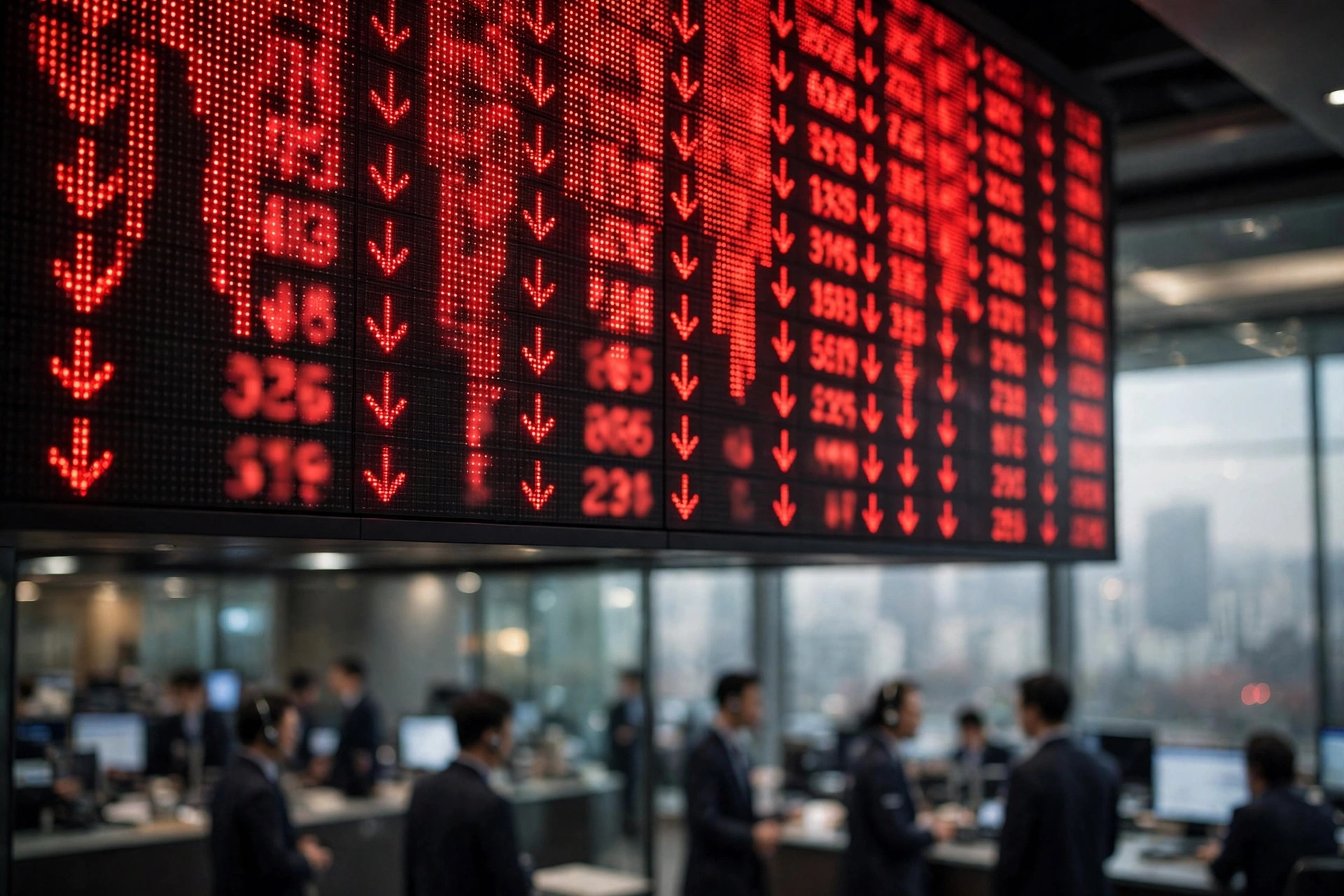
The KOSPI crash November 2026 arrived with a speed that forced South Korea's financial authorities into emergency action within hours. On Friday 6 November 2026 the KOSPI, South Korea's main stock index, fell 8.52 percent intraday to 4,924.61 shortly after the open, triggering a 20-minute circuit-breaker halt. The index closed down 6.02 percent at 5,059.65. The KOSDAQ, the index for smaller and technology-focused companies, fell 7.26 percent intraday. The fall followed a slide in US technology shares after the US midterm elections and concerns over AI data-centre regulation. An emergency market-monitoring meeting held on 6 November, chaired by Deputy Prime Minister and Finance Minister Lee Hyoung-il, agreed the response. Securities firms will be waived for three months from Monday 9 November from the requirement to maintain a 140 percent collateral ratio on margin loans, to prevent forced selling amplifying the decline. The waiver is a targeted measure, not a ban on forced selling, and brokerages may still apply their own risk rules. It is the first such forced-selling reprieve since July 2022, and it comes after a year in which the KOSPI has already triggered its circuit breaker ten times before this one.
KOSPI Crash November 2026: What Happened on Friday 6 November
On Friday 6 November 2026 the KOSPI fell 8.52 percent intraday to 4,924.61 shortly after the open. The fall was sharp enough to trigger a 20-minute circuit-breaker halt. A circuit breaker is a pause in trading that is triggered when an index falls by a set amount in a short time, and its purpose is to give the market time to absorb the shock and to stop panic selling from feeding on itself. This was the 11th circuit breaker on the KOSPI this year and the 17th on record. Those two counts describe different things. Eleven is the number of times the circuit breaker has been triggered on the KOSPI in 2026 so far. Seventeen is the total number of times it has been triggered since records of such halts began. The index closed down 6.02 percent at 5,059.65, which means it recovered part of the morning loss during the rest of the day but still ended the session sharply lower. The KOSDAQ fell 7.26 percent intraday, showing that the selling was not confined to the largest companies on the KOSPI.
The scale of the fall becomes clearer when set against where the KOSPI had been. The index stood at 6,838 at the end of September and at 5,384 on 5 November, the day before the crash. That means the market had already fallen steeply from its end-of-September level before Friday's drop, and Friday took it lower still. The closing level of 5,059.65 on 6 November was below the 5,384 level of the previous day, and the intraday low of 4,924.61 was lower again. The fall followed a slide in US technology shares after the US midterm elections and concerns over AI data-centre regulation. Those two drivers, a slide in US technology shares and concerns over regulation of AI data centres, are the causes given in the verified reporting for this story. They link the Korean market's fall to events in the United States, which is a reminder that South Korea's market, with its heavy weight of technology and chip companies, moves closely with US technology shares. When US technology shares slide, Korean technology shares often follow, and on 6 November that is what happened.
Background: Margin Loans, Forced Selling and the 140 Percent Rule
The emergency response to the KOSPI crash November 2026 centres on margin loans. A margin loan is money borrowed from a brokerage to buy shares, with the shares themselves serving as collateral for the loan. The collateral ratio is the value of the shares held against the loan, expressed as a percentage of the loan. Under the rule in place before the waiver, securities firms had to maintain a 140 percent collateral ratio on margin loans. That means the value of the collateral had to stay at or above 140 percent of the amount borrowed. When share prices fall, the value of the collateral falls with them, and the ratio can drop below the required level. When that happens, the brokerage can demand more collateral or sell the shares to repay part of the loan. That sale is forced selling. It is forced because the investor does not choose the timing. The sale happens because the collateral rule requires it. Forced selling can make a falling market fall further, because sales push prices down, which pushes more collateral ratios below the required level, which triggers more forced sales. That cycle is what the waiver is meant to break.
Outstanding margin loans stood at 28.64 trillion won as of 4 November, down 25.9 percent from the peak of 38.63 trillion won on 24 June. Those two figures describe the size of margin borrowing in the market. The peak of 38.63 trillion won on 24 June was the highest level reached, and the figure of 28.64 trillion won on 4 November was lower by 25.9 percent, which means margin borrowing had already fallen substantially before the crash. Even so, 28.64 trillion won is a large amount of borrowed money tied to share prices, and a sharp fall in prices puts that borrowing under strain. Forced sales at Korea's 10 largest brokerages totalled 919.34 billion won in the first half of 2026. That figure shows that forced selling was already happening at scale in the first six months of the year, before the November crash. The waiver does not erase those loans or those sales. It changes the rule that forces sales when collateral ratios fall, for a limited time.
KOSPI Crash November 2026: The Emergency Meeting and the Waiver
An emergency market-monitoring meeting was held on 6 November, chaired by Deputy Prime Minister and Finance Minister Lee Hyoung-il. The meeting brought together Financial Services Commission Chairman Lee Eok-weon, Financial Supervisory Service Governor Lee Chan-jin and Bank of Korea Senior Deputy Governor Kwon Min-soo. Those four names cover the finance ministry, the financial regulator, the financial supervisor and the central bank, which shows that the response was coordinated across the institutions that oversee the market. The meeting agreed the response: securities firms will be waived for three months from Monday 9 November from the requirement to maintain a 140 percent collateral ratio on margin loans. The Financial Supervisory Service, known as the FSS, is to issue a no-action letter on 9 November. A no-action letter is a formal statement from a regulator that it will not take enforcement action for a specified course of conduct, and here it gives effect to the waiver. The waiver lasts three months from Monday 9 November, which is the start date for the relief. Its stated purpose is to prevent forced selling amplifying the decline.
The limits of the waiver matter as much as its scope. Forced selling is not banned outright, and brokerages may still apply their own risk rules. That means a brokerage can still sell shares held on margin if its own internal risk rules require it, even while the regulatory collateral requirement is waived. The waiver removes the regulatory trigger for forced sales, but it does not remove the brokerages' own risk management. Investors who have borrowed on margin should not read the waiver as a guarantee that their shares will not be sold. It is a reprieve, not a shield. It is also the first such forced-selling reprieve since July 2022, which puts the measure in context. The last time South Korea's authorities gave this kind of relief was in July 2022, more than four years earlier. The fact that it has not been used since then shows that it is reserved for moments of severe market stress, and the 6 November fall, with its 8.52 percent intraday drop and its circuit-breaker halt, was judged to be such a moment. A parallel market fall in the region is covered in Taiwan's stock market crash in November 2026.
Why It Matters: A Record Run, a Sharp Fall and the Risk of a Spiral
The KOSPI crash November 2026 matters because of the contrast with what came before it. The KOSPI stood at 6,838 at the end of September. By 5 November it was at 5,384. On 6 November it fell to an intraday low of 4,924.61 and closed at 5,059.65. That is a steep fall from the end-of-September level in a little over a month, and it happened in a year when the circuit breaker had already been triggered ten times before 6 November, making this the 11th this year and the 17th on record. A market that triggers its circuit breaker 11 times in a year is a market that has repeatedly fallen fast enough to halt trading. Each halt is a sign of stress, and the accumulation of 11 halts in one year is itself a measure of how volatile the year has been. The KOSDAQ's intraday fall of 7.26 percent on 6 November adds to the picture, showing that smaller and technology-focused companies were hit as well as the largest companies.
The forced-selling risk is the reason the authorities acted on margin rules rather than on something else. Outstanding margin loans of 28.64 trillion won as of 4 November, down 25.9 percent from the 24 June peak of 38.63 trillion won, still represent a large stock of borrowed money. Forced sales at Korea's 10 largest brokerages totalled 919.34 billion won in the first half of 2026, which shows that forced selling was already a live feature of the market before November. When prices fall sharply, margin borrowers are the investors most likely to be forced to sell, and their sales can push prices lower for everyone else. The waiver is designed to break that link for three months, from Monday 9 November, by removing the regulatory requirement to maintain a 140 percent collateral ratio. The fact that brokerages may still apply their own risk rules means the link is weakened rather than removed entirely. The authorities' judgement, as agreed at the emergency meeting chaired by Lee Hyoung-il, was that weakening that link was worth doing. The fall's drivers, a slide in US technology shares after the US midterm elections and concerns over AI data-centre regulation, are external to Korea, which means the Korean authorities cannot control them. What they can control is the domestic mechanism by which a fall feeds on itself, and that is what the waiver addresses. How Singapore's banks fared in the same reporting season is covered in Singapore banks' Q3 2026 results for DBS, OCBC and UOB.
Key Facts at a Glance
In the KOSPI crash November 2026, on Friday 6 November 2026 the KOSPI fell 8.52 percent intraday to 4,924.61 shortly after the open, triggering a 20-minute circuit-breaker halt. It was the 11th circuit breaker on the KOSPI this year and the 17th on record. The index closed down 6.02 percent at 5,059.65. The KOSDAQ fell 7.26 percent intraday. The fall followed a slide in US technology shares after the US midterm elections and concerns over AI data-centre regulation. An emergency market-monitoring meeting on 6 November was chaired by Deputy Prime Minister and Finance Minister Lee Hyoung-il, with Financial Services Commission Chairman Lee Eok-weon, Financial Supervisory Service Governor Lee Chan-jin and Bank of Korea Senior Deputy Governor Kwon Min-soo. Securities firms will be waived for three months from Monday 9 November from the requirement to maintain a 140 percent collateral ratio on margin loans. The FSS is to issue a no-action letter on 9 November. Forced selling is not banned outright, and brokerages may still apply their own risk rules. Outstanding margin loans were 28.64 trillion won as of 4 November, down 25.9 percent from the 24 June peak of 38.63 trillion won. Forced sales at Korea's 10 largest brokerages totalled 919.34 billion won in the first half of 2026. It is the first such forced-selling reprieve since July 2022. The KOSPI stood at 6,838 at the end of September and at 5,384 on 5 November.
Two figures in that list are easy to confuse, and they should be kept apart. The fall on 6 November was 8.52 percent intraday and 6.02 percent at the close. The number 11 is the count of circuit breakers on the KOSPI this year, and 17 is the count on record. The number 11 is the count of circuit breakers on the KOSPI this year, not the size of the fall. The intraday low was 4,924.61, the close was 5,059.65, and the previous day's level was 5,384. The end-of-September level was 6,838. The margin loan figures are 28.64 trillion won on 4 November and 38.63 trillion won at the 24 June peak, a fall of 25.9 percent. The forced-sales figure is 919.34 billion won at the 10 largest brokerages in the first half of 2026. The waiver lasts three months from Monday 9 November, and the FSS no-action letter is due on 9 November. The safe-haven story running alongside the sell-off is covered in gold above 4,000 as central banks bought 321 tonnes.
What Happens Next: Three Months of Relief and the US Technology Link
The immediate next step after the KOSPI crash November 2026 is Monday 9 November, when the waiver takes effect and the FSS is to issue its no-action letter. From that date, securities firms are waived for three months from the requirement to maintain a 140 percent collateral ratio on margin loans. The three-month window is the period during which the regulatory trigger for forced selling is lifted. What happens inside that window will depend on two things: the market itself, and the brokerages' own risk rules. Brokerages may still apply their own risk rules, so forced selling will not stop entirely. The question for investors is whether the waiver is enough to stop the cycle in which falling prices trigger forced sales, which push prices lower. The answer will show in the trading data over the coming days and weeks, including the level of the KOSPI, the level of outstanding margin loans, and the volume of forced sales.
The wider question is whether the drivers of the KOSPI crash November 2026 will ease. The fall followed a slide in US technology shares after the US midterm elections and concerns over AI data-centre regulation. Those drivers are outside South Korea's control, and they link the KOSPI's path to the path of US technology shares. If US technology shares stabilise, the pressure on the KOSPI should ease. If they fall further, the KOSPI will face further pressure, and the waiver will be tested. The KOSPI's own recent history, from 6,838 at the end of September to 5,384 on 5 November, then to an intraday low of 4,924.61 and a close of 5,059.65 on 6 November, shows a market that has already fallen a long way in a short time. The circuit breaker count, 11 this year and 17 on record, shows a market that has repeatedly hit its own safety pause. The waiver, the first such reprieve since July 2022, is the authorities' answer to that pattern. It buys three months of relief from the regulatory forced-selling trigger, starting on Monday 9 November. Whether that relief is enough will be judged by what the market does next.
Sources
The Global Banker; Korea JoongAng Daily; Morningstar/Dow Jones; Seoul Economic Daily. November 2026.