
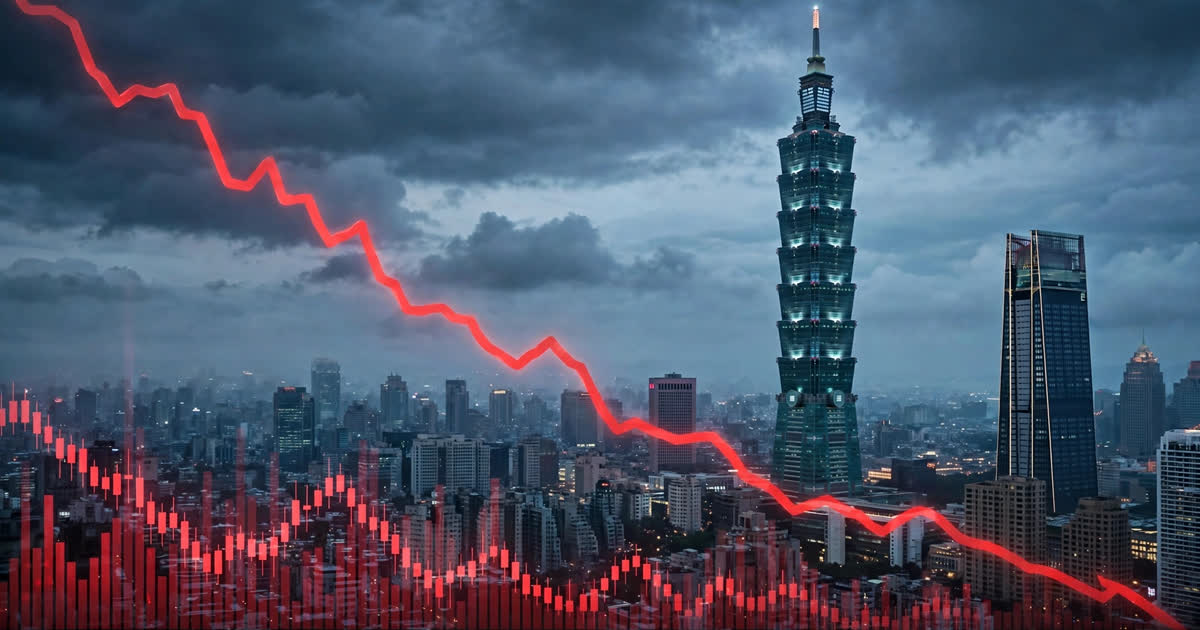
The Taiwan stock market crash on Friday, 6 November 2026, set a record nobody in Taipei wanted. The TAIEX plunged 3,737.67 points within minutes of the opening bell — an 8.99% drop to an intraday low of 37,837.05 — the largest intraday point fall in the market's history, according to Taiwan's Central News Agency. By the close, the index had clawed back part of the loss to finish at 39,701.64, down 1,873.08 points, or 4.51%, still the fourth-largest closing point decline the market has ever recorded. Trading value hit NT$1.25 trillion as investors rushed for the exits. The crash did not stop at Taiwan's shores. South Korea halted trading after the KOSPI plunged more than 8%, and Japan's Nikkei 225 closed about 6% lower, more than 20% below its June peak. The trigger was Thursday's rout on Wall Street, where the Nasdaq Composite fell 5.52% and the Philadelphia Semiconductor Index dropped 12.25%.
Taiwan Stock Market Crash: How the TAIEX Lost 3,737 Points in Minutes
The scale of the opening drop stunned even veteran traders. The index opened at 38,915.76, already 2,658.96 points lower — a 6.4% gap down — and kept falling until it touched 37,837.05 shortly after trading began at 9 a.m. local time. The intraday plunge of 3,737.67 points was the largest in the market's history. At its worst, the TAIEX sat below 40,000 points and under its 240-day moving average of about 38,827, a level technicians watch as a dividing line between a healthy market and a broken one. The rebound that followed still left the index 1,873.08 points lower at the close, its fourth-biggest closing point loss on record. Turnover of NT$1.25 trillion showed just how many investors were selling at once. The fall capped a brutal week. The TAIEX had closed at 45,211.83 on Friday, 30 October; by Friday, 6 November it was about 12% below that level. It fell 1,612.60 points on Tuesday, 3 November — then the seventh-largest single-day point decline on record — and another 1,374.19 points on Thursday, 5 November, to 41,574.72. Foreign institutional investors sold a net NT$107.31 billion of shares on the main board on 3 November and NT$102.46 billion on 5 November, the tenth-largest one-day net foreign sell-off on record, according to Taiwan Stock Exchange data cited by Focus Taiwan.
TSMC Hits Its Daily Limit as Taiwan's Biggest Stock Drags the Market
No single company mattered more than Taiwan Semiconductor Manufacturing Co. TSMC accounts for more than 40% of the market's total value, according to Taiwan's Central News Agency, so when its shares fall, the whole index follows. On Friday they fell hard: TSMC dropped NT$220 to its daily limit of NT$2,020 shortly after trading began, a 9.8% fall and the largest absolute intraday price drop in the stock's history. The slide wiped about NT$5.7 trillion from the company's market value in a single session. The pain spread across the technology sector. MediaTek fell to its daily limit at NT$3,115, Delta Electronics hit its daily limit at NT$1,020, and Hon Hai Precision Industry — known globally as Foxconn — fell more than 9%. The pattern was the same across all of them: the companies that build the hardware for the artificial intelligence boom were the ones investors sold first. That is the paradox at the heart of this crash. The same AI spending that pushed Taiwan's market to record highs in October is now the reason investors are selling, because they doubt how fast that spending will keep growing — and Taiwan's market, more than any other, is built on it.
The Rout Spreads: KOSPI Circuit Breaker and Nikkei Bear Market
Seoul felt it first in clock terms. The KOSPI plunged more than 8% within minutes of the open, falling to 4,924.61 and below the 5,000-point level for the first time in nine months. At 9:03 a.m. local time the Korea Exchange triggered a circuit breaker, suspending all trading for 20 minutes to slow the slide. The index recovered some ground and closed down 6.02% at 5,059.65, a loss of 324.15 points. SK Hynix closed 10.44% lower at 1,132,000 won and Samsung Electronics fell 6.35% to 188,700 won. South Korea's government convened an emergency meeting on market conditions after the close. Tokyo's Nikkei 225 dropped more than 7% intraday to a low of 56,745.81 before closing at 57,434.77, down 3,643.13 points, or 5.96%. That left the index more than 20% below its June peak — the definition of a technical bear market — and marked its worst day since April 2025. SoftBank fell 10.83% and chipmaker Kioxia dropped 8.72% in Tokyo. The figures differ in detail, but the story is the same in all three markets: the AI-chip trade that powered Asia's rally has become the trade investors are fleeing.
Why the Taiwan Stock Market Crash Happened: AI Spending Fears After the US Sell-Off
The spark came from Wall Street. On Thursday, 5 November, the Nasdaq Composite fell 5.52% and the Philadelphia Semiconductor Index plunged 12.25%, while the Nasdaq 100 dropped 6.4% and erased a record $2.3 trillion of market value in a single session. The S&P 500 lost 4.36%. The US sell-off wiped out the post-midterm rally of two days earlier. The Associated Press reported that investors were worried about a slowdown in AI data-centre construction after borrowing costs rose, and that criticism had grown that AI stock prices had climbed too far and entered bubble territory. Sweeping Democratic victories in the US midterm elections added a political edge: the prospect that governments could halt additional data-centre construction. Goldman Sachs' Delta One trading desk had reportedly warned that 2027 could mark the cyclical peak for semiconductors as capital costs constrain expansion. None of that means demand for AI chips has disappeared. It means investors are no longer willing to pay any price for growth that may arrive later than expected — and markets built on that growth, like Taiwan's, feel the repricing first.
What Taiwan's Government Said — and What Happens Next
Taipei moved quickly to calm nerves. President Lai Ching-te urged the public not to panic, and Premier Cho Jung-tai instructed the Financial Supervisory Commission to draft measures to stabilise the market. Ruan Qinghua, deputy minister of finance and executive secretary of the National Stabilization Fund, said Taiwan's economic fundamentals remain sound. Analysts cited by Taiwan's Central News Agency warned that the index could face a wave of selling linked to margin calls, and advised investors to wait for technical signals that the market had stabilised. What to watch next: the US October jobs report, due at 8:30 a.m. Eastern time on Friday, 6 November; whether foreign investors keep selling Taiwanese shares or step back in; whether TSMC can hold above its NT$2,020 limit-down level when trading resumes; and whether Taipei and Seoul follow through with stabilisation measures. A single day does not decide a market's direction. But a record intraday plunge, a circuit breaker in Seoul and a bear market in Tokyo in the same session is a warning that the AI rally's easy phase is over.
Putting the Taiwan Stock Market Crash in Perspective
Context matters. The TAIEX's market capitalisation reached NT$158 trillion at the end of October, up about 61% year over year, according to the head of the Financial Supervisory Commission. Even after a week that took the index about 12% below its 30 October close, Taiwan's market is far above where it stood a year ago. A 3,737-point fall sounds catastrophic — and for anyone who bought at the October peak, it is painful — but it is an 8.99% intraday drop, not a collapse of the market itself. The question now is whether this is a correction inside a longer AI build-out or the start of something worse. The answer will come from data-centre spending plans, borrowing costs and the next round of chip earnings, not from one day's panic. This article is general information, not investment advice.
Sources: Taiwan's Central News Agency (Focus Taiwan); Nikkei Asia; Associated Press; Yonhap News Agency; FISCO.