
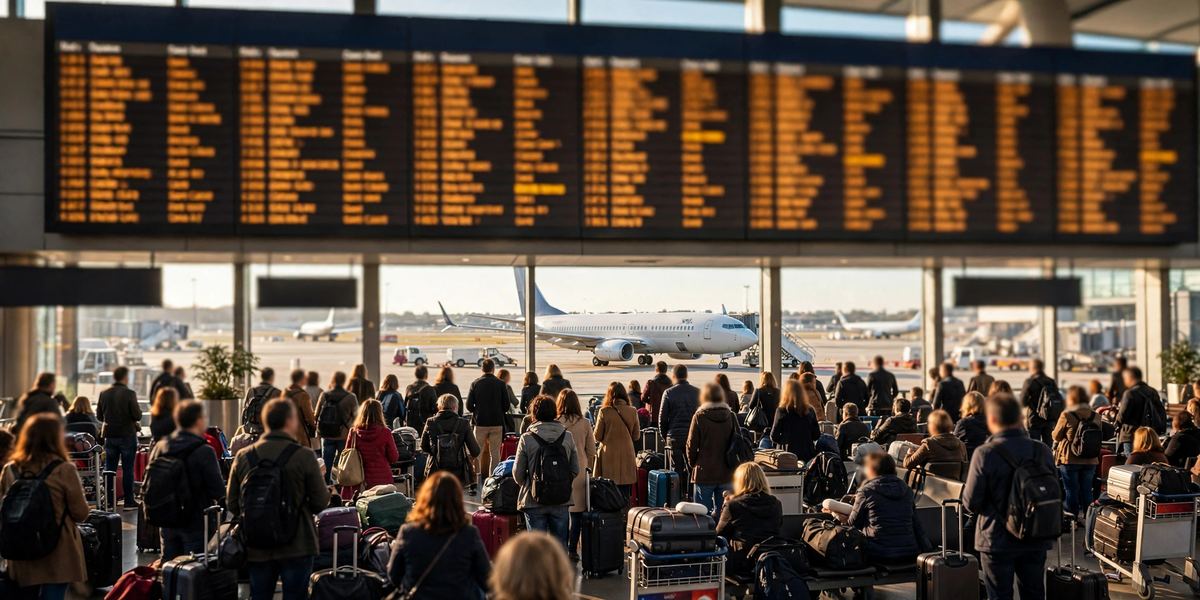
Friday 16 October 2026 was shaping up to be one of the most disruptive days for European air travel this autumn, and Italy found itself at the centre of it. A nationwide 24-hour strike by easyJet cabin crew, walkouts by airport security and ground staff, and a separate technical fault in the country's air traffic control network combined to produce delays and cancellations across Italian airports, with knock-on effects in the United Kingdom and beyond. For passengers, the day became a case study in how quickly a routine trip can unravel when labour action and infrastructure problems collide. This explainer sets out what happened, why, which flights were affected, and what rights passengers hold when their journey is disrupted. The story is trending per news coverage across travel and mainstream outlets on 16 October 2026.
The easyJet strike: a full day of walkouts
The main event was a 24-hour nationwide strike by easyJet cabin crew in Italy, running from midnight to 11:59 p.m. local time on Friday 16 October. The action was called by the USB Lavoro Privato union and covered easyJet Airlines Limited flight personnel across the airline's Italian bases, meaning it could affect domestic and international easyJet flights to and from Italy throughout the day.
The dispute centres on a contract renewal signed on 15 September. According to strike reporting, the USB union alleges that the vote results were published late and that its request to observe the process was refused. The strike date itself had already moved once: it was first announced for 15 October before the union withdrew that date and re-filed it for the following day.
The effects were visible before the strike even began. Around 200 UK easyJet flights to Rome and Milan were cancelled ahead of the walkout, according to UK press reports, and ITA Airways confirmed 13 direct flights between London and Italian destinations were cancelled. Passengers on other carriers were not spared either: security staff at Venice Marco Polo airport staged a 24-hour walkout, while ground staff at Pisa Galileo Galilei and Florence Peretola airports also struck for 24 hours, affecting check-in, baggage handling and aircraft turnaround for every airline using those airports. A four-hour stoppage by ENAV air traffic controllers had also been scheduled for 13:00 to 17:00 Italian time, according to pre-strike reporting. In the UK, Leeds Bradford Airport was on day two of a three-day security workers' strike, slowing screening for passengers heading to Italy.
The second blow: an air traffic control technical fault
As if the strikes were not enough, Italy's air traffic control system suffered a technical fault on the same day. Reuters reported on Friday that air travellers faced delays and cancellations across Italy due to a technical fault affecting air traffic control, which authorities said was not caused by malicious activity.
Air traffic authority ENAV said it had introduced temporary restrictions on air traffic capacity after detecting anomalies overnight on the data transmission network supporting air traffic control services nationwide. Rome airports operator ADR warned that, due to technical issues affecting air traffic control systems nationwide, flight delays and cancellations could occur, and advised passengers to contact their airline. Milan airports company SEA issued a similar notice. ENAV said the source of the problem had been identified and that efforts were under way to restore full operations.
The fault matters because it compounded the strike. Capacity restrictions mean fewer aircraft can be handled safely even where crews are available, so delays can cascade through the day long after the original problem is fixed. It is also important to be clear about what the fault was not: authorities explicitly said it was not caused by malicious activity, and there is no evidence at this stage of a cyberattack. It was, on the available evidence, an infrastructure failure on the worst possible day.
Update — the scale: ENAV said in a statement on 16 October that its operating capacity remained at 50 percent of overall air traffic while the fault persisted, and flow-management measures temporarily cut the country's air traffic capacity by half. Cirium counted 192 cancellations around midday, with Rome Fiumicino the worst hit, and full capacity was restored in the afternoon, at about 15:30. Some cancellations that day were strike-related rather than caused by the fault, since the easyJet walkout fell on the same day.
What still flew: protected windows and minimum services
Italian aviation rules do not allow a strike to shut the skies entirely. The civil aviation authority ENAC sets protected time windows during which flights departing Italy must operate: 07:00 to 10:00 and 18:00 to 21:00 local time. Flights scheduled inside those windows were expected to operate, and they were the safest bet for anyone who had to travel on the day.
ENAC also published a minimum-service notice naming five specific easyJet services that had to operate. Four connected mainland Italy with island destinations, including Naples to Olbia and Milan Malpensa to Lampedusa, and the fifth was flight EJU3897 from Milan Malpensa to Sharm El Sheikh in Egypt. International flights arriving in Italy, including those transiting through Italian airports, were also covered by the authority's minimum-service provisions. Other services could still operate if easyJet had sufficient available crews and resources, so the five named flights were not the only ones expected to run.
France: the strike that did not happen
Travellers watching the wider European picture received better news from France. A nationwide five-day strike by pilots and cabin crew at Air France, Transavia France and Corsair, covering around 36,000 crew members, had been scheduled to begin on Saturday 17 October and run through Wednesday 21 October, landing exactly at the start of France's Toussaint school holidays. The dispute concerned the government's planned reform of the Cumul-Emploi-Retraite pension scheme, which allows people to work while drawing a pension, due to take effect on 1 January 2027.
According to reports published on 14 October, the union coalition stood the strike notice down after the government agreed to protect the crews' pension fund, so Air France, Transavia France and Corsair did not face a crew strike at the start of the school holidays. A separate French air traffic control strike had already been averted through last-minute agreement. The episode is a reminder that strike notices in Europe are often negotiating tools: they are filed, they shape behaviour, and they are sometimes withdrawn before a single flight is cancelled. Passengers with French bookings should still check their flight status, but the wave of cancellations many feared did not materialise.
Your rights if your flight was disrupted
For passengers caught in the Italy disruption, the key framework is EU Regulation 261/2004, with UK261 applying to flights departing the UK. If your flight was cancelled, the airline must offer you a choice between a full refund and rebooking to your destination at the earliest opportunity. If you are stranded, the airline also owes you a duty of care: meals, refreshments, hotel accommodation where an overnight stay is needed, and transport between the airport and the hotel.
Cash compensation is a separate question. For cancellations notified fewer than 14 days before departure, or arrivals delayed by three hours or more, passengers may be entitled to fixed compensation of 250 euros for short-haul flights, 400 euros for medium-haul, and 600 euros for long-haul. Whether compensation applies depends on the cause of the disruption. A strike by an airline's own staff is generally not treated as an extraordinary circumstance under EU case law, including the European Court of Justice ruling in Krusemann v TUIfly, which means compensation may be available for flights cancelled because of the easyJet cabin-crew walkout. Disruption caused by airport staff or air traffic control action is treated differently and may be classed as extraordinary circumstances, so eligibility should be assessed against the actual reason for each specific cancellation. Compensation is not automatic: passengers should claim through the airline first and keep boarding passes, booking confirmations and receipts.
A few practical rules helped on the day. Travellers who had not yet been cancelled were advised to wait for the airline to cancel before rebooking themselves, because rebooking independently can weaken a compensation claim. Anyone rebooking was best served by choosing a flight inside a protected window. And passengers using Venice, Pisa or Florence airports were advised to allow extra time, since the ground and security walkouts there affected every airline, not only easyJet.
A season of disruption across Europe
Italy's difficult Friday did not come out of nowhere. Europe has endured a run of transport labour action this autumn, from the easyJet cabin-crew strike in Portugal in early October to pilot walkouts at Air Corsica and a bus strike in Lyon the day before the Italy action. Airlines are also under financial pressure: easyJet has been reported to be removing up to 1.4 million seats from its winter 2026-27 schedule to limit the cost of high fuel prices. Geopolitical tensions have added a further layer of disruption, with KLM extending Middle East flight suspensions into late October.
For passengers, the lesson of 16 October is a familiar one: check flight status before leaving home, know the protected windows, understand the difference between a refund, rebooking and compensation, and keep every receipt. Strikes in Italy are sometimes called off or reduced at short notice, so the picture can change quickly, but on this occasion the combination of a walkout and a technical fault made disruption close to unavoidable.