
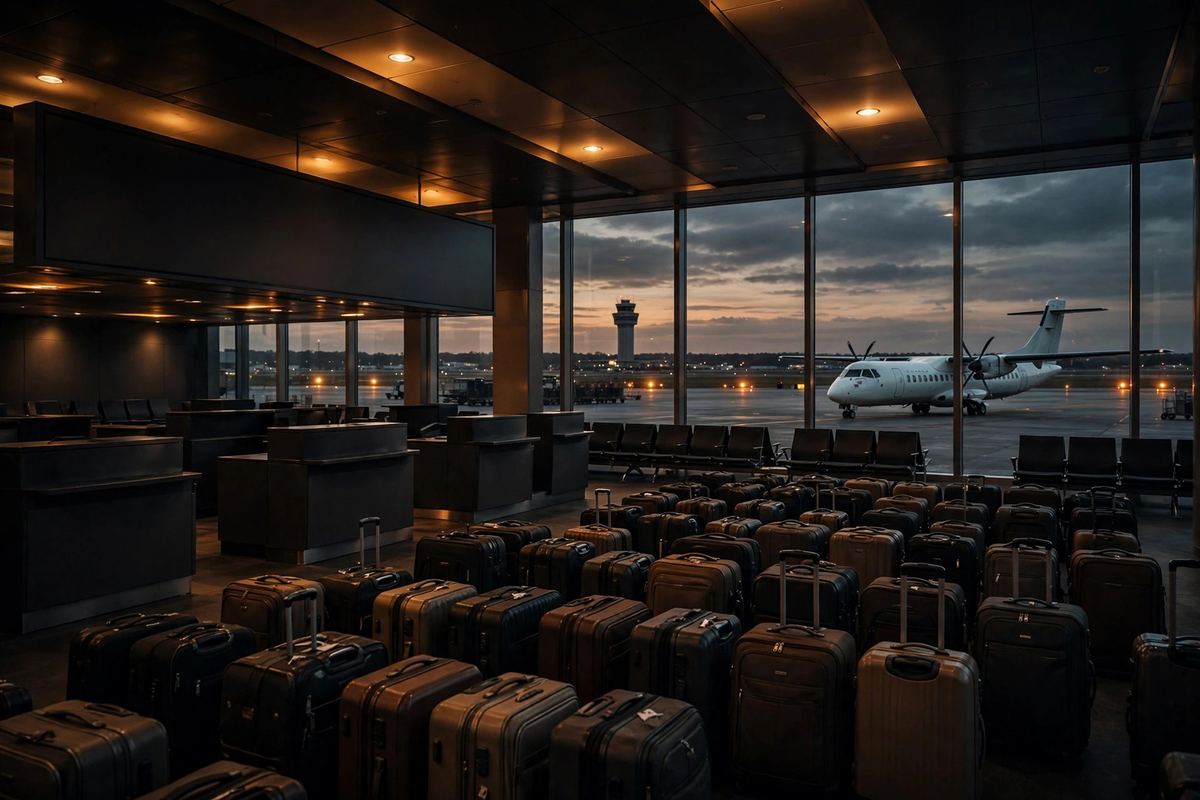
Leeds Bradford Airport, Yorkshire's main regional airport, is facing a standstill weekend. Around 130 members of the Unite union — working in air traffic control, security, customer service and cleaning — are due to walk out from Friday 16 October to Sunday 18 October 2026 in a long-running dispute over pay. The union says the action will shut the airport down; the airport says it expects near-normal operations. For travellers, the only reliable source of truth will be their airline.
The walkout lands in mid-October, a busy period for autumn half-term getaways, and affects an airport that handled a record 4.45 million passengers in its last financial year. Jet2.com and Jet2holidays, for whom Leeds Bradford is a hometown airport and one of their biggest UK bases, are among the operators most exposed to disruption. Here is what is happening, why, and — crucially — what the law says airlines owe you if your flight is cancelled.
What happened: the strike dates and who is walking out
The industrial action was announced after nearly ten months of pay negotiations failed to produce a settlement. Hourly-paid staff are scheduled to strike from 3:00 am on Friday 16 October until 6:00 am on Sunday 18 October, while air traffic control staff are due to walk out from 6:00 am on Friday 16 October until 6:00 am on Sunday 18 October — a full 48 hours.
The striking workers are a mix of air traffic controllers, customer experience staff, security screeners and cleaners. Unite argues the combination is critical: as the union puts it, no flights can operate without air traffic control, no passengers can depart or arrive without passport-control cover, and there would be nobody in the terminal to assist travellers. The airport has formally responded that it respects the right to lawful industrial action but considers a strike the wrong way to resolve issues still under discussion, describing its pay proposal as “fair, responsible and significantly above inflation”.
Airport management's public position is notably calmer than the union's: in an official statement, Leeds Bradford said that at this stage it anticipates “running near-normal operations during the period” and that it remains committed to constructive dialogue with Unite. No airline cancellation programme had been announced at the time the strike was called — which is why passengers should treat airline notifications, not either side's forecast, as the authority on whether their flight will operate.
The background: a ten-month pay dispute
Pay talks have been under way since December 2025, when a four-year pay deal came to an end. Unite says the airport's offers have not gone far enough to address what it describes as a lack of pay parity — some departments have fallen behind equivalent roles at comparable airports such as Newcastle, which handles around 5.5 million passengers a year.
The union points to the airport's financial strength: Leeds Bradford reported turnover of £61.5 million for the year ending 31 March 2025, up 14 per cent from £54 million the previous year — the highest in its history. In May 2026 it was partially taken over by Spanish operator AENA, which acquired a 51 per cent majority stake as part of a £270 million holding-company deal. Unite general secretary Sharon Graham said the airport could “more than afford to come back to the table” with a better offer.
The airport tells a different story about its finances. According to figures reported by the Yorkshire Evening Post, Leeds Bradford recorded a £6.6 million loss for the 2025/26 financial year, following a £479,000 profit the previous year — even as it posted its busiest-ever year with passenger numbers up four per cent to about 4.4 million. Management says any profits are reinvested in facilities and infrastructure, including the ongoing LBA:REGEN project, and that its offer reflects current economic conditions and the need for long-term sustainability. Both sides' claims are on the record; the figures underline that this is a genuine dispute about affordability, not a misunderstanding.
Why this matters
For passengers, the timing is awkward. Mid-October covers the autumn half-term holiday period in parts of the UK, when families head for destinations such as Alicante, Tenerife and Antalya — all served from Leeds Bradford. Even a partial disruption would ripple through tightly scheduled airline operations, and a full shutdown would strand thousands.
The airport's reliance on a single tower crew makes the air traffic control element decisive: unlike terminal services, certified controllers cannot be replaced at short notice, which is the basis of Unite's claim that no aircraft will be able to move. That is also why the airport's “near-normal operations” statement is so significant — it implies management believes it has contingency cover, though it has not said publicly what that cover is. As with the recent aviation security incident covered by Worldlession, the gap between official reassurance and operational reality is where travellers get hurt — so verify everything with your airline directly.
There is also a wider economic angle. Leeds Bradford describes itself as vital to connecting Yorkshire with the world, and business travellers as well as holidaymakers rely on its routes. If the strike goes ahead in full, surface travel to Manchester or Newcastle — the nearest large alternatives, both involving significant journey times — would be the fallback for rebooked passengers.
Key facts
- Who: around 130 Unite members at Leeds Bradford Airport, in air traffic control, security, customer experience and cleaning roles.
- When: hourly-paid staff strike 3:00 am Friday 16 October to 6:00 am Sunday 18 October 2026; air traffic control staff strike 6:00 am Friday to 6:00 am Sunday (48 hours).
- Why: pay dispute ongoing since December 2025; Unite cites pay disparities with comparable airports, the airport says its offer is significantly above inflation.
- Union position: the walkout will shut the airport — no flights without air traffic control, no terminal assistance.
- Airport position: expects near-normal operations; remains committed to talks; calls the strike disappointing.
- Financial backdrop: £61.5m turnover in the year to 31 March 2025 (a record); £6.6m loss reported for 2025/26; AENA took a 51% stake in May 2026.
- Passengers: a record 4.45 million in the last financial year; popular routes include Alicante, Tenerife and Antalya.
- Key operator: Jet2.com and Jet2holidays count Leeds Bradford as a hometown airport and major UK base.
- Status: talks could still settle the dispute before 16 October — the situation may change.
Your rights if your flight is cancelled: UK261 explained
If your flight is cancelled or heavily delayed because of the strike, UK law — the retained version of EU Regulation 261/2004, known as UK261 — sets out what your airline must do. The first distinction to understand is between compensation and care. Strikes by airport or air traffic control staff are generally treated as “extraordinary circumstances” beyond the airline's control, which means cash compensation (normally £220 for short-haul, £350 for medium-haul and £520 for long-haul flights) is unlikely to be payable. That is different from strikes by an airline's own staff, which courts have increasingly held to be the airline's responsibility.
But extraordinary circumstances do not let the airline off the hook entirely. Your right to care remains whatever the cause of the disruption: the airline must provide meals and refreshments, hotel accommodation and transport if you are stranded overnight, and — most importantly — the choice between a full refund or rerouting to your final destination at the earliest opportunity (or at a later date of your choosing, subject to seat availability). If the airline cannot reroute you itself, it may rebook you via another carrier or airport.
Practical steps: do not cancel your own booking pre-emptively, or you may lose these rights — wait for the airline to cancel or offer an alternative, since a passenger-initiated cancellation is treated as voluntary. Keep every receipt for meals, transport and hotels, because you can claim reasonable expenses back. If your flight is cancelled with less than 14 days' notice, check the compensation question carefully with the airline or the Civil Aviation Authority — the “extraordinary circumstances” defence is fact-specific, and not every cancellation during a strike period automatically qualifies.
Travel insurance is the other safety net. Check now whether your policy covers strike disruption and “scheduled airline failure”; many standard policies exclude industrial action unless you bought an upgrade. If you booked a package holiday, you have stronger protection: the organiser must offer an alternative or a full refund, and ATOL protection covers you if the travel company itself collapses. Travellers with trips booked during the strike window may also want to read our latest travel advisories before finalising plans.
What happens next
The dispute is not yet settled, and strikes are frequently called off at the last minute when talks progress — the airport says it would welcome continued discussions, and Unite says its members have “full support” but would prefer a deal. Until 16 October, the situation is fluid, and passengers should monitor three things: their airline's app and email for cancellation or retiming notices, the airport's departure and arrival boards, and any joint statements from Unite and airport management.
If you are flying that weekend, the sensible checklist is: download your airline's app and enable notifications; screenshot your booking and any disruption notices; pack essentials (medication, chargers, a change of clothes) in hand luggage in case of rebooking via another airport; know the refund-versus-rerouting choice before you speak to the airline; and research the Manchester and Newcastle alternatives now, while seats and trains are still available. If your flight is cancelled, you are entitled to care and rerouting or a refund regardless of what caused the strike — do not let anyone tell you otherwise.