
A Reuters investigation published on 29 October 2026 has described how Iran MOD agencies moved at least $2 billion worth of hardware, explosives and heavy-duty trucks into Iran since January 2025, despite a United States naval blockade and Western sanctions. Working with the Israeli-American risk consultancy 240 Analytics, Reuters identified more than 5,000 numbered agencies behind names beginning with the letters MOD. The findings were trending per news coverage after publication, because they offered an explanation for a central question in the war that began on 28 February 2026: how has the Islamic Revolutionary Guard Corps kept replenishing its missile and drone arsenals while firing those weapons in their thousands? This explainer sets out what the Iran MOD agencies are, how money and goods moved, what was bought, and what the evidence does and does not prove.
What Are the Iran MOD Agencies?
The Iran MOD agencies are numbered bodies whose names begin with MOD, for the Ministry of Defense, or VODJA in Farsi, followed by a five- or six-digit number written out in words rather than numerals. Each agency also has a unique 11-digit government identity number and appears in Iran’s corporate registry. All share the same Tehran address as Iran’s Ministry of Defense and Armed Forces Logistics, known as MODAFL, and list 11 February 1979, the day Ayatollah Khomeini took power, as their incorporation date. Reuters found that most were in fact established in 2013, when Iran was struggling under sanctions that had cut crude exports and hit its currency.
The Iran MOD agencies were identified for the first time by Reuters working with 240 Analytics. Noam Binstok, a senior analyst at 240 Analytics, said he spotted the numbered entities in June 2025 while uploading thousands of pages of Bank Sepah documents found on Telegram and on WikiIran, a website that solicits leaked documents and says it is run by Iranians in exile. Bank Sepah handles salary and pension payments for the Revolutionary Guard, and the documents had been obtained in a hack claimed by a group called Codebreakers. Reuters said it could not determine who runs WikiIran, although two experts who reviewed the findings said they had used WikiIran data before and found it accurate.
In the bank records, 36 of the Iran MOD agencies held foreign-exchange accounts with $1.2 billion on deposit at the end of 2024, while the rest held around $1.8 billion in local currency, averaging about $360,000 per account. Phone numbers registered to 91 agencies also appeared in Bank Sepah records for Revolutionary Guard personnel, including at least two commanders whom the United States has accused of abuses against civilian protesters. Some agencies were tied to bonyads, the quasi-governmental foundations controlled by Iran’s elite. Reuters said it could find no evidence that any numbered agency had been designated, or formally sanctioned by name, by Western governments, even though Iran’s military has been under multiple United States sanctions for decades.
How the Iran MOD Agencies Moved Money Without Banks
According to the investigation, the Iran MOD agencies form a foreign-trade system running parallel to the formal global economy. They operate through frontmen and foreign shell companies, collectively described as trustees, who use proceeds from illicit oil sales to buy goods for Iran. Money rarely crosses borders in a way that might trigger a sanctions alarm. For 97% of the shipments Reuters reviewed, transactions were settled “without currency transfer”: trusted frontmen in the diaspora, using cash held in foreign banks, bought the goods and shipped them home.
One end user of the network, Reuters reported, is the military unit overseeing Iran’s ballistic missile programme. Another is Sahara Thunder, sanctioned by the United States in 2024 for manufacturing and supplying drones to Russia. Miad Maleki, a former senior United States Treasury official who helped design the American sanctions programme against Iran, called the network the regime’s military lifeline. “This is the complete ecosystem of the Iranian military’s trade business,” Maleki said. The same oil-revenue loop helps explain why pressure on Iran’s shadow tanker fleet has not, on its own, stopped military procurement.
What the Iran MOD Agencies Bought: Propellants, Trucks and Detonators
One agency stood out: MOD 346428. Its overseas purchases rose from $442 million in the 12 months ending in March 2023 to $988 million in the following year, according to customs statistics published in Iranian media, placing it among Iran’s top 10 importers. From January 2025 through June 2026, MOD 346428 imported $2.3 billion of military hardware according to ImportGenius import-export records. That figure comes from a different record set from the headline finding of at least $2 billion for the wider network of Iran MOD agencies since January 2025, so the two figures should not be added together.
In the first six months of 2026, deliveries included $1.9 million worth of detonators, tonnes of explosives, aircraft engine parts, rocket fuel ingredients and heavy-duty launch vehicles, which weapons and sanctions experts said could be used for ballistic missiles and drones, including the Shahed series. In February 2026, ships brought 93 tonnes of unwrought Chinese titanium into Bandar Abbas, along with 268 tonnes of nitrocellulose and 276 tonnes of other chemicals originating in China and listed under a code that includes perchlorate. Titanium can be used for missile airframes and rocket motor casings, while nitrocellulose and perchlorates are ingredients for rocket propellant and explosives.
An earlier chemical shipment raises a question the investigation could not settle. Between January and April 2025, MOD 346428 imported 886 tonnes of chemicals into Bandar Abbas, listed as originating in China under a code that includes sodium chlorates and other perchlorates, key precursors for solid rocket fuel. Three days after the final shipment, an enormous explosion shook the port on 26 April, killing at least 70 people and injuring more than 1,200. Two people with knowledge of the explosion told Reuters it was caused when sodium perchlorate ignited in dockside containers, and Iranian state media reported the chemicals were stored by Sina Port and Marine Services Development Co, owned by Bonyad Mostazafan, a foundation sanctioned by the United States in 2020. Sina’s chief executive at the time blamed a “false statement” about a consignment delivered “without documents and tags”. Reuters stated clearly that it could not determine whether the chemicals in the final 75-tonne shipment were responsible, and this article does not claim that they were.
Trucks were a large part of the trade by the Iran MOD agencies. In the autumn of 2022, an Iranian car dealer living in Italy bought six Iveco Eurocargo trucks for 426,000 euros and shipped them to Deilami Trading Co in Dubai, which delivered them to Bandar Abbas for Sahara Thunder; the end buyer’s identity number belonged to MOD 346428. Between January 2025 and June 2026, MOD 346428 imported 435 more Iveco trucks, and Reuters matched three vehicle identification numbers to a customs lot outside Tehran in February 2025. Iveco said distributors must guarantee its products are not used for military purposes, that it had no control over third-party transfers, and that most trucks in the customs yard had been destined for Central Asia. Reuters also noted United States Central Command footage from March showing a strike on what it described as a disguised mobile missile launcher; Reuters could not determine whether that vehicle was among those imported by MOD 346428.
The Iran MOD agencies also imported thousands of Toyota Hilux and Land Cruiser trucks, which the Revolutionary Guard and its proxies modify to mount heavy machine guns, and four Toyota Tundra vehicles in January 2025, a type the Guard uses to haul drones. Toyota said it does no business in Iran and had no involvement in or knowledge of the purchases. The data also showed precision machinery, including computer-controlled lathes, electron-beam furnaces and particle accelerators, which have industrial uses and can also be used to make drone and missile bodies, and hundreds of millions of dollars of trucks, engine components and electronics listed as coming from Germany and elsewhere in the European Union, including $34 million in Iveco trucks, with MOD 346428 named on the paperwork.
How the Iran MOD Agencies Moved Hardware Despite the Blockade
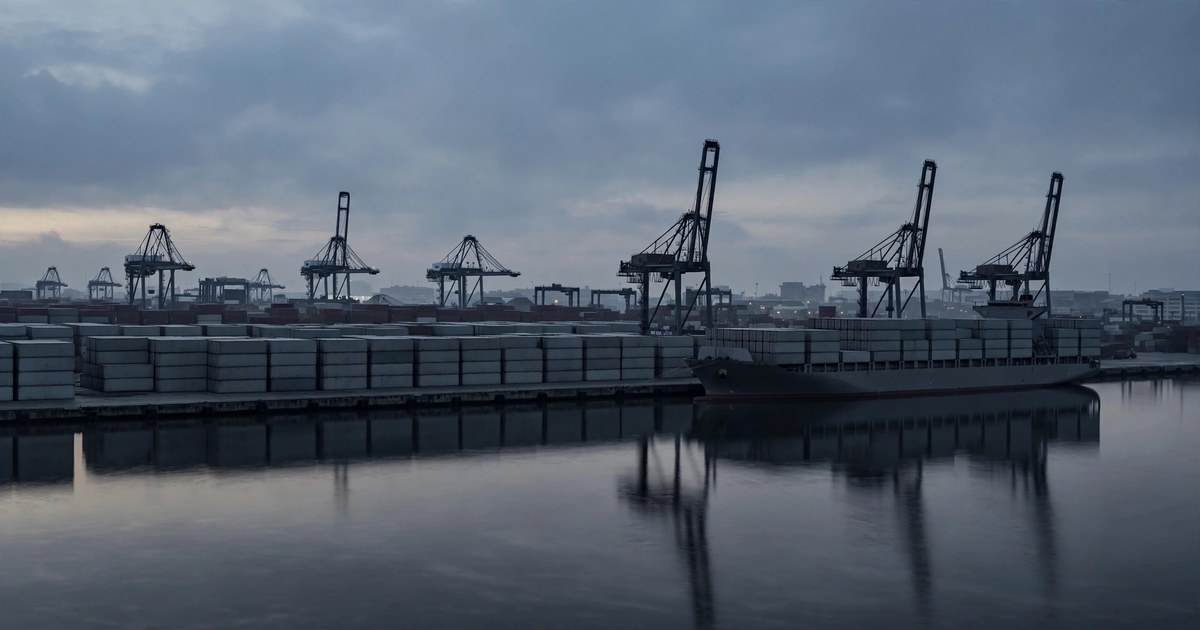
Hardware bought by the Iran MOD agencies entered Iran by cargo ship across the Caspian Sea from Russia, by truck from Central Asia, and by freight plane from China, according to documents reviewed by Reuters and ImportGenius records. Much of it was recorded as originating in China, Russia and Germany. Monthly import volumes fell by 47% to $54 million in March, Reuters reported, but had risen to $77 million by May. A June 2026 shipment of $1.9 million in Russian detonators was the last of five similar Russian shipments totalling $7.6 million since the start of 2025.
Goods recorded as originating in the United Arab Emirates also feature in the data: $27 million worth since the war started, nearly all arriving by sea. The most recent Emirates shipment, listed as electronics, arrived on 27 June, nine days after the United States announced it was suspending its naval blockade. The blockade resumed in mid-July and remains in effect. The Emirates government did not respond to a request for comment. The United States and Israel have targeted Iran’s ballistic missile and drone operations since the war began, including factories the Pentagon said were turning out munitions, but Reuters said it could not determine the extent of the damage, and Iran has continued to fire on its neighbours and on ships transiting the Strait of Hormuz. On 12 October, President Donald Trump said he did not believe China and Russia were providing support to Iran; China’s Foreign Ministry said it was unaware of the situation described and opposed attempts to link regional hostilities to China.
What Remains Unproven About the Iran MOD Agencies
The investigation is detailed, but its limits matter for any reader of the Iran MOD agencies story. Reuters cross-checked a portion of some 19,000 import records using shipping documents, social-media footage and state-media reports, and found nearly all items were duty-exempt and marked as military equipment. Even so, experts noted that much of the material, including explosives, can be considered dual-use and could have civilian purposes. Not all import data contained detailed descriptions, and in many instances Reuters relied on customs codes to identify contents and declared origins without independently confirming them. A customs code alone does not prove the final use of a shipment.
None of the Iranian government entities or companies contacted by Reuters responded, including Tehran’s delegation to the United Nations in Geneva and the presidency. A United States Treasury spokeswoman said the United States “has severed the regime’s economic lifelines” and is “always 10 steps ahead” of evasion. A European Union spokesperson said member states enforce EU sanctions, which include Sahara Thunder. The investigation should therefore be read as strong evidence of a procurement system and large-scale imports by the Iran MOD agencies, not as proof that every item reached a missile or drone.
Why the Iran MOD Agencies Story Matters
If the findings are correct, the Iran MOD agencies help explain how Iran has sustained its missile and drone campaign despite sanctions, a naval blockade and strikes on weapons factories. Thousands of lightly documented agencies, funded from oil sales held abroad and settled mostly without cross-border currency transfers, are harder to sanction one by one than a single state importer. The same trucks, chemicals and machine tools can arrive by sea, road and air, from several countries, under paperwork that does not always reveal the final buyer.
The implications reach beyond Iran: drones linked to Sahara Thunder matter for Ukraine, the missile programme matters for Gulf energy infrastructure and Strait of Hormuz shipping, and the question of further strikes or talks remains live, as recent warnings to Gulf states about possible strikes after the United States midterms and reports of post-midterm strike planning by the United States and Israel show. Whether Western governments designate the numbered Iran MOD agencies, whether more records emerge, and whether Iran responds at all are the developments to watch next.
Sources: Reuters investigation, “Iran’s hidden web of military agencies is slipping hardware past the US blockade”, 29 October 2026, with 240 Analytics, based on Iranian bank and government records, corporate filings and ImportGenius import data; responses from the United States Treasury Department, China’s Foreign Ministry, Iveco, Toyota, Japan’s Ministry of Economy, Trade and Industry and the European Union as reported by Reuters. Reuters: Iran’s hidden web of military agencies.