
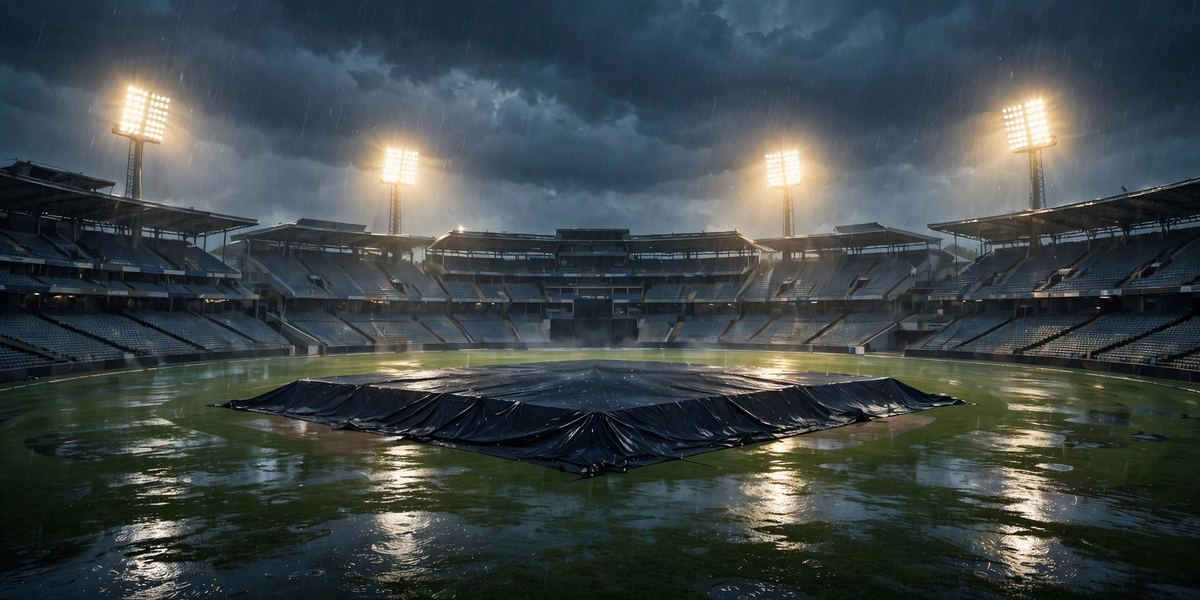
Rain has gatecrashed the biggest night of the West Indies tour of India. The toss for the fifth and deciding T20I between India and West Indies at the M. Chinnaswamy Stadium in Bengaluru was delayed on Saturday 17 October 2026 after a heavy downpour swept across the city, leaving the covers on, the outfield wet, and two teams who have spent eleven days trading blows waiting to find out whether they will get a proper finale. The five-match series is locked at 2-2, the match was scheduled to start at 7:00 PM IST, and with every passing shower the prospect grows that the decider could be shortened — or washed out entirely, which would leave the trophy shared. The story is trending per news coverage.
The delay was confirmed shortly before the scheduled toss at 6:30 PM IST, with live coverage reporting that it was still raining and the covers firmly in place. The India Meteorological Department had forecast generally cloudy skies with one or two spells of rain or thundershowers and a thunderstorm warning for Bengaluru, with temperatures between 20°C and 29°C. Private forecasts put the chance of precipitation at around 67 percent at 7:00 PM and 71 percent at 8:00 PM, before tapering later in the evening. Both teams had already been unable to complete their practice sessions on the eve of the match because of rain, so the disruption was, if not expected, then at least widely feared.
A series that has refused to follow the script
Few five-match series in recent memory have swung as wildly as this one. India began in style, West Indies answered with the biggest chase of the tour, India steadied, and then West Indies levelled it again — and almost every game has been decided by a big individual performance.
The opener in Lucknow on 6 October was the most one-sided game of the series. West Indies were bowled out for 171, and India chased the target down with eight wickets in hand, reaching 172 for 2 in 14.4 overs. Shreyas Iyer was named Player of the Match, and at that stage the tour looked like it might follow a familiar pattern: a strong Indian side easing past the visitors at home.
Ranchi on 9 October tore that script up. India posted 249 for 5, a total that wins the overwhelming majority of T20 internationals. West Indies chased it down with six wickets in hand, reaching 252 for 4 in 18.3 overs. Shai Hope was the architect, finishing unbeaten on 102 from just 45 balls, and the chase — the second-highest successful run chase in T20I history at the time of reporting — announced that this West Indies batting line-up was not in India to make up the numbers.
Indore on 11 October swung back India's way. Abhishek Sharma blazed 69 from 30 balls as India piled up 223, and although West Indies fought hard — Shimron Hetmyer and Nicholas Pooran among the runs — they finished on 209 for 7, and India won by 14 runs. Arshdeep Singh took three wickets and was named Player of the Match. India led 2-1, and the series looked to be heading for a home win.
Then came Hyderabad on 14 October, the best game of the tour. West Indies, put in to bat, posted 247 for 3. Hope was again the star, finishing unbeaten on 102 from 50 balls — his second century of the series — with four fours and nine sixes, reaching the milestone with a six off the final delivery. Sherfane Rutherford supported him with an unbeaten 49 from 26 balls, and the pair shared an unbroken 91-run stand from 43 balls that carried West Indies from a big total into historic territory.
India's chase began brilliantly. Sanju Samson raced to 56 from 23 balls, and with Tilak Varma (43 from 25) and Nitish Kumar Reddy (41 from 20) adding a 70-run stand from 32 balls, the impossible briefly looked plausible. But Keemo Paul, who had already removed Samson, returned to trigger a collapse in the 19th over, finishing with five wickets for 41 runs. India were bowled out for 223 in 19.3 overs, and West Indies won by 24 runs to level the series 2-2. It was a night of 470 runs, a century, a five-wicket haul, and a decider in Bengaluru that nobody could call.
Shai Hope: the batter who has owned this tour
If one player has defined this series, it is Shai Hope. The West Indies captain has scored two T20I centuries in four matches — 102 not out from 45 balls in Ranchi and 102 not out from 50 balls in Hyderabad — and reporting during the tour has credited him with four centuries across formats on this visit to India. He has stayed unbeaten three times on tour, and West Indies have won all three of those matches. That is not a coincidence; it is the story of the series compressed into a single statistic.
What has impressed observers most is the pacing. Hope has lost partners around him — Hetmyer for a 12-ball 33 in Hyderabad, Rovman Powell for 24, Jewel Andrew for 21 — and never once played a panic shot. He has built innings rather than simply swung, balancing aggression with respect for the bowlers, and his unbroken stand with Rutherford in Hyderabad turned a big total into a match-winning one.
India's players have been generous in their praise. Samson, speaking after the fourth T20I, said Hope was playing really well and that India needed to respect what he has been doing, adding that Hope had been playing proper cricket shots without taking that much risk and that India were switched on to how to respond to him every game. Samson also backed India's top order, calling Ishan Kishan and Abhishek Sharma the world's best opening pair and pointing to Abhishek's 69 in the previous game as evidence that one quiet outing was nothing to worry about. For the decider, stopping Hope early is, simply, India's biggest task.
Bhuvneshwar's return — and the rain that threatens it
India go into the decider with one forced change. Arshdeep Singh, who took three wickets and Player of the Match honours in Indore, injured his shoulder during the fourth T20I — he was hit on the shoulder and retired hurt late in India's chase — and veteran seamer Bhuvneshwar Kumar has been added to the squad in his place. Bhuvneshwar, whose experience in Bengaluru conditions is extensive from years of Indian Premier League cricket at the Chinnaswamy, was widely expected to come straight into the side for the decider, with the home attack badly in need of control after leaking 247 and 252 in two of the four games so far.
The expected India side for Bengaluru featured Abhishek Sharma, Samson, Ishan Kishan, captain Shreyas Iyer, Tilak Varma, Nitish Kumar Reddy, Axar Patel, Bhuvneshwar, Prince Yadav and Mayank Yadav, with one further batting or bowling option to be decided at the toss. West Indies were expected to stick with the side that levelled the series: Hope, Andrew, Hetmyer, Powell, Rutherford, Romario Shepherd, Roston Chase, Paul, Shamar Springer, Gudakesh Motie and Shamar Joseph.
Whether any of them get on the field as planned depends on the weather. The Chinnaswamy Stadium has one of the best drainage systems in the country — ground staff there can reportedly have the ground ready within about 20 minutes of the rain stopping — but persistent rain could still lead to an abandonment. If overs are lost, the toss and the ability to adapt quickly to a shortened contest become decisive, and the Duckworth-Lewis-Stern method would come into play for a reduced-overs game. The wet ball and evening dew would make life harder for bowlers on both sides, and the captain who wins a delayed toss would have a genuine decision to make.
Why Chinnaswamy usually means runs — lots of them
If the rain does relent, history says the decider should be a run-fest. The Chinnaswamy Stadium in Bengaluru is famous as a batting paradise, with short boundaries, a true pitch and high altitude that helps the ball travel. It has hosted some of the highest-scoring matches in international cricket and the Indian Premier League, and the first four games of this series — totals of 249, 252, 223 and 247 — suggest both batting line-ups are in the mood to keep that tradition going.
The one wrinkle is that a pitch kept under covers through a rainy afternoon can offer the seamers something early on, which would be a welcome relief for two bowling attacks that have been punished all series. The powerplay overs are usually the best time to bat in Bengaluru — but they can also be the best time for seamers to take wickets if the ball moves. Whoever adapts fastest to whatever conditions the rain leaves behind will have a real edge.
The rain had the final word. After hours of delays, the match was reduced to nine overs per side, the toss finally took place at 9pm IST with West Indies captain Shai Hope winning it and choosing to bowl, and India raced to 118 for 5 in 7.4 overs — Ishan Kishan making 30 off 10 balls and Naman Dhir an unbeaten 24 off six — before rain returned and the match was abandoned at 10:16pm, with no further play possible before the cut-off. The five-match series therefore finished shared at 2-2, with neither side lifting the trophy outright, and Shai Hope was named Player of the Series. Sporting series deciders have delivered drama elsewhere this weekend too, and baseball's postseason has already produced one sweep. As with the severe weather disrupting sport elsewhere in the Pacific, the Bengaluru rain is a reminder that even the best-planned fixtures are at the mercy of the forecast. Sources: ESPNcricinfo live coverage (17 October 2026); Reuters (14 October 2026); CricToday (17 October 2026); Sportskeeda (17 October 2026); PTI via Swadesi (14 October 2026); Daily Jagran (17 October 2026); LiveMint (17 October 2026); CricketDaily (17 October 2026).
India's batters are in formidable T20 form this season, highlighted by a record chase of 226 to beat New Zealand in the first T20I.