
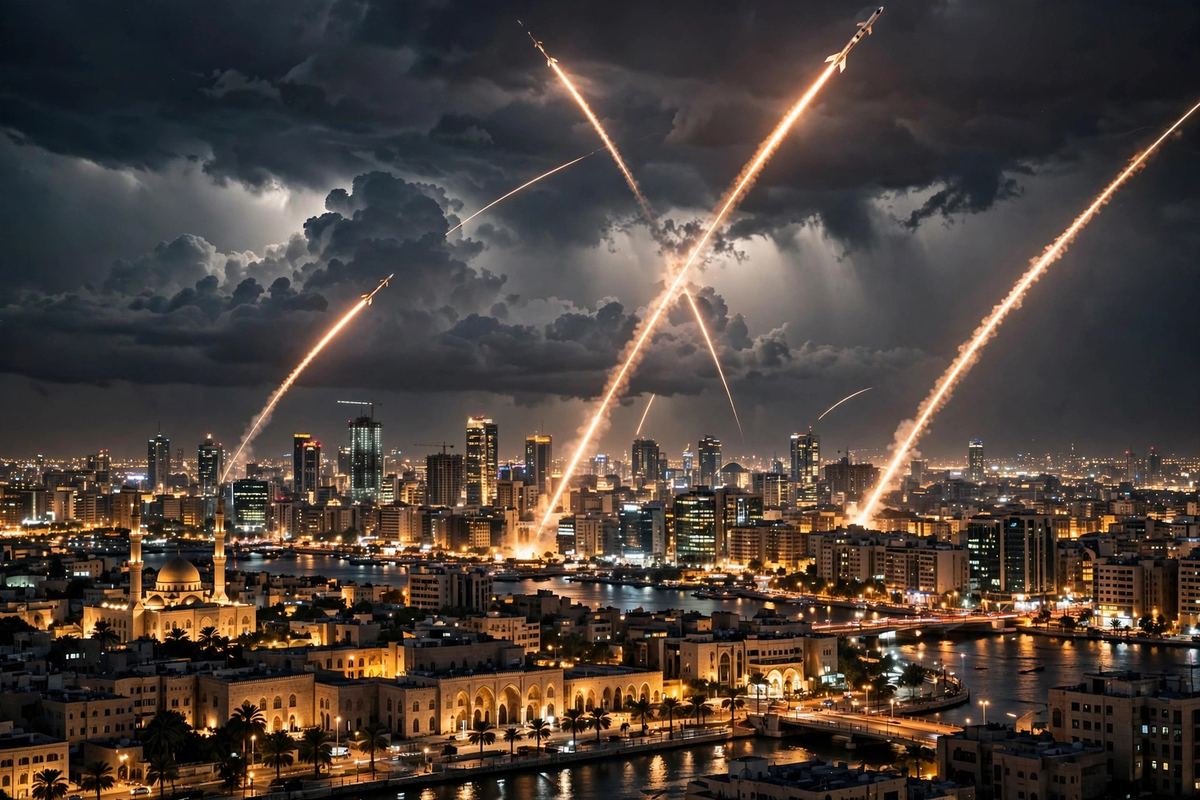
Interception over the capital
The Saudi-led coalition said it intercepted a ballistic missile fired by Yemen's Houthis towards Riyadh on Wednesday, October 14, as several loud booms were heard in the Saudi capital. Saudi authorities had earlier issued an alert for a possible aerial threat in Riyadh before the warning was lifted, and a witness told Reuters it was not immediately clear what caused the booms. The interception was the latest in a week of escalating strikes that has brought the renewed war in Yemen to Saudi Arabia's cities, airports and oil facilities — and that has begun to rattle global energy markets.
The coalition later gave a fuller account of the day's air defence activity: it said Saudi defences had intercepted and destroyed three cruise missiles and two drones targeting the Riyadh region and southern Saudi Arabia, and in a separate accounting, two drones, four cruise missiles and one ballistic missile targeting Riyadh, a ballistic missile targeting Dhahran, and a cruise missile targeting Al-Kharj, a key military and industrial city. At least four people were injured by falling debris, according to Saudi authorities, and civil defence said debris from intercepted strikes had left one person injured in the capital. The state-run SPA news agency published images showing a damaged building and a vehicle with a large cylindrical object, seemingly part of a missile, lodged in its hood.
The Aramco headquarters strike
The Riyadh interception came a day after the most symbolically significant attack of the week: a strike on the headquarters of Saudi Aramco, the world's largest crude oil producer, in Dhahran. The Saudi Energy Ministry said Tuesday's attack had caused a limited fire and no injuries or deaths. But two regional officials told the Associated Press that the strike had damaged the top three floors of a building used by senior Aramco executives, including the office of the firm's chief executive. Three people with knowledge of the matter told Reuters the fire spread across several floors, though operations continued normally with employees working from home. The Dhahran complex hosts a major operations centre for Aramco, overseeing a vast network of onshore and offshore oil rigs, pipelines, refineries and export terminals.
The Houthis said they had launched ballistic missiles, cruise missiles and drones at Aramco facilities in Dhahran, King Khalid International Airport in Riyadh and an Aramco refinery in Riyadh. The Saudi-led coalition said shrapnel from an interception had fallen in a residential area of Dhahran. For background on the Dhahran strike itself, see our earlier report on the Aramco headquarters strike, and on the airport attacks, the Riyadh airport missile attack.
The Houthi vow — and the evacuation warning
On Wednesday, the Houthis vowed to press on with attacks on airports and oil facilities in Saudi Arabia "in the coming days." In a broad threat, the group urged "international shipping companies," civilians and workers to evacuate airports and oil facilities, which it declared legitimate military targets. The warning was aimed at the infrastructure that underpins Saudi Arabia's economy and its connection to the world: the airports that carry passengers and cargo, and the oil facilities that produce and export the crude on which the kingdom — and much of the global energy market — depends.
The Houthis say they have been retaliating for the kingdom's backing of Yemeni government forces in the Yemen war, which restarted last month and was reignited by the US-Iran confrontation in the Gulf. Saudi Arabia has faced widening Houthi strikes over the past week, including an attack on Riyadh airport on Saturday that killed 13 people. A refinery in Jazan has remained shut since an earlier attack, a key oil export port on the Red Sea coast has been targeted, and last month Aramco's main cross-country pipeline, which transports oil for export, was temporarily shut down following an attack launched from Iraq. The pattern is one of widening geographic reach and growing ambition.
Saudi retaliation and the wider war
Saudi Arabia has responded with strikes of its own. The kingdom attacked a key fuel depot in Yemen on Tuesday, which it claimed was being used by the Houthis to support strikes on Saudi airports and energy facilities and attacks on shipping in the Red Sea. The Houthi-controlled Yemen Oil Company said the facility held no petroleum products and that the attack would not affect fuel reserves or supplies. The Houthi-run Health Ministry said two people were killed in a Tuesday airstrike on the Ras Isa port area in Hodeida province. The Saudi-led coalition said it had warned civilians to leave the area beforehand.
The fighting is also having a heavy civilian cost inside Yemen. The United Nations has warned that around 800,000 people have been cut off from life-saving food assistance as fighting and road closures worsen. The war's maritime dimension adds a further layer of risk: the Strait of Hormuz, through which a large share of the world's oil and gas passes, has seen vessel losses and attacks in recent days, including the sinking of ships reported in our coverage of the GFS Pride and Cape Dao sinkings. The combination of land, air and maritime escalation is what makes the current moment so dangerous.
Why it matters for energy and the world
Striking Saudi Aramco threatens the backbone of the kingdom's economy and a critical source of global energy supplies. The escalating conflict has dealt a blow to Saudi Crown Prince Mohammed bin Salman's ambitious plans to transform and diversify the Saudi economy and reduce its reliance on oil. Energy markets have already reacted: Reuters' Wednesday oil-market report described Brent near $105.56 a barrel amid persistent concerns over the safety of Gulf shipping and Saudi infrastructure. US President Donald Trump accused the Houthis of intensifying attacks on Saudi infrastructure to push up energy prices ahead of the US midterm elections, according to Al Jazeera.
The question now is whether the escalation can be contained. The Houthis have shown they can hit high-profile targets; Saudi Arabia has shown it can intercept many — but not all — of the incoming missiles and drones, and that it will retaliate. The United States, which has been evaluating whether to join Saudi strikes against the Houthis in the latest front in the Iran war, is now part of the calculation. For ordinary people in Riyadh, Dhahran and Yemen's cities, the immediate reality is simpler: alerts, booms, debris and the knowledge that the next attack may already be on its way.
What happens next
Three developments will shape the coming days: whether the Houthis follow through on their vow of further attacks on airports and oil facilities; whether Saudi air defences continue to intercept the majority of incoming fire, and at what cost in debris injuries; and whether diplomatic efforts — including any US role — can break the cycle of strike and retaliation. The evacuation warning to shipping companies and civilians is a sign that the Houthis intend to keep the pressure on. The coming days will show whether that pressure produces a new round of escalation or a new push for restraint.
Key facts
- Saudi-led coalition says it intercepted a Houthi ballistic missile aimed at Riyadh on Wednesday, October 14, plus cruise missiles and drones aimed at Riyadh, Dhahran and Al-Kharj.
- Houthis vowed more attacks on Saudi airports and oil facilities "in the coming days" and urged evacuation of those sites.
- Aramco's Dhahran headquarters was hit on Tuesday; the Energy Ministry reported a limited fire and no injuries; AP sources said top floors, including the CEO's office, were damaged.
- An attack on Riyadh airport on Saturday killed 13 people; a Jazan refinery remains shut after an earlier attack.
- UN warns around 800,000 people in Yemen have been cut off from life-saving food assistance.