
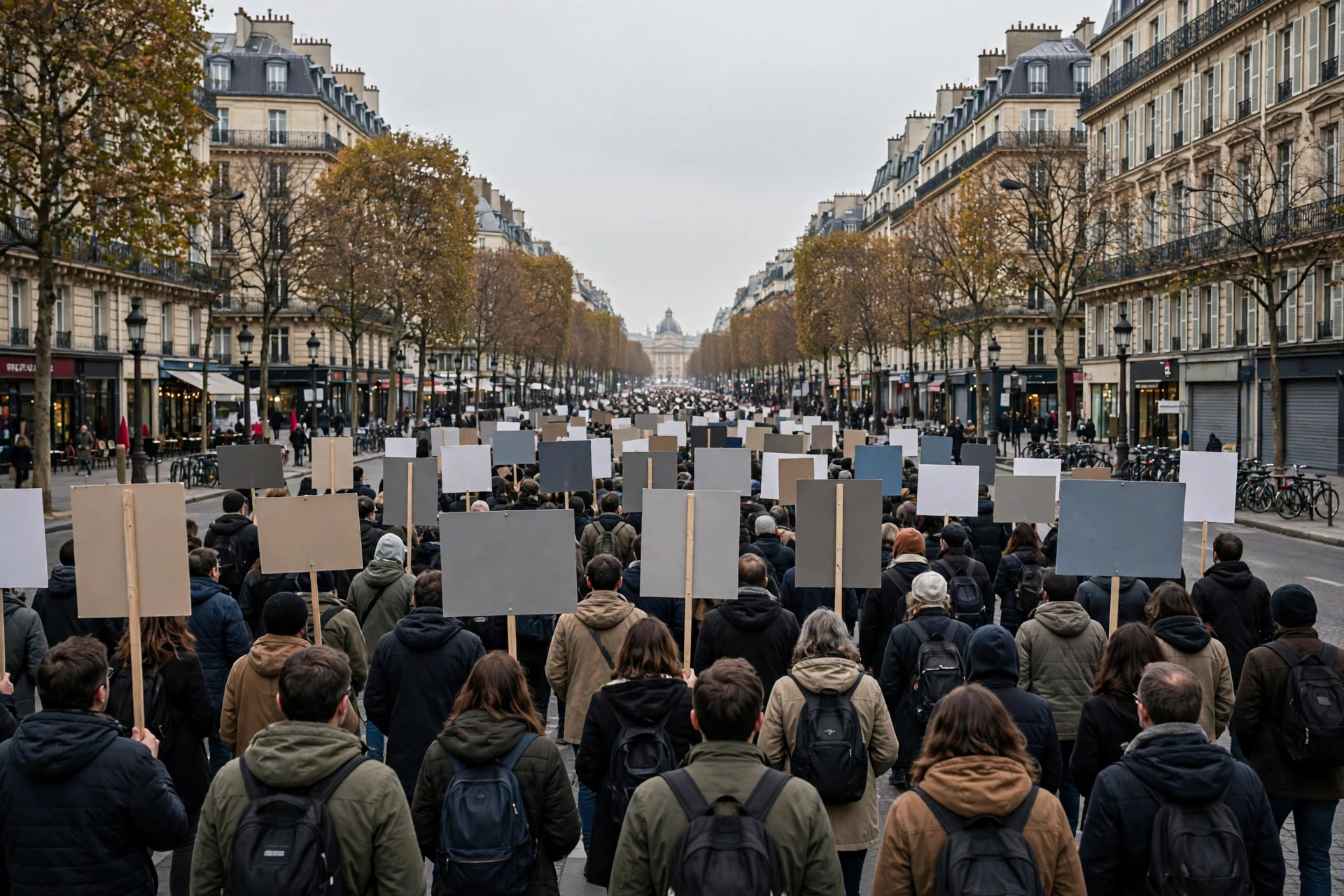
France nationwide strike November 2026: on Thursday 5 November 2026, France saw a nationwide strike and marches that brought hundreds of thousands of people onto the streets in cities across the country. Five of France's main union confederations — the CFDT, CGT, FO, UNSA and FSU — called the action together, joined by the CFTC, CFE-CGC and Solidaires, in a rare display of unity across the labour movement. The unions were demanding higher wages, a rise in the national minimum wage, more funding for public services and a revision of the government's draft 2027 budget. With 70,000 police deployed and marches held in every large city, the day became one of the biggest protests France has seen in years, and it set up a direct confrontation between the unions and the government of Prime Minister Sébastien Lecornu.
France Nationwide Strike November 2026: Who Walked Out and Why
The strike was called by five of France's main union confederations — the CFDT, CGT, FO, UNSA and FSU — with support from the CFTC, CFE-CGC and Solidaires. It was the first time the five main confederations had struck together since the pension reform protests of 2023 and 2024, and the breadth of the coalition was itself a message to the government. Teachers, public-sector workers and workers across the public and private sectors took part, and marches were held in cities across France. In schools, about 16 percent of teachers struck according to the ministry, while the Snes-FSU union put the figure for secondary school teachers at 52 percent, a gap that reflects how differently the two sides count participation.
The unions' demands were clear. They want higher wages to help households cope with the cost of living, a rise in the national minimum wage, known as the SMIC, which currently stands at 12.31 euros an hour, and more funding for public services such as education, health care and transport. The CFDT, France's largest union confederation, wants a net increase of 100 euros a month for workers, while the CGT wants a 10 percent rise in the minimum wage plus indexation, so that pay keeps pace with prices. Behind the wage demands lies a wider argument about the government's draft 2027 budget, which the unions say does too little for workers and public services at a time when living costs remain high. For the wider wave of protest across Europe, see Gen Z protests across Europe in November 2026.
Turnout: Two Very Different Counts
As with most French protests, the two sides gave very different figures for how many people took part. The Interior Ministry counted about 575,000 to 600,000 demonstrators nationwide, including 65,000 in Paris. The CGT, the union confederation that organised many of the marches, put the figure at about 1.6 million nationwide, including 350,000 in Paris. The gap between the official count and the organisers' count is a familiar feature of French protest, and the true figure lies somewhere between the two. What is not in doubt is that the marches were large: hundreds of thousands of people took to the streets, and the authorities deployed 70,000 police officers and gendarmes across the country to manage the demonstrations.
The turnout matters because it is the unions' main measure of strength. A large turnout gives them leverage in negotiations with the government, while a small one would have suggested the movement was fading. The 5 November figures, even on the ministry's lower count, show a mobilisation on a scale that the government cannot ignore. The day followed weeks of protest: a public-sector strike on 29 September, a cost-of-living day of action on 17 October, and Yellow Vest and student marches on 24 and 31 October. The 5 November strike brought those separate movements together into a single national day of action.
The Demands Behind the Strike
The central demand of the strike was pay. The SMIC, France's national minimum wage, stands at 12.31 euros an hour, and the unions argue that it has not kept pace with the cost of living. The CFDT wants a net increase of 100 euros a month for workers, a figure that would make a real difference to household budgets. The CGT goes further, demanding a 10 percent rise in the minimum wage plus indexation, which would tie future increases to prices so that pay cannot fall behind again. The difference between the two demands shows that the unions are not united on the exact figure, but they agree on the direction: wages must rise, and the minimum wage must rise fastest.
Alongside pay, the unions want more funding for public services. Schools, hospitals and public transport have all faced pressure from budget cuts and staff shortages, and the unions argue that the draft 2027 budget does not provide enough to fix them. The strike was also a protest against the budget itself: the unions want the government to revise its draft 2027 budget, which they say prioritises deficit reduction over the needs of workers and public services. France's public debt stands at near 120 percent of GDP, one of the highest levels in Europe, and the government argues that it must bring the deficit down. The unions argue that the burden of that adjustment should not fall on workers' pay and public services.
France Nationwide Strike November 2026: The Budget Clash
The strike took place against a tense parliamentary backdrop. The day before the strike, on 4 November, the National Assembly rejected the revenue section of the draft 2027 budget, a setback for the government that showed how fragile its parliamentary support is. The budget is the government's central piece of legislation, and its rejection in part has left the government searching for a way through parliament. The unions timed their strike to put maximum pressure on the government at the moment when the budget was most vulnerable, and the combination of a parliamentary defeat and a nationwide strike has left Prime Minister Sébastien Lecornu facing pressure from both sides.
Lecornu has responded by announcing a social conference, to be held on Monday 9 November at Matignon, the prime minister's office. The conference will bring together unions and employers to discuss wages, working conditions and the wider social situation, and it is the government's main answer to the strike. Whether the conference produces concrete results, or whether it is seen by the unions as a talking shop, will determine whether the movement escalates or eases. The CGT has already called on workers to vote in workplace meetings on whether to continue the action, so the days after the conference will be watched closely.
A Year of Protest in France
The 5 November strike did not come from nowhere. It followed a public-sector strike on 29 September, a cost-of-living day of action on 17 October, and Yellow Vest and student marches on 24 and 31 October. The protests began in September, when high school students took to the streets to complain about poor conditions and a lack of resources in education, and they have grown into a wider movement about pay, public services and the cost of living. The 5 November strike was the moment when the main union confederations, which had previously acted separately, joined together in a single day of action.
The strike also comes at a difficult time for France in other ways. The country has faced a series of challenges in recent weeks, including a cyberattack on its blood banks, which disrupted a vital public service. For more on that incident, see France blood banks hit by cyberattack. The combination of strikes, protests and pressure on public services has made the autumn of 2026 one of the most turbulent periods in French politics in recent years, and the government will need to show that it can respond to the demands on the streets as well as to the arithmetic of the budget.
What Happens Next
The next milestone is the social conference on Monday 9 November at Matignon, where Prime Minister Sébastien Lecornu will meet unions and employers. The unions will be looking for concrete commitments on wages, the minimum wage and public-service funding, and the government will be looking for a way to ease the pressure without abandoning its budget plans. If the conference produces real movement, the strike may prove to have been a turning point. If it does not, the unions have shown that they can bring hundreds of thousands of people onto the streets together, and they are likely to do so again.
For now, the 5 November strike stands as a measure of the strength of feeling in France about pay and public services. The turnout, whether counted at 575,000 to 600,000 by the ministry or at 1.6 million by the CGT, was large enough to make the day one of the biggest protests in years. The budget debate continues in parliament, the social conference is four days away, and the question of how France pays its workers and funds its public services remains unresolved. What is clear is that the unions, having struck together for the first time since the pension protests of 2023 and 2024, have shown that they can act as one, and that the government will have to reckon with them in the weeks ahead. For the wider media and institutional backdrop, see BBC faces £500m cuts as Ofcom demands answers.
Sources: Guardian, France 24, Reuters, AFP, November 2026