
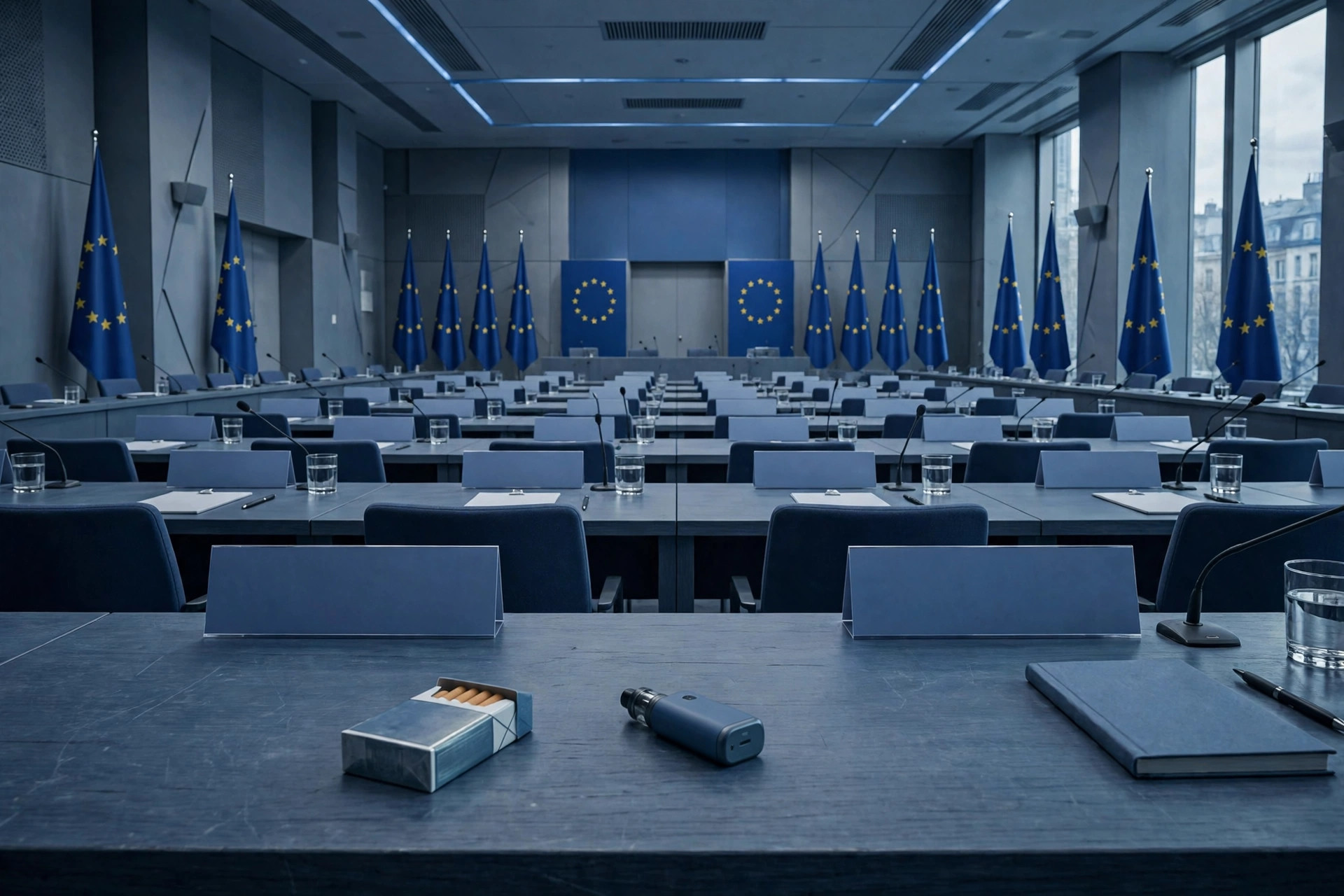
The EU tobacco tax overhaul was one signature away from agreement. On 9 November 2026, finance ministers from 26 of the European Union's 27 member states were ready to approve it at the ECOFIN council in Brussels. Malta was not. Because EU tax law needs every member state to agree, one objection was enough. The reform — the first overhaul of EU tobacco taxation since 2011 — stalled, and the next attempt will come on 11 December. This is how a single small island state blocked 26 governments, what the deal would have done, and what happens now.
The proposal would have raised minimum excise duties on cigarettes and, for the first time, set EU-wide minimum taxes on e-cigarette liquids, heated tobacco and nicotine pouches. The European Commission presented the reform on 16 July 2025 as part of its cancer policy. The current rules date from 2011, before vapes and nicotine pouches existed as mass-market products. That gap is the heart of the file: today, nicotine pouches face no EU minimum tax at all. Irish Finance Minister Simon Harris, who chaired the 9 November meeting as holder of the Council presidency, warned his counterparts that until the reform passes, the rate applied to nicotine pouches is zero euro, there are no fully agreed limits on cross-border purchases, and governments cannot even track where those purchases go.
How Malta blocked the EU tobacco tax deal
Tax harmonisation under Article 113 of the Treaty on the Functioning of the European Union requires unanimity in the Council. Unlike most EU legislation, where a qualified majority is enough, a 26–1 split produces no Council position at all. That is the whole mechanism: Malta did not need allies, arguments that convinced others, or a veto coalition. It needed only to say no.
The meeting itself showed how close the deal came. During the round table, three countries — Finland, Estonia and Malta — opposed the Irish presidency's compromise proposals, which had been tabled on 6 November and on the day of the meeting. Finland and Estonia then accepted the compromise. Estonia accepted after the presidency offered to freeze minimum rates against inflation until the next revision of the directive. Malta held out. Harris told reporters afterwards: "We have reached a stage where 26 of the 27 Member States are ready to give their approval. I regret that Malta is not yet in a position to do so." He promised a further attempt in December.
What Malta objected to in the EU tobacco tax plan
Maltese Finance Minister Clyde Caruana said Malta backed the reform's overall aims but that earlier concerns remained unresolved. According to MaltaToday and reporting by Agence Europe, three points drove the objection: the proposed minimum excise was above Malta's current domestic level, the mechanism for periodic rate adjustments, and an arrangement linking minimum burdens to member states' purchasing power and price levels. Caruana argued that even after the latest text changed the nicotine pouch rate, the overall minimum could hit Malta's economy disproportionately and left too little room for national tax policy. The Times of Malta reported that Valletta insists taxation should remain a national prerogative, and that Prime Minister Robert Abela intervened personally with his Irish counterpart Micheal Martin.
Malta's position is not new. As early as October 2025, Malta was among the countries that considered the proposed minimum rates too high. What changed on 9 November is that every other objector dropped away, leaving Malta alone against the compromise. Sweden, until then the main opponent on nicotine pouches, backed the deal after being offered a transitional minimum rate equal to its current national rate.
The rates Malta blocked: cigarettes, vapes and pouches
For cigarettes, the compromise would have raised the EU minimum excise duty from the current €90 per 1,000 cigarettes to €140 from July 2028, then €170 in 2030 and €200 in 2032. Those are minimum tax floors, not direct consumer price rises of the same amount; each government still sets its own rates above the floor. Ten member states — Cyprus, Greece, Italy, Bulgaria, Spain, Croatia, Luxembourg, Portugal, Romania and Slovenia — would have had until 1 January 2036 to reach the new cigarette minimum, a transition that matters particularly to Cyprus, where the government would otherwise have had to meet the thresholds by 2032.
For e-liquids, whether or not they contain nicotine, the compromise set an EU minimum of €0.36 per millilitre, with lower transitional rates of €0.20 and then €0.25 per millilitre. For nicotine pouches, the presidency proposed a phased schedule in a Council note dated 5 November: from 1 January 2028, 10% of the retail price or €30 per kilogram; from 1 January 2030, 25% or €40 per kilogram; from 1 January 2032, 50% or €50 per kilogram. But the pouch rate itself remained unsettled: according to Agence Europe, member states agreed to write the principle of a minimum tax on nicotine pouches into EU law, with the level to be set later, and the Commission to propose legislation setting that minimum in early 2029 if necessary. The European Parliament gave its opinion on the two linked files on 17 June 2026; it rejected the rate-setting proposal, but the Council decides the final text.
What the EU tobacco tax block means for shoppers and sellers
Nothing changes for consumers right now. The proposed minimums have not entered into force, and national tax rules continue to apply. A shopper in Malta, Cyprus or France pays whatever their own government charges, and manufacturers selling into the EU still face 27 separate national regimes for vape liquids, heated tobacco and pouches. Even if the deal had been agreed on 9 November, the first minimum rates would not have applied before 2028.
That delay is the cost of the block, and it falls unevenly. Countries with high tobacco taxes already, such as Ireland and France, lose little. Countries with low taxes keep an advantage that lets cross-border shopping undercut their neighbours. Public health campaigners lose the EU-wide floor they wanted on new nicotine products, which are growing fast among young users. The industry, meanwhile, keeps the patchwork it knows: 27 rulebooks instead of one.
What happens next for the EU tobacco tax reform
The next regular ECOFIN meeting is scheduled for 11 December 2026, the last under the Irish presidency, and Ireland intends to return to the file then after further talks with Malta. Harris said the presidency would not reopen the negotiations and would keep working with the remaining member state. If no agreement is reached by the end of the year, the file passes to Lithuania, which holds the Council presidency from January 2027. A deal on 11 December is not fixed: it depends on whether Malta's objections on the minimum rate level and the indexation mechanism can be met without unravelling the compromise the other 26 have already accepted.
The episode is a reminder of how EU tax law works. In most policy areas, a large majority wins. In tax, one country can stop 26. Malta used that rule on 9 November, and it will hold the same power on 11 December. The question for the next month is whether Ireland can find a form of words — on rates, on indexation, on purchasing power — that lets Malta sign without breaking the deal for everyone else.
Read more: Malta's 2027 budget and higher charges for non-EU workers, Malta's €8 nightly tourist tax from 2027, Turkey's fuel tax rise and California voters reject the billionaire tax.