
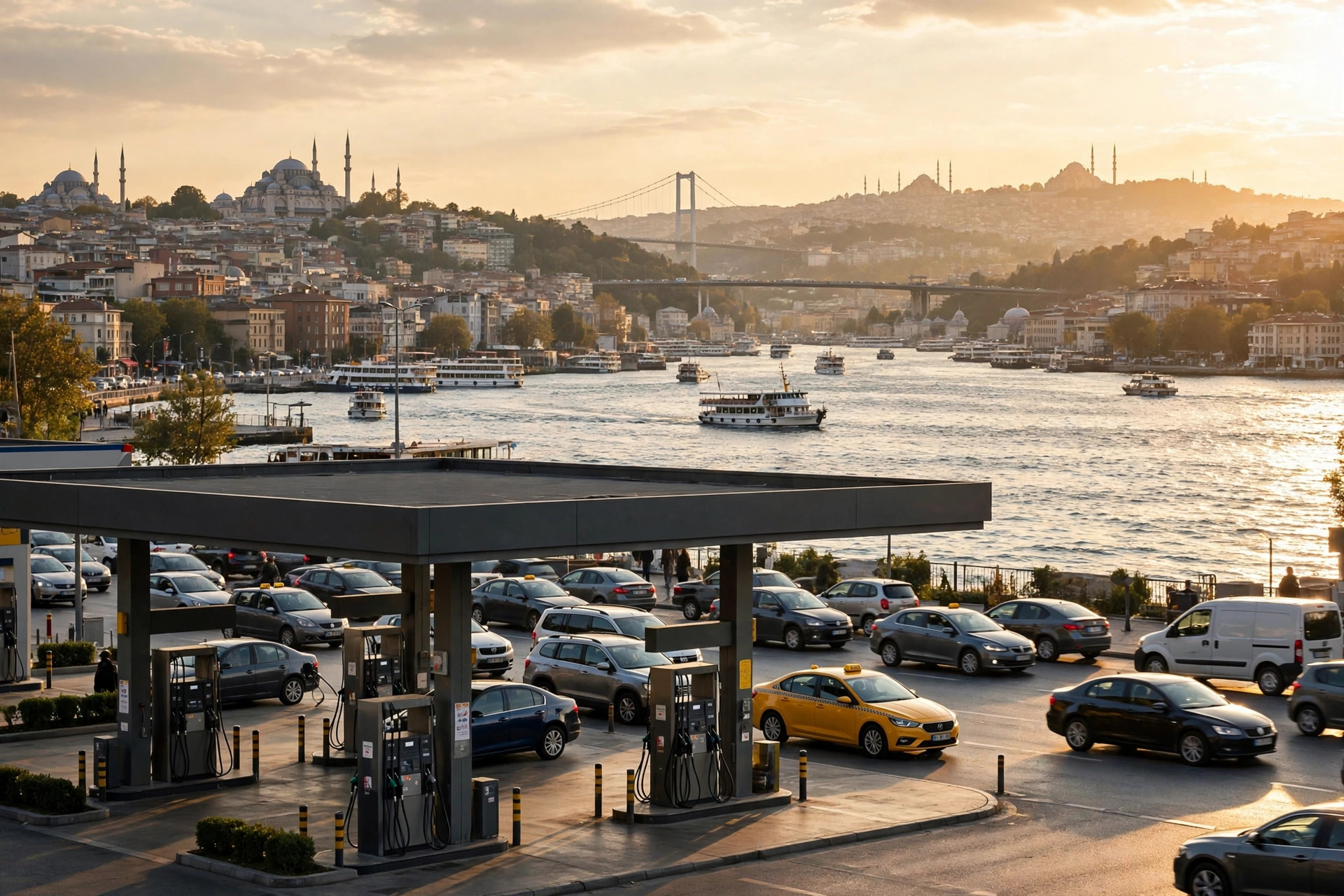
The Turkey fuel prices November 2026 took a sharp step up on 1 November, when a scheduled rise in the special consumption tax, known as ÖTV, took effect. In Istanbul, a litre of diesel now costs more than 100 lira and a litre of petrol more than 80 lira, after the tax step added 3.60 lira to diesel and about 4.15 lira to petrol. The rise was not a surprise: it was set by Presidential Decision 11606, published in the Official Gazette on 13 August 2026, and it is one step in a staircase of tax increases that runs through the coming months. For Turkish drivers, the change is the latest in a year of steep fuel inflation, and it arrives alongside a weaker lira and high global oil prices.
Turkey Fuel Prices November 2026: The New Pump Rates
The tax step works like this. On diesel, the ÖTV rises from 6 lira to 9 lira a litre on 1 November, an increase of 3 lira. With 20 percent VAT charged on top of the tax, the effect at the pump is 3.60 lira a litre. On 95-octane petrol, the ÖTV rises from 8.90 lira to 12.36 lira a litre, a difference of 3.46 lira, which means an increase of about 4.15 lira including VAT. The result, using industry figures reported before the change, is that diesel in Istanbul rises from an average of 96.90 lira to 100.50 lira a litre, and petrol from 76.30 lira to 80.45 lira. Live price trackers on 3 November show Istanbul's European side at 80.50 lira for petrol and 100.50 lira for diesel, with Ankara at 81.50 lira for petrol and 101.60 lira for diesel, and Izmir at 81.70 lira for petrol and 101.90 lira for diesel.
Autogas, or LPG, also rose. Industry representatives expected an increase of about 9 lira a litre, and live trackers show Istanbul LPG at about 50.70 lira a litre after a rise of roughly 9.50 lira. Prices vary by place, because Turkey has 81 provinces and the energy regulator, EPDK, treats Istanbul as two separate price regions, the Asian side and the European side, making 82 price regions in total. On 29 October, the EPDK medians reported by distributors were 76.10 lira for petrol on Istanbul's Asian side and 76.30 lira on the European side, and 96.60 lira for diesel on the Asian side and 96.76 lira on the European side. The cheapest petrol in the country that day was 76.10 lira and the most expensive 78.91 lira, while diesel ranged from 96.60 to 99.62 lira, so the November tax step lifts the whole range by roughly the same amount everywhere.
How the Tax Step Works
The ÖTV on fuel is a fixed amount per litre, not a percentage, so a tax step is a known number rather than a forecast. That is what makes this rise different from the usual daily movement in pump prices, which follows the Brent oil price, refining margins and the dollar-lira exchange rate. The November step is arithmetic: 3 lira of extra tax on diesel plus 20 percent VAT equals 3.60 lira at the pump, and 3.46 lira of extra tax on petrol plus VAT equals about 4.15 lira. The pump price also moves with product costs and the exchange rate, so the final price in any city is the tax step plus whatever the market did, but the tax part is fixed and known in advance.
The step is part of a wider reform. In March 2026, Turkey introduced a mechanism to adjust fuel excise taxes in response to changes in international petroleum prices and exchange rates, and the November step is one of a series of scheduled increases. A further diesel step of the same size, 3.60 lira a litre, is expected in December. The October step was larger and different in kind: on 1 October, the petrol tax adjustment mechanism expired, and the ÖTV on petrol rose from 4.43 lira to 14.83 lira a litre, a record single increase of 12.48 lira including VAT that pushed petrol close to 95 lira a litre and narrowed the gap with diesel. That October shock is the reason the November step, large as it is, was treated by the market as the next instalment of a known plan rather than a surprise.
Turkey Fuel Prices November 2026: What a Full Tank Costs Now
For a driver in Istanbul, the November step adds about 180 lira to a 50-litre tank of diesel and about 208 lira to a 50-litre tank of petrol. A 50-litre diesel fill that cost about 4,845 lira on 29 October now costs about 5,025 lira; a 50-litre petrol fill rises from about 3,815 lira to about 4,023 lira. For a taxi driver or a delivery driver who fills up several times a week, the monthly cost runs into thousands of lira, and the cost feeds through to the prices of everything that moves by road. Fuel is one of the largest single costs for transport, and transport costs feed into food prices, so a fuel tax rise is never only a driver's problem.
The rise also lands in an economy where the lira has been weakening and global oil prices are high. Reports before the change noted Brent crude futures around $110 to $111 a barrel, with physical spot prices higher, and warned that the exchange rate and the course of Brent oil could add further pressure to pump prices in November. The government has not said it will soften the tax staircase, and the December step is already scheduled. For drivers, the practical response is the same as in earlier rounds: fill up before a known step where possible, compare prices between stations, and remember that Istanbul's two price regions differ by a few kuruş, with the Asian side usually slightly cheaper.
What Comes Next: December and Beyond
The next date to watch is the December tax step, when diesel is expected to rise by another 3.60 lira a litre. Beyond that, the formula-based adjustment mechanism introduced in March 2026 will keep linking fuel taxes to international prices and the exchange rate, so the direction of pump prices will depend on Brent crude and the lira as much as on tax policy. The government collects substantial revenue from fuel taxes, and the staircase is designed to raise that revenue in predictable steps rather than in a single shock. For households, the November rise is a reminder that fuel in Turkey is now priced in three figures for diesel and above 80 lira for petrol, levels that would have seemed unthinkable a few years ago. The numbers to remember are simple: diesel 100.50 lira and petrol 80.45 lira in Istanbul after the 1 November step, with more to come in December. For the regional energy picture, see our report on the Mecca pact talks involving Turkey, and for how fuel costs feed into inflation, our report on Japan's inflation and our account of US warnings over Gulf oil routes.