
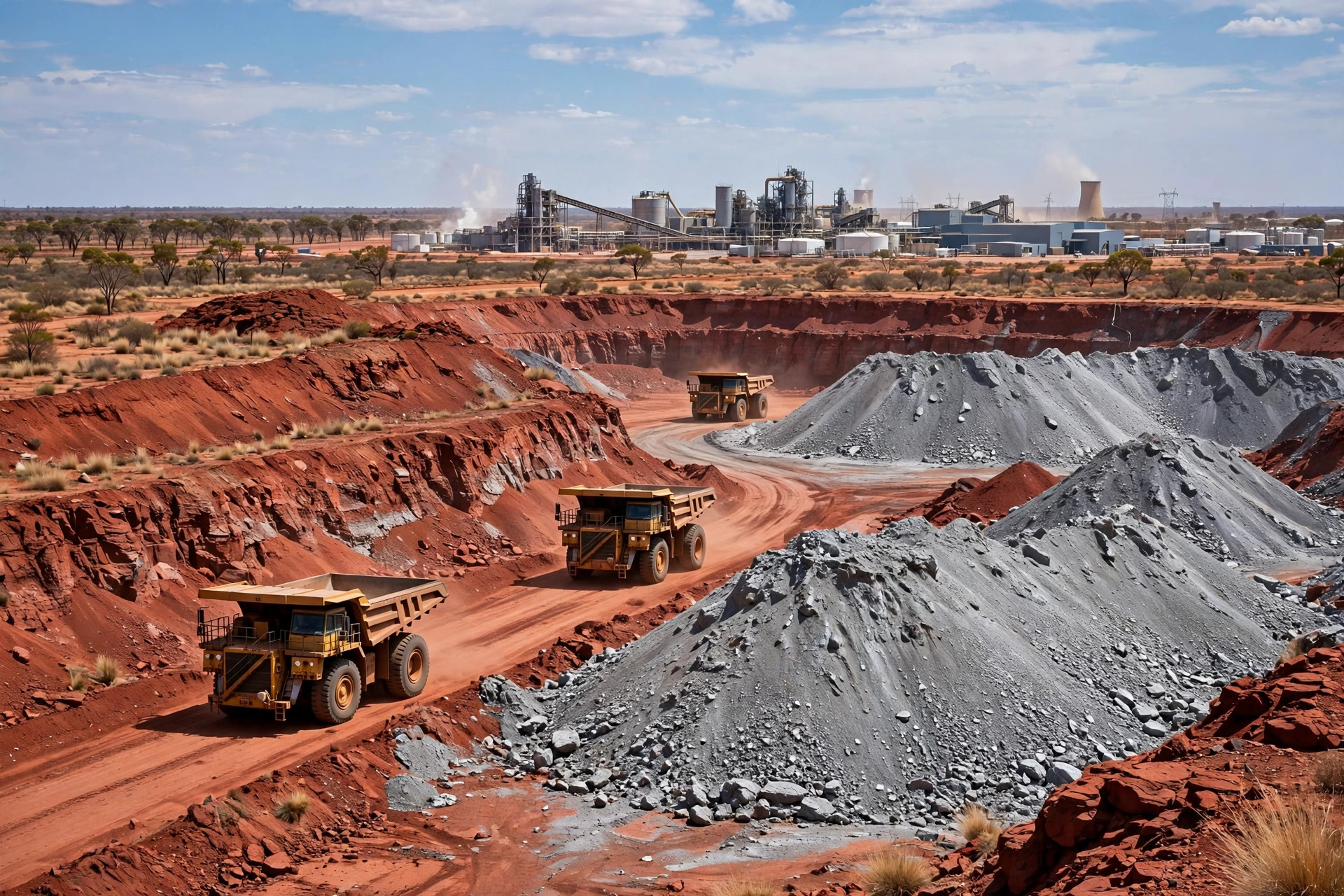
The European Union is preparing to invest heavily in Australia's critical minerals sector, the bloc's ambassador to Australia said on Tuesday, in a move that could reshape supply chains for batteries, electronics and defence equipment. Lawrence Meredith, the EU ambassador in Canberra, told Reuters that the investment wave would follow the free trade agreement Australia and the EU struck in March after eight years of negotiations, which removes tariffs on almost all goods and eases EU access to Australian critical minerals.
The scale of the ambition is large. EU policy proposals have set out as much as 10 billion euros, about 11.2 billion US dollars, for critical raw materials within a larger 409 billion euro competitiveness fund, as the bloc debates its budget for 2028 to 2034. Australia is one of several critical minerals partners the EU is courting, alongside Brazil, South Africa and Canada, but Meredith described Australia as one of the most likely partners given its reserves and its reliability as a supplier.
What the EU Australia Critical Minerals Investment 2026 Plan Involves
The immediate steps are institutional rather than industrial. Talks are very close, Meredith said, for Australia to sign a memorandum of understanding with the European Investment Bank, which would act as the bloc's funding vehicle for projects. Once both parties sign and ratify the free trade agreement, expected early next year, a 5.5% EU tariff on critical minerals will be removed. Meredith called that change a game changer for the economics of Australian projects.
The bloc is looking first at the minerals Australia has prioritised for its strategic reserve: gallium, antimony and rare earths. Gallium is used in semiconductors and radar systems, antimony in flame retardants and batteries, and rare earths in electric-vehicle motors, wind turbines and precision-guided weapons. All three are markets where China currently dominates processing, which is precisely why Brussels wants alternative sources.
Investment is expected along the whole supply chain, not only in mines. Meredith said the EU also expects to invest in processing, the stage where raw ore is refined into usable material and where dependence on a single country is most acute. That matters for Australia, which has historically exported raw minerals and watched the higher-value processing happen elsewhere.
Why Australia Is Refreshing Its Critical Minerals Strategy
On the same day, Australia said it would refresh its critical minerals strategy to place greater emphasis on refining and processing, as competition for investment intensifies and supply-chain concerns grow. The refresh reflects a shift in thinking: digging minerals out of the ground is no longer enough if the value and the strategic leverage sit downstream.
Australia's position is strong on paper. It holds large reserves of lithium, rare earths, cobalt, nickel and other minerals essential to the energy transition. Woodside, the Australian energy company, separately announced it would exit the long-stalled Timor gas project, a reminder that the country's energy and resources portfolio is being reshaped at the same time. The challenge is converting geological advantage into operating refineries, which require capital, energy, skilled workers and environmental approvals.
The EU agreement helps on the first of those: capital. The European Investment Bank memorandum, if signed, would give Australian projects a credible European funding channel. The free trade agreement helps on market access. What remains is delivery, and that will be tested project by project over the next few years.
How the EU Australia Critical Minerals Deal Fits the China Diversification Push
The context for the whole programme is diversification away from China. Beijing dominates the processing of many critical minerals, and recent years have shown how export controls and geopolitical tension can turn that dominance into leverage. The EU, the United States, Japan and other economies have all responded with friend-shoring strategies: building supply chains among allies and partners rather than relying on a single source.
Australia is an attractive partner in that strategy because it is politically stable, has strong environmental and labour standards by global comparison, and already trades deeply with Europe. The March free trade agreement, after eight years of talks, removed a long-standing obstacle. Meredith's message in Sydney was that the agreement is not only about tariffs, but about signalling to investors that Australia and Europe intend to build a shared industrial future.
What Happens Next for the EU Australia Critical Minerals Investment 2026
The next milestones are clear. Ratification of the free trade agreement is expected early next year. The European Investment Bank memorandum is close to signature. Australia's refreshed critical minerals strategy will set the domestic rules for which projects get priority, including the strategic reserve minerals. Individual projects will then need to secure financing, approvals and offtake agreements with European buyers.
For readers, the story to follow is not the announcement but the first projects that actually break ground with European money behind them. If processing plants follow the mines, Australia will have moved up the value chain and Europe will have reduced a strategic vulnerability. If they do not, the investment wave will remain a promise rather than a supply chain. The next year will show which outcome is taking shape.
The Processing Bottleneck Behind the EU Australia Critical Minerals Deal
The hardest part of the critical minerals story is not finding the minerals, but refining them. Mining produces ore; processing turns ore into the high-purity materials that go into batteries, magnets and chips. For many minerals, processing capacity is concentrated in a small number of countries, and building new plants elsewhere takes years, large amounts of energy and water, and complex environmental approvals. That is why the EU's interest in Australian processing, and Australia's own decision to emphasise refining in its refreshed strategy, matters more than the headline investment figures. A mine without a refinery still depends on whoever controls the next step in the chain, while a refinery without secure ore supply is equally vulnerable. The projects that will define this partnership are therefore the ones that combine both: Australian ore feeding Australian or European processing, with long-term purchase agreements from European manufacturers. Those projects will also face the practical tests that have slowed similar efforts elsewhere, including energy costs, skilled-labour shortages, and community concerns about industrial development. The ambassador's optimism in Sydney is a starting point, not a guarantee, and the measure of success will be operating plants, not memoranda.
Related reading: France-Germany EU auto deal, India-US trade deal, Japan chip investment.