
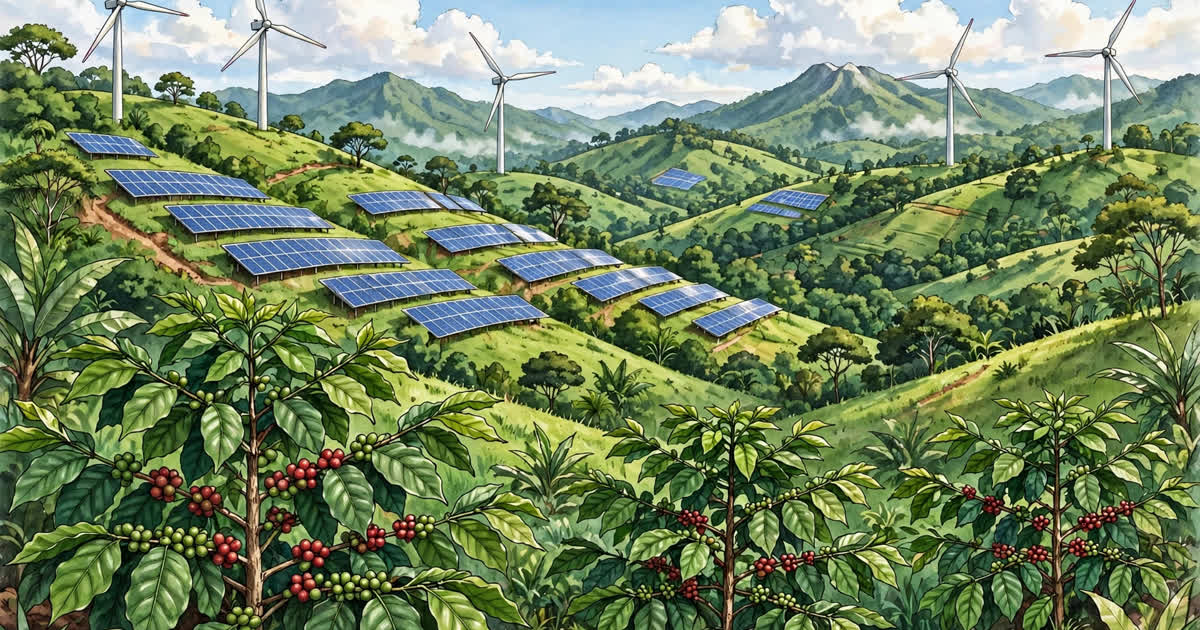
Costa Rica clean energy coffee brings together two of the country's best-known strengths: an electricity system powered overwhelmingly by renewables, and a coffee industry famous for high-altitude, high-quality beans. Both sectors attract investors, exporters and visitors, and both face climate, market and infrastructure challenges that any serious investor should understand. This guide to Costa Rica clean energy coffee explains how renewable power works, where coffee grows, how exports reach markets, and what risks to weigh.
Costa Rica's clean energy story is often summarised in a single statistic: for long stretches, almost all electricity comes from hydro, wind, geothermal, solar and biomass. That achievement rests on geography, public investment and policy, not on a single technology. Coffee, meanwhile, has shaped Costa Rica's economy, culture and landscape for two centuries, with smallholder farms, cooperatives and specialty buyers creating a quality-focused export chain. Together, they illustrate a green economy that is real, but not automatic.
Costa Rica Clean Energy Coffee: Renewable Electricity Explained
Costa Rica clean energy coffee starts with electricity. Hydroelectric power provides the largest share in most years, using rivers and rainfall, supplemented by geothermal energy from volcanic areas, wind farms in Guanacaste, solar installations, and biomass from agricultural residues. The national electricity institute, ICE, and other generators and distributors manage a grid that balances variable renewables with hydro storage, which acts as a buffer when wind and solar vary. That hydro buffer is a key reason Costa Rica can run on renewables for long periods without the storage challenges faced by other countries.
Renewable leadership does not mean the system is simple. Dry seasons reduce hydro output, climate change alters rainfall patterns, and growing demand from electric vehicles, data centres and industry requires new generation, transmission and storage. Investors should distinguish between generation, distribution and services: building a wind or solar project involves land, environmental permits, grid connection, power purchase agreements and community relations, each with timelines and risks. Small-scale solar for homes and businesses, by contrast, offers a simpler investment with clearer payback, depending on tariffs and net-metering rules.
Costa Rica Clean Energy Coffee: Coffee Regions and Quality
Costa Rica clean energy coffee's second pillar is coffee geography. Main regions include Tarrazú, famous for high-altitude, bright and complex coffees; the Central Valley, with historic farms near San José; Tres Ríos, known for balanced cups; the West Valley, including Naranjo and Grecia; Brunca in the south; Turrialba in the east; and Guanacaste's lower-altitude farms. Altitude, volcanic soil, rainfall and shade shape flavour, and Costa Rican law historically required arabica only, supporting quality reputation, though farming practices and varieties continue to evolve.
Quality coffee in Costa Rica is often produced by smallholders who deliver cherry to cooperatives or micro-mills, which process, dry and export it. Specialty buyers pay premiums for traceable lots, cup scores and certifications such as Fair Trade, Rainforest Alliance or organic, while commodity coffee competes on volume and price. For investors and exporters, understanding the chain from farm to mill to exporter to roaster matters more than owning land alone, because quality, consistency and relationships determine whether a lot earns a specialty premium or a commodity price.
Costa Rica Clean Energy Coffee: Exports and Markets
Costa Rica clean energy coffee exports reach roasters and retailers in the United States, Europe, Japan and other markets, with the United States historically the largest buyer. Exporters must manage quality control, shipping, contracts, currency and compliance with importing countries' food safety and sustainability requirements. Prices for specialty coffee are negotiated lot by lot, while commodity prices follow international futures markets, creating volatility that farmers and exporters hedge through contracts, diversification and cooperatives.
Beyond coffee, Costa Rica exports medical devices, electronics, pineapples, bananas and other agricultural products, and clean energy expertise itself is an export in the form of consulting and technology services. PROCOMER, Costa Rica's export promotion agency, supports exporters with market information, trade fairs and buyer contacts. New exporters should start with market research, samples, and small trial shipments, building buyer trust before scaling, because a single quality failure can damage a reputation that took years to build.
Costa Rica Clean Energy Coffee: Investment Opportunities
Costa Rica clean energy coffee investment opportunities span several scales. At household level, rooftop solar, energy efficiency and electric vehicles offer savings and resilience, with payback depending on tariffs and usage. At business level, renewable generation, energy services, coffee processing, roasting, agritourism and export services offer growth, though each needs permits, capital and local partners. At larger scale, wind, solar, geothermal and hydro projects require significant capital, environmental assessment and grid agreements, and should only be pursued with specialist legal, technical and financial advice.
Tourism-linked investments, such as coffee farm tours, lodges and tasting rooms, combine agriculture with hospitality and can diversify farm income, but they also add hospitality regulation, marketing and seasonality risks. Impact investors interested in climate and livelihoods should look for projects with clear community benefits, transparent governance and measurable outcomes, rather than green labels alone. In every case, visit the site, meet local partners, and verify permits and titles before investing, because remote due diligence misses ground realities in rural Costa Rica.
Costa Rica Clean Energy Coffee: Risks, Climate and Prices
Costa Rica clean energy coffee risks are real and interconnected. Climate change affects rainfall for hydro and coffee, with droughts, floods and pests such as coffee leaf rust threatening yields. International coffee prices swing with global supply, currency moves and speculation, while energy project returns depend on tariffs, grid access and regulatory stability. Labour costs, land prices and infrastructure in popular areas have risen, squeezing margins for farms and small energy projects alike.
Mitigation strategies include diversification across crops, energy sources and markets, water and soil conservation, shade-grown coffee that protects biodiversity, and insurance where available for weather and crop risks. Cooperatives help smallholders share processing, marketing and risk, while long-term buyer relationships stabilise prices better than spot sales. Investors should stress-test any project for a bad coffee year, a dry hydro year, and a price downturn occurring together, because climate and market shocks often coincide in agricultural economies.
Costa Rica Clean Energy Coffee: A Practical Starting Point
A practical Costa Rica clean energy coffee starting point depends on your role. For a coffee buyer, visit regions, cup lots, meet cooperatives, and start with small, traceable purchases. For a farm investor, partner with experienced local operators, verify land title and water rights, and budget for processing and marketing, not just planting. For an energy investor, study grid connection, tariffs and permits before committing capital, and consider smaller distributed projects before utility-scale ones. For a visitor, coffee tours and renewable energy sites offer a vivid introduction to both sectors.
Costa Rica's green reputation is earned, but it is maintained by policy, investment and farming skill, not by nature alone. With that understanding, Costa Rica clean energy coffee offers genuine opportunities for investors, exporters and travellers who do their homework. For related business and environment guidance, see how to start a small business, what climate change means, and how solar panels work.