
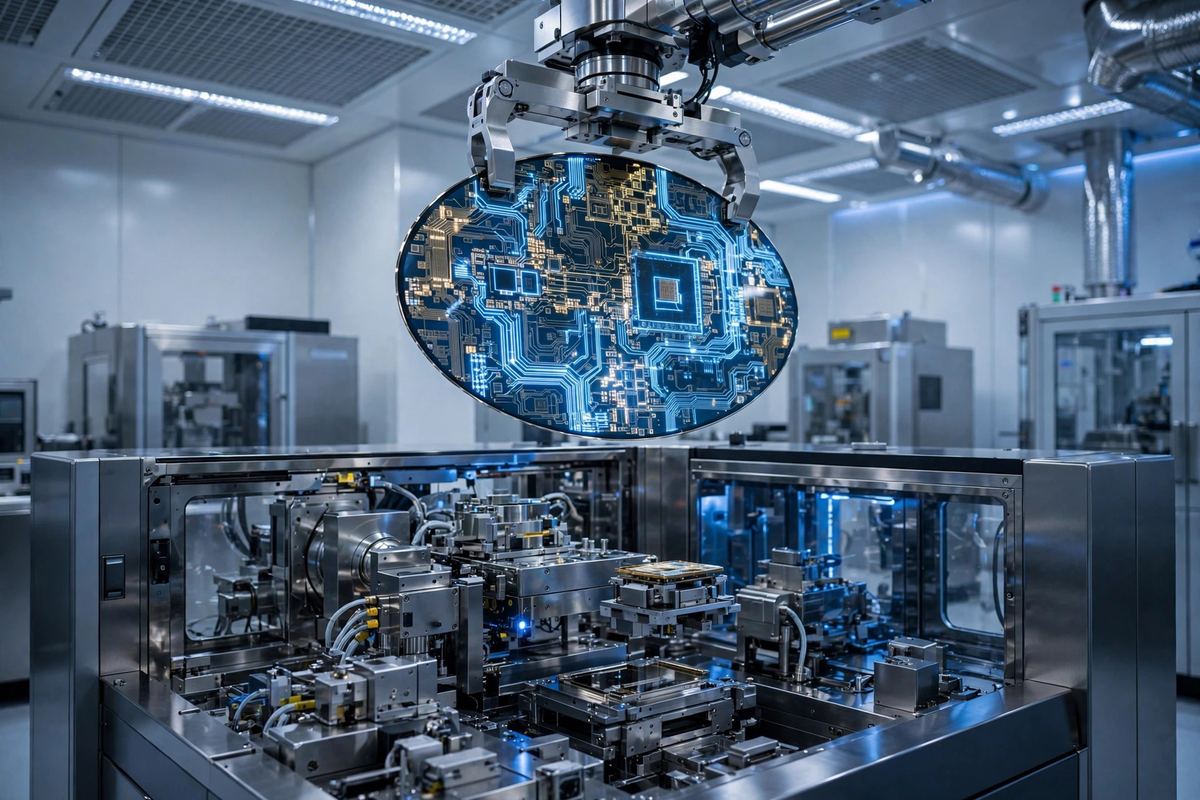
Japan is doubling down on its most ambitious industrial gamble in decades. The Ministry of Economy, Trade and Industry has unveiled plans to make an additional equity investment of ¥400 billion — roughly $2.5 billion, according to media reports — in Rapidus, the government-backed venture racing to mass-produce advanced 2-nanometer chips. The story, which has been trending in news coverage, is the latest escalation in a global contest in which governments are pouring public money into semiconductor factories to secure supplies of the chips that power artificial intelligence.
The Announcement
According to reports from Nikkei and MLex, METI presented the plan on October 19, 2026, at a meeting of the Finance Ministry's Fiscal System Council subcommittee on fiscal investment and loans. The ministry intends to seek a total of ¥400 billion in additional equity investment in Rapidus across three fiscal years: ¥150 billion in fiscal 2027, another ¥150 billion in fiscal 2028, and ¥100 billion in fiscal 2029. The ¥150 billion earmarked for fiscal 2027 is already included in the ministry's preliminary budget request; the rest will be requested in later budgets. Nikkei put the dollar figure at approximately $2.58 billion.
The funding would be made through "industrial investment," a Japanese government mechanism that channels dividends from state-held shares and other revenues into private companies. If the plan is approved and executed in full, the government's cumulative equity investment in Rapidus would reach ¥650 billion — about $4.1 billion, per media reports — on top of the ¥250 billion it has already injected, through ¥100 billion in February 2026 and ¥150 billion in June 2026 via the Information-technology Promotion Agency, an organisation under METI's jurisdiction.
What Is Rapidus?
Rapidus is Japan's flagship attempt to break back into the leading edge of chip manufacturing. The company was established in August 2022 with a combined ¥7.3 billion investment from eight major Japanese firms: Toyota Motor, Sony Group, NTT, SoftBank, NEC, Denso, Kioxia and MUFG Bank. Its chairman is Tetsuro Higashi, a former chairman of Tokyo Electron, one of the world's largest chip-equipment makers; its chief executive is Atsuyoshi Koike, formerly head of Western Digital's Japanese subsidiary.
The venture's strategy rests on a technological partnership with IBM of the United States, giving it access to cutting-edge logic-chip manufacturing know-how, and on a brand-new fabrication plant — the IIM-1 facility in Chitose, on the northern island of Hokkaido — where a pilot production line began operating in April 2025. In July 2025 the company confirmed that its 2-nanometer-class gate-all-around transistors worked properly on 300-millimeter wafers, a milestone on the road to commercial production. This year it has focused on improving yields by refining prototypes and reducing defects. Private capital is following the public money: in February 2026, 32 Japanese private companies, including NTT, Sony Group, Canon and SoftBank, invested a combined ¥167.6 billion, lifting Rapidus's stated capital and reserves to ¥424.95 billion as of June.
Why the Government Is Writing the Cheque
Building a leading-edge chip factory is ruinously expensive — Rapidus estimates it will need around ¥5 trillion in total to reach its goals — and METI's explanation for the new injection is practical rather than ideological. To borrow large sums from banks, a company must maintain a healthy equity ratio, so the government is bulking up Rapidus's capital base to unlock private lending. Rapidus is seeking to borrow a total of ¥2 trillion from major financial institutions, partly backed by government debt guarantees, to fund production line construction. Nonbinding letters of intent for loans of that scale were issued by lenders last year, and negotiations to finalise them are continuing. METI also argued the investment is justified on merit, telling the council that the business is making progress and that the outlook for returns is relatively improving. The target remains mass production of 2-nanometer chips in the second half of fiscal 2027.
From Chip King to Comeback
The urgency behind Rapidus becomes clearer with a look back. As late as the late 1980s, Japan accounted for roughly half of the global semiconductor market, and names like NEC, Toshiba, Hitachi, Fujitsu and Mitsubishi Electric topped the world's chip sales rankings on the strength of high-quality DRAM memory chips.
That dominance unravelled through a series of blows. Intensifying trade friction with the United States led to the 1986 U.S.–Japan Semiconductor Agreement, which pressured Japanese firms on export pricing and market access; the yen's sharp appreciation after the 1985 Plaza Accord made Japanese chips more expensive abroad; and the collapse of Japan's bubble economy in the early 1990s starved companies of investment capital. Just as damaging was a structural failure to adapt: Japanese firms clung to a vertically integrated model, doing everything from design to manufacturing inside giant conglomerates, while the United States and Taiwan split the industry into fabless designers and dedicated foundries — a model Taiwan's TSMC rode to global dominance. Demand also shifted from memory chips to the logic chips — CPUs and systems-on-chip — that power PCs, smartphones and the internet, a transition Japanese firms missed while aggressive South Korean rivals seized the memory market. Elpida Memory, formed from the merger of NEC's and Hitachi's DRAM businesses, went bankrupt in 2012; Toshiba sold its chip business in 2018; Panasonic sold its semiconductor operations to Taiwan's Nuvoton in 2019. Rapidus is the government's chosen vehicle for reversing that long retreat.
Why Governments Everywhere Are Subsidising Chips
Japan is not acting alone. The United States, the European Union, South Korea and others have all rolled out vast chip subsidies in recent years, driven by two forces. The first is demand: artificial intelligence data centres are hungry for advanced processors, and the companies making the equipment to build them are thriving — ASML's record third-quarter results in 2026 were powered by exactly that AI chip demand. The 2-nanometer chips Rapidus aims to make would compete directly for that market, where smaller transistors mean faster, more power-efficient AI hardware.
The second force is fear: advanced chip production is concentrated in a handful of places, above all Taiwan, and governments increasingly treat a domestic supply of leading-edge chips as a matter of economic security. Rapidus CEO Koike has said the venture will price its 2-nanometer chips at or slightly below Taiwan's TSMC — a bold promise given that Rapidus has yet to validate the yields and reliability commercial customers require. The bet also sits within a wider economic strategy being debated in Tokyo — see our explainers on the government's yen and inflation policy and the Bank of Japan's inflation warnings and rate stance — making Rapidus both an industrial wager and a fiscal one.
The Numbers at a Glance
- New equity investment sought: ¥400 billion (roughly $2.5 billion) over fiscal 2027–2029
- Split: ¥150 billion in fiscal 2027, ¥150 billion in fiscal 2028, ¥100 billion in fiscal 2029
- Government equity invested so far: ¥250 billion
- Cumulative total if plan is fully executed: ¥650 billion (about $4.1 billion)
- Private loans being negotiated: ¥2 trillion, partly with government debt guarantees
- Target: 2-nanometer mass production in the second half of fiscal 2027
What Happens Next
The plan still has to clear Japan's budget process: the fiscal 2027 portion is in METI's preliminary budget request, but the later tranches must be approved in subsequent years, and the full ¥400 billion depends on each year's budget being passed. Beyond politics, the hard problems are technical and commercial. Rapidus must push its yields — the share of usable chips per wafer — to competitive levels, prove reliability to demanding customers, and hit a mass-production timeline that leaves little slack: the second half of fiscal 2027 is barely a year and a half away. It must also make good on its pricing promise against TSMC, the world's most experienced advanced foundry. For Tokyo, the bet is that a state-built capital base can buy time for engineering to catch up — and that in an age of AI-driven chip demand, the payoff for success justifies the risk.