
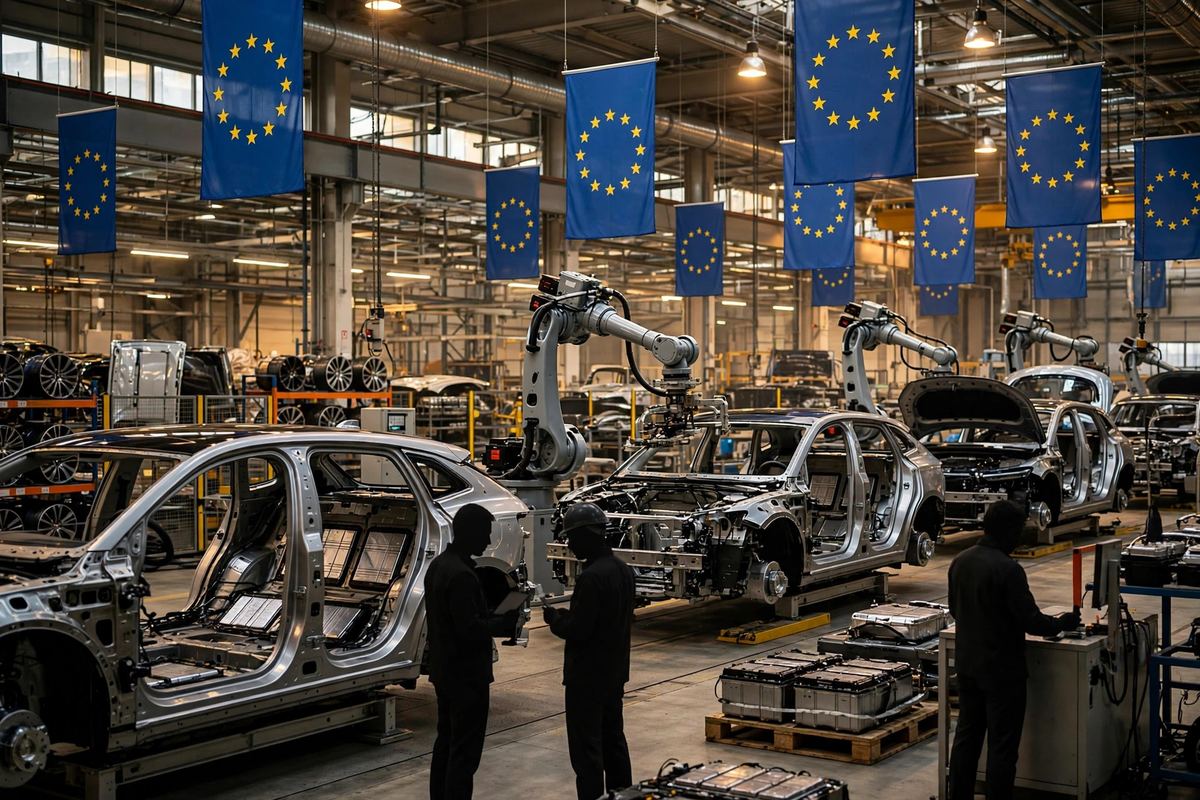
French President Emmanuel Macron used the opening of the 91st Paris World Motor Show to declare that a landmark automotive agreement between France and Germany is within reach. Speaking at the industry exhibition, Macron said a deal with Berlin was "inevitable" and could be finalized "within hours or days," setting the stage for the pact to be presented to European Union leaders ahead of their summit in Brussels on October 15.
The emerging compromise pairs two major concessions. Germany would win looser rules on the phase-out of combustion-engine cars, including a relaxation of the EU's 2035 deadline for ending sales of new CO2-emitting vehicles. France, in return, would get Berlin's backing for strict "Made in Europe" requirements that would tie public subsidies and government tenders for electric vehicles and batteries to production inside the European Union.
The stated goal is to protect European carmakers from surging Chinese competition without abandoning the continent's decarbonization ambitions entirely. But turning a Franco-German handshake into EU law will require approval from the other member states and the European Parliament, and parts of the package are already raising concerns among trading partners such as the United Kingdom and Japan.
Update — 16 October 2026: France and Germany confirmed the agreement. Under the joint position reported by Handelsblatt and Le Monde, new cars sold in the EU from 2035 must cut average CO2 emissions by 90 percent from 2021 levels, with the remaining 10 percent not requiring offsetting — a smaller softening than the roughly 80 percent some market analysts had estimated before the deal. In return, Germany backed France's Made-in-Europe rules tying purchase incentives and public contracts to vehicles produced in the EU, with the United Kingdom also recognised under reciprocity conditions. The joint position still needs approval from other EU member states and the European Parliament before it becomes law.
Background: why Europe's car rules are back on the table
Europe's 2035 phase-out of combustion-engine cars has been politically fragile since the day it was agreed. Under the current rules, new cars and vans sold from 2035 must produce zero carbon dioxide emissions, effectively ending sales of petrol and diesel vehicles. Germany, home to some of the world's biggest engine manufacturers, resisted the strictest version of the plan and previously secured space for cars running on synthetic e-fuels. With a scheduled review of the rules on the horizon, Berlin has pushed for a broader softening of the timetable.
The pressure comes above all from China. Chinese car brands held a 10.7 percent share of the European market in the second quarter of 2026, up from 5.7 percent a year earlier, according to Schmidt Automotive Research, and have already overtaken Japanese rivals that arrived in Europe in the 1970s. Around 20 Chinese brands are displaying at this year's Paris show, roughly double their presence at the last edition in 2024, joined by newcomers such as Aito and by state-owned Changan's new Nevo and Avatr marques.
Brussels responded to the first wave of the challenge with tariffs on Chinese-made fully electric vehicles in October 2024. Chinese manufacturers pivoted quickly toward hybrids, and just days before the Paris show the EU announced an agreement with China that could cut Chinese hybrid-vehicle imports by more than half, though details of how it will work remain scarce. Our explainer on that agreement is here: EU-China hybrid car import cap.
The squeeze on Europe's own manufacturers is meanwhile plain to see. Car sales in China, the world's largest auto market, fell 20 percent in the first half of 2026, and with the US market effectively closed to China's auto industry, Europe has become the top export priority for Chinese brands. "If they drop exports in Europe they die because they can't make the money elsewhere," said Francois Roudier, secretary general of the International Organisation of Motor Vehicle Manufacturers. Volkswagen is cutting thousands of jobs and weighing factory closures, while BMW is also shedding workers. Stellantis, the world's fourth-largest automaker, is using the Paris show to launch six new models across its European brands and unveil nine concept cars.
What happened at the Paris Motor Show
Macron's remarks came as the industry gathered in Paris. "We are finalizing an agreement with our German partners so that Europe can move forward, better protect its industry, preserve its decarbonization goals, improve competitiveness and strengthen its sovereignty," he said, adding that the pact should give Europe "a pragmatic approach to our decarbonization goals."
The groundwork was laid on the eve of the show, when representatives of the European automotive industry met Macron at the Elysee Palace. Renault chief executive Francois Provost said he expects an agreement as early as this week, noting that about 1 million jobs in France alone depend on the automotive industry and that European manufacturers have already invested heavily in shifting toward electric vehicles in line with EU rules.
Volkswagen chief executive Oliver Blume also urged Paris and Berlin to reach a deal as quickly as possible, warning of growing pressure from Chinese manufacturers. Speaking at an event on Sunday evening, he welcomed progress in EU-China trade talks but insisted that Europe must ensure a level playing field in its own markets, adding that those who sell here should compete under comparable conditions and create jobs and value in Europe too. Talks between Paris and Berlin have been running since the summer, and one European official said progress on the related Brussels initiatives is possible only if the package is agreed as a whole.
The trade-off: looser combustion rules for Made-in-Europe money
On the German side of the bargain, Berlin is seeking looser emissions targets for automakers in 2030, although that element has not yet been finalized, according to a source familiar with the talks. Berlin is also expected to secure a further easing of the ban on new internal-combustion-engine vehicles after 2035. According to two sources, as many as 10 percent of new cars sold after that date could still be fitted with internal-combustion engines, without a mandatory requirement to use low-carbon fuels or materials.
The confirmed Franco-German position sets the 2035 CO2 reduction target at 90 percent, with no offsetting required for the remaining 10 percent, which would let manufacturers keep selling hybrids and conventional cars for longer. For Germany's giants, including Volkswagen and BMW, that would be a lifeline: both have struggled with the speed of the transition to pure-electric fleets while facing weak demand and intense cost pressure.
France's prize is German backing for rules that would restrict public subsidies and public contracts in sectors such as electric vehicles and batteries largely to companies manufacturing within the EU. The Made-in-Europe provisions would give priority to cars, components and batteries produced inside the bloc when governments spend money or award support. French officials see this as a shield for domestic champions such as Renault and Stellantis.
The details are not fully settled. Some companies, including Renault and Ford, produce vehicles with a high share of European components outside the EU, for example in Turkey, and are seeking exemptions for certain third countries under the Made-in-Europe rules. Such rules could also potentially exclude cars made in the United Kingdom from some European subsidy programs, although one source said that provision has not yet been finalized.
Why it matters
At its core, the deal is an attempt to buy European carmakers time and home-market advantage at once. The looser combustion rules give Volkswagen, BMW and others breathing room to fund their electric transition with continued sales of hybrids and conventional models. The Made-in-Europe requirements aim to make sure that public money spent on the green transition flows to factories and supply chains inside the EU rather than subsidizing imports.
The pact would also mark the EU's most ambitious industrial-policy intervention in the auto sector since the 2024 tariffs on Chinese electric vehicles. If Made-in-Europe provisions take hold in cars and batteries, similar requirements could spread to other strategic industries, reshaping how Brussels uses public procurement and subsidies across the single market. Chinese automakers are already adapting by seeking European production bases, often in partnership with established manufacturers: Geely said in July it would produce electric SUVs at a Ford factory in Spain, and BYD is studying a factory in France.
There are real tensions inside the compromise. Climate advocates will see any weakening of the 2035 target as a retreat from the EU's green commitments, even if Macron frames it as pragmatic decarbonization that keeps hybrids in the mix. Trading partners are watching too: in its proposed form the package could draw objections from the United Kingdom and Japan, which risk being shut out of the Made-in-Europe system. And the Franco-German engine of EU policymaking has been strained on other files this autumn, including the EU budget clash between Paris and Berlin, a reminder that even an "inevitable" handshake can stall on the way to law.
Key facts
- Macron said the France-Germany auto agreement is "inevitable" and could be finalized within hours or days, speaking at the 91st Paris World Motor Show.
- The pact is expected to be presented to EU leaders ahead of their summit in Brussels on October 15.
- Germany wants looser 2030 emissions targets and an easing of the 2035 combustion-engine ban: up to 10 percent of new cars could still have combustion engines after 2035.
- Analysts say cutting the 2035 CO2 mandate from 100 percent to about 80 percent would let hybrids and conventional cars stay on sale longer.
- France wants Made-in-Europe rules tying EV and battery subsidies and public tenders to EU-based manufacturing.
- Any final deal needs approval from EU member states and the European Parliament.
- The package could draw objections from the UK and Japan, which risk exclusion from the Made-in-Europe system.
- About 20 Chinese brands are at the Paris show, double the 2024 edition; around 60 new models were expected to be unveiled.
- Renault's chief executive says about 1 million French jobs depend on the auto industry.
What happens next
The immediate test is the October 15 summit, where EU leaders are expected to see the proposed package. From there, the European Commission's related legislative proposals would need to move through member-state negotiations and the European Parliament, where the details that matter most, such as the exact 2030 targets, the final Made-in-Europe thresholds, and any exemptions for third countries such as Turkey or the UK, will be fought over line by line.
Watch too for how trading partners and rivals respond. Any formal objection from the UK or Japan, or from Chinese manufacturers whose European plans are already accelerating, could complicate the timeline. For European carmakers, the show itself offered a glimpse of the fight ahead: with dozens of new models unveiled in Paris and Chinese brands doubling down on Europe, the continent's auto contest is only just beginning.
The EU's web of deals keeps widening: Andorra and San Marino have signed association agreements that plug them into the single market without full membership.