
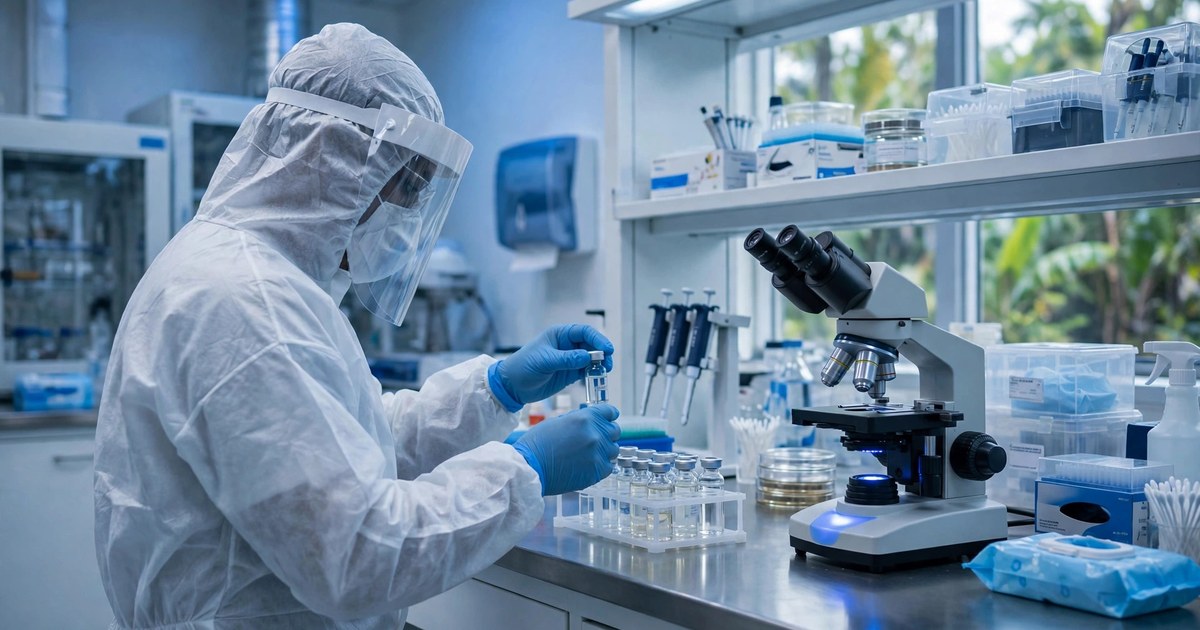
The Ebola vaccine trial now under way in the Democratic Republic of the Congo could finally answer one of the most urgent questions of the largest Bundibugyo Ebola outbreak ever recorded: can a vaccine protect people against a strain of Ebola for which no approved shot exists? The trial, named TUMAINI — the Swahili word for "hope" — enrolled its first participants in Bunia, in Ituri province, on Friday, 23 October 2026, according to the World Health Organization (WHO). It is the first Phase 2/3 Ebola vaccine trial of candidates designed to fight Bundibugyo virus, and it arrives as the outbreak it targets continues to grow.
According to WHO's latest Disease Outbreak News, published on 23 October, the Democratic Republic of the Congo had reported 9,704 confirmed cases and 4,687 deaths as of 20 October 2026 — a case fatality ratio of 48.3%. The outbreak, declared on 15 May 2026, has spread across 66 health zones in eight provinces and has been designated a public health emergency of international concern. It is already the largest Ebola outbreak ever recorded in the country and the second-largest globally, behind only the 2014–2016 West Africa epidemic. Imported cases have since been confirmed in Kenya and Nigeria, and Uganda, which recorded 20 cases earlier in the year, declared its own outbreak over in July.
What is the Ebola vaccine trial TUMAINI?
TUMAINI is a DRC-led Phase 2/3 Ebola vaccine trial, supported by WHO, the Africa Centres for Disease Control and Prevention (Africa CDC) and the Coalition for Epidemic Preparedness Innovations (CEPI). A Phase 2/3 trial tests both safety and effectiveness: researchers first establish that a candidate vaccine triggers a safe immune response, then measure whether it actually prevents disease in people at real risk of infection.
The Ebola vaccine trial's first question is a practical one. The opening candidate is Ervebo, the licensed Ebola vaccine that protects against the Zaire strain of the virus — the strain behind most previous Ebola epidemics, including the 2014–2016 West Africa outbreak. Whether Ervebo also protects against Bundibugyo virus, a different species of the virus family, is unknown in humans. TUMAINI will find out. Two candidates built specifically for Bundibugyo virus are expected to join the trial shortly: one developed by the University of Oxford using its ChAdOx1 platform, and an mRNA candidate from Moderna, both supported by CEPI. The Oxford candidate is being developed with the Serum Institute of India, and Gavi, the Vaccine Alliance, has committed up to $40 million toward manufacturing readiness so that any successful vaccine can be produced at scale.
"This trial will help us understand whether any of the vaccine candidates designed for Bundibugyo virus work," WHO Director-General Tedros Adhanom Ghebreyesus said. "WHO is supporting this DRC-led effort to find answers and save lives."
Why the Ebola vaccine trial matters now
The urgency is written into the outbreak's numbers — and it is why the Ebola vaccine trial has drawn backing from WHO, Africa CDC, CEPI and Gavi. With 9,704 confirmed cases and 4,687 deaths in the DRC alone, nearly one in every two confirmed patients has died. The outbreak has now spread to three regions of Africa, and Africa CDC Director-General Jean Kaseya has called it the most geographically widespread Ebola outbreak on record. "We cannot allow this outbreak to spread to more countries or continue for another year," he warned.
Nigeria confirmed its first case of the outbreak on 20 October, when a woman who had arrived in Abuja from Uganda tested positive for Bundibugyo virus — the country's first Ebola case in more than a decade and the outbreak's first case in West Africa. Forty-four contacts, mostly health workers, were placed under surveillance. Kenya's first imported case, confirmed in early October, grew into a contained cluster of nine cases. Uganda's health ministry has stressed that it currently has no active confirmed cases, after a dispute with Nigeria over where the Abuja patient was exposed.
The trial also matters because, until now, the response has had to rely on the oldest tools in outbreak control: finding cases fast, isolating patients, tracing contacts, practising safe burials and persuading communities to trust health workers — all in eastern DRC regions strained by armed conflict, displacement and food insecurity. A vaccine that works would change that equation for health workers, contacts of cases and entire communities living in the outbreak's path.
How the Ebola vaccine trial works: ring vaccination
The Ebola vaccine trial uses a strategy called ring vaccination, the same approach that helped end the 2014–2016 West Africa epidemic. When a new case is confirmed, the "ring" of people around that patient — their close contacts, and the contacts of those contacts — is offered vaccination. If the vaccine works, each ring becomes a wall that stops the virus reaching the next person.
Notably, the Ebola vaccine trial is open to groups often excluded from early vaccine research: pregnant women and children aged 12 and over can take part, according to reporting of the trial's design. That matters because Ebola outbreaks hit families and health workers hardest, and a vaccine that cannot be given to the people most exposed to the virus would be of limited use. Participants are monitored for safety, immune response and whether they go on to develop disease, and the ring design means the trial can generate evidence even while the outbreak is still moving.
Alongside the vaccine trial, WHO is running the PARTNERS treatment trial, which is testing the antibody MBP134 and the antiviral remdesivir as potential treatments for Bundibugyo virus disease. At present there is no approved treatment either — patients receive supportive care such as fluids and management of symptoms — so the vaccine and treatment trials are advancing on parallel tracks.
What is Bundibugyo virus, and why did it have no vaccine?
Bundibugyo virus is one of the orthoebolaviruses that cause Ebola disease. It was first identified in Bundibugyo district, Uganda, in 2007, and before 2026 it had caused only two known outbreaks: in Uganda in 2007 and in the DRC in 2012. Because those outbreaks were small and brief, the virus attracted far less vaccine research funding than the Zaire strain — the gap that Africa CDC's Kaseya highlighted when he said that if this outbreak were in Western countries, vaccines would already be available.
That funding gap is now closing fast. Phase Ib trials of the Oxford ChAdOx1 candidate began in Uganda on 6 October 2026, following Phase Ia trials in Britain in July, while Moderna's candidate received ethical approval for Phase Ib trials in Uganda on 7 October after Phase Ia trials in Canada in early August. An Egypt-manufactured candidate is also in development. But those early-phase studies only establish safety and immune response in small groups; TUMAINI is the first trial designed to show whether any of these vaccines actually prevents Bundibugyo disease in an outbreak setting.
Some protection may already be reaching frontline workers: WHO reported that 8,497 people had received Ervebo off-label under a study protocol by early October. TUMAINI will now test, rigorously, whether that cross-protection is real.
What happens next for the Ebola vaccine trial
The Ebola vaccine trial's timeline will be driven by the outbreak itself: rings form as new cases are confirmed, and evidence accumulates as participants are followed over time. Africa CDC has called an extraordinary virtual meeting of African health ministers for 28 October 2026 to strengthen the collective response, and WHO has urged countries across the region to maintain a high level of readiness to detect cases early and protect health workers.
For readers outside the affected region, the risk picture is unchanged. The US Centers for Disease Control and Prevention says no case linked to this outbreak has been confirmed in the United States and rates the risk to the US public as low; the US has restricted entry for travellers who were in the DRC in the previous 21 days. The trial's importance is not about immediate danger to distant countries — it is about whether the world will finally have a vaccine for a virus that has killed nearly 4,700 people in five months, and whether the next Bundibugyo outbreak can be stopped before it starts.
If the Ebola vaccine trial succeeds, the payoff extends beyond this outbreak. A proven Bundibugyo vaccine, backed by Gavi's manufacturing commitment, would give health agencies a tool they have never had for this strain — and would stand as evidence that vaccine research can move at outbreak speed when the world decides a neglected virus matters. If it fails, researchers will still have learned which candidates do not work, and why — knowledge the next trial will build on. Either way, the first participants enrolled in Bunia on 23 October mark the moment the fight against Bundibugyo Ebola moved from containment alone to prevention.
Sources: WHO Disease Outbreak News (23 October 2026); CEPI; Africa CDC; Reuters; US Centers for Disease Control and Prevention; Al Jazeera.
Related coverage on Worldlession: Nigeria's first Ebola case in Abuja and the 44 contacts traced, how the DRC outbreak passed 9,000 cases, and Kenya's imported Ebola case explained.