
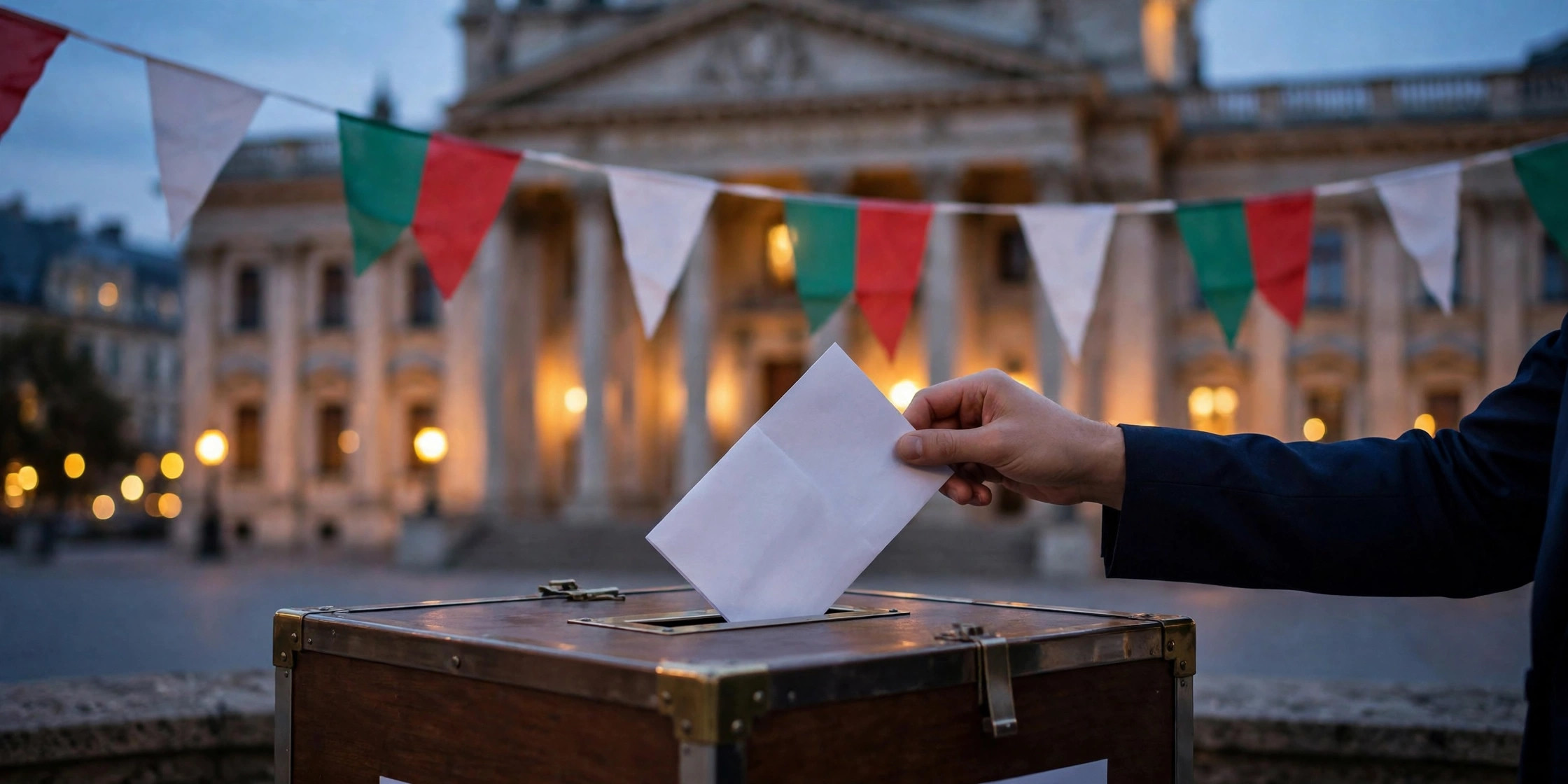
Bulgaria's presidential election is heading to a runoff on November 1, 2026, after no candidate came close to winning outright in the first round on October 25. Incumbent President Iliana Iotova and her running mate Kiril Valchev finished narrowly ahead of former caretaker prime minister Andrey Gyurov and Georgi Kandev, according to exit polls and parallel vote counts reported by Bulgarian media, in a result that sets up a direct contest between two sharply different visions for the European Union and NATO member state.
The Bulgaria presidential election runoff comes after a first round defined less by who won than by who stayed home. Turnout collapsed to roughly 22% of Bulgaria's 6.6 million registered voters, about 1.47 million people, a record low that observers attribute to deep mistrust of politicians and widespread voter apathy. Under Bulgaria's rules, a first-round victory requires more than half of the valid votes, so the low participation alone made a second round certain long before the final counts were in.
Bulgaria presidential election runoff results: Iotova leads, Gyurov close behind
Exit polls from three agencies put Iotova and Valchev on between 35% and 36.5% of the vote, with Gyurov and Kandev on about 32%. Alpha Research gave the incumbent ticket 35.3% against 32.4% for Gyurov, Trend put the gap at 36.5% to 32.4%, and Myara at 35.2% to 32.2%. One parallel count, by Market Links, even placed Gyurov a fraction ahead, at 33.5% against 32.7% for Iotova, underlining how tight the race is. The figures are exit polls and parallel counts rather than final official results, and the margin between the two finalists is far smaller than pre-election surveys had suggested: a Gallup International Balkan poll published on October 23 had given Iotova 43.2% against 29.7% for Gyurov.
Kostadin Kostadinov and Petar Volgin, backed by the nationalist Vazrazhdane (Revival) party, finished third in every poll, on roughly 12% to 14% of the vote. Further behind were Radostin Vasilev and Krasimir Manov on about 4%, Ivelin Mihaylov and Yuliana Mateeva on about 3.5%, and Ivan Hristanov and Stoyanka Cherkezova on about 2%. Between 3.6% and 4.8% of voters ticked the option "I do not support anyone", according to the polling agencies. The field was the largest in Bulgaria's modern history, with 27 candidate pairs on the ballot, a reflection of a fragmented political landscape in which coalitions have rarely lasted more than a year since 2021.
The first round was the first major electoral test for the Moscow-friendly Progressive Bulgaria party of Prime Minister Rumen Radev since its triumph in parliamentary elections in April 2026. Iotova, who has served as president and is backed by Radev's party, had been expected to win more comfortably. Instead, the unexpectedly strong performance of Gyurov, backed by pro-Western opposition parties, has turned the runoff into a genuinely open contest.
Why turnout collapsed to a record low in the Bulgaria election
Turnout of around 22% is far below even the modest expectations of pollsters, who had projected participation of about 39%. By 4 p.m. on polling day, the Central Election Commission had counted turnout at just 16.04% of registered voters, against 25.72% at the same point in the 2021 first round, which was held alongside parliamentary elections. Participation varied widely across the country, from 25.9% in one Sofia electoral district to just 6.77% in Kardzhali.
Observers point to a combination of voter fatigue, distrust of the political class, and the perception that the outcome was preordained. Bulgaria has endured years of unstable governments and repeated elections, and many voters appear to have concluded that a presidential contest would change little in their daily lives. The interior ministry described the voting process itself as peaceful, noting an absence of the vote-buying accusations that have marred past contests, although police had seized more than 1 million euros in raids linked to vote buying in the weeks before the vote.
The low turnout also raises a question that will hang over the runoff: whether a two-candidate ballot can draw back voters who sat out the first round, or whether apathy will deepen further. Campaign teams on both sides will spend the coming week trying to mobilise not only their own supporters but also the voters of eliminated candidates, above all the roughly 13% who backed the nationalist third-place ticket.
Iotova vs Gyurov: what each candidate stands for
The runoff presents Bulgarian voters with a clear choice on the country's international direction. Iotova, the incumbent, is a left-leaning president whose political home is with Radev's Progressive Bulgaria movement, which is sceptical of deeper confrontation with Russia and has argued for a more cautious, sovereigntist foreign policy. Her supporters present her as a guarantor of stability and of a presidency that speaks for ordinary Bulgarians rather than for Brussels.
Gyurov, a former caretaker prime minister, is the candidate of the pro-Western reformist opposition, backed by the We Continue the Change-Democratic Bulgaria coalition. His campaign has stressed firm anchoring in the European Union and NATO, anti-corruption reform, and a clear-eyed stance on Russia's war in Ukraine. Both finalists condemned recent drone attacks on commercial vessels in the Black Sea, but they diverge sharply on how Bulgaria should balance its Western alliances with its relationship with Moscow.
Domestic issues cut across the foreign-policy divide. The campaign focused heavily on rising energy prices and inflation, which have squeezed household budgets, particularly in rural areas, and on growing economic hardship. Bulgaria's presidency carries real powers over the armed forces, legislation and treaties, including the ability to veto laws and to appoint caretaker governments, which is why the contest matters beyond symbolism even in a parliamentary system.
What the November 1 runoff will decide
The November 1 runoff will decide who holds the presidency for the next five years at a moment when Black Sea security has become a European concern. Recent drone attacks on cargo ships off Bulgaria's coast have heightened anxiety in the EU and NATO member country, and the government has asked its partners for help strengthening maritime security. The next president will shape Bulgaria's voice in those conversations, its stance on further support for Ukraine, and its handling of the country's energy dependence.
The result will also shape the balance of power in Sofia. A Gyurov victory would give the pro-Western opposition a presidency to counterbalance Radev's government, while an Iotova win would consolidate the Progressive Bulgaria movement's hold on the country's institutions after its April parliamentary triumph. Either way, the winner will inherit a country where barely one voter in five turned out for the first round, and where rebuilding trust in politics may prove harder than winning the runoff itself.
For readers following elections across Europe, the Bulgarian runoff sits alongside a busy season of votes: Brazil's presidential runoff delivered a historic comeback for Luiz Inacio Lula da Silva, while Serbia's student-led movement ended Aleksandar Vucic's 12-year rule. The Bulgarian story is smaller in scale but follows the same pattern of voters using the ballot box to settle a country's direction.
Bulgaria election runoff: what happens next
Gyurov has invited Iotova to a televised debate before the runoff, although it is not yet confirmed whether she will accept or when any debate would be held. Campaign events for the second round are expected to concentrate on Sofia and the larger cities, where turnout held up best, and on winning over the voters of eliminated candidates.
Official first-round results are still being finalised, and the final turnout figure may shift slightly from the exit-poll estimates. What is already settled is the shape of the contest: a head-to-head vote on November 1 between an incumbent promising continuity and a challenger promising a firmer Western course, decided by an electorate that largely stayed away the first time. If the runoff repeats the first round's apathy, the winner will take office with a mandate from a small fraction of the country, a fact neither side will be able to ignore.
Sources: CNN, Bulgarian polling agencies Alpha Research, Trend, Myara and Market Links as reported by Bulgarian media, the Central Election Commission of Bulgaria, and Al Jazeera.
Related reading: Bulgaria Presidential Election 2026: Voting Day Guide, Lula Wins Brazil Runoff 2026: Historic Fourth Term After Comeback, Serbia Election 2026: Vucic Concedes Defeat to Student List.